

AcousticRadiationValue
AcousticRadiationValue[pred,vars,pars]
represents a time or frequency radiation boundary condition for PDEs with predicate pred indicating where it applies, with model variables vars and global parameters pars.
AcousticRadiationValue[pred,vars,pars,lkey]
represents a time or frequency domain boundary condition with local parameters specified in pars[lkey].
Details
- AcousticRadiationValue specifies a boundary condition for AcousticPDEComponent and is used as part of the modeling equation:
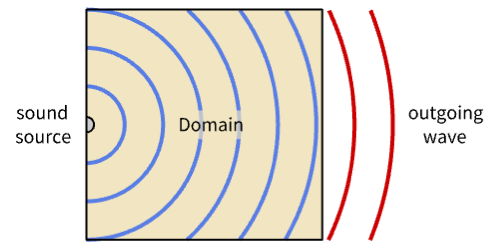
- AcousticRadiationValue is typically used to model sound sources and sinks on the boundary.
- AcousticRadiationValue models a time or frequency domain boundary source or sink with dependent variable pressure
 in
in  , independent variables
  in
in  and time variable
  in
in  or frequency variable
  in
in  .
. - Time-dependent model variables vars are vars={p[t,x1,…,xn],t,{x1,…,xn}}.
- Frequency-dependent model variables vars are vars={p[x1,…,xn],ω,{x1,…,xn}}.
- The time domain acoustics model AcousticPDEComponent is based on a wave equation with time variable
 , density
  , sound speed
  and sound sources
  and
and  :
: - The frequency domain acoustics model AcousticPDEComponent is based on a Helmholtz equation with angular frequency
 :
: - The time domain radiation value AcousticRadiationValue with boundary pressure source
 , boundary unit normal vector
  and unit wave direction vector
  models:
 - The frequency domain radiation value AcousticRadiationValue models:
- The dipole source
 will only be valid within the domain and thus can be excluded from the boundary conditions.
 - Model parameters pars are specified as for AcousticPDEComponent.
- The following model parameters pars can be given:
-
parameter default symbol "BoundaryUnitNormal" Automatic 
"MassDensity" 1  , density of media in
"Material" Automatic 
"SoundSpeed" 1  , speed of sound in
"SoundDirectionVector" 
 , sound direction vector
"SoundIncidentPressure" 0  , sound pressure in
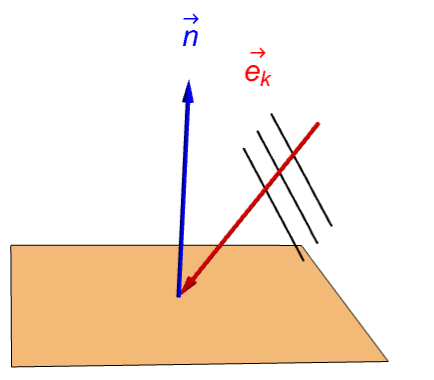
- The relation between the outward-pointing boundary unit normal vector
 and the incident sound wave direction vector
  is illustrated in the following:
 - AcousticRadiationValue combines an AcousticPressureCondition and an AcousticAbsorbingValue.
- AcousticRadiationValue evaluates to a generalized NeumannValue.
- The boundary predicate pred can be specified as in NeumannValue.
- An absorbing boundary can be used with:
-
analysis type applicable Time Domain Yes Frequency Domain Yes Eigenfrequency No - If the AcousticRadiationValue depends on parameters
 that are specified in the association pars as …,keypi…,pivi,…, the parameters
  are replaced with
  .
.





Examples
open all close allBasic Examples (4)
Set up a time domain acoustic radiation boundary:
AcousticRadiationValue[x ≥ 0, {p[t, x, y], t, {x, y}}, <|"MassDensity" -> ρ, "SoundSpeed" -> c, "SoundIncidentPressure" -> Sin[t], "SoundDirectionVector" -> e|>]Set up a frequency domain acoustic radiation boundary:
AcousticRadiationValue[x ≥ 0, {p[x, y, z], ω, {x, y, z}}, <|"MassDensity" -> ρ, "SoundSpeed" -> c, "SoundIncidentPressure" -> h, "SoundDirectionVector" -> e|>]Define model variables vars for a frequency domain acoustic pressure field with model parameters pars:
vars = {p[t, x], t, {x}};
pars = <|"SoundSpeed" -> 343, "MassDensity" -> 1.2|>;
Define silent initial conditions ics:
ics = {p[0, x] == 0, Derivative[1, 0][p][0, x] == 0};Set up the equation with an acoustic radiation boundary at the left end, a pressure source  of
of  and a radiation angle
  of
of  :
:
eqn = AcousticPDEComponent[vars, pars] == AcousticRadiationValue[x == 0, vars, pars, <|"SoundIncidentPressure" -> Sin[800π t]|>];pfun = NDSolveValue[{eqn, ics}, p, {t, 0, 0.01}, x∈Line[{{0}, {1}}]];Manipulate[Plot[pfun[t, x], {x, 0, 1}, ...], {{t, 0.0074}, 0, 0.01, 10 ^ -4}, Rule[...]]Define model variables vars for a frequency domain acoustic pressure field with model parameters pars:
vars = {p[x], ω, {x}};
pars = <|"SoundSpeed" -> 343, "MassDensity" -> 1.2|>;
Set up the equation with an acoustic radiation boundary at the left end, a pressure source  of
of  and a radiation angle
  of
of  :
:
eqn = AcousticPDEComponent[vars, pars] == AcousticRadiationValue[x == 0, vars, pars, <|"SoundIncidentPressure" -> 1|>];pfun = ParametricNDSolveValue[eqn, p, x∈Line[{{0}, {1}}], {ω}];Visualize the sound field in the frequency domain at various frequencies  :
:
Plot[Table[Legended[Abs[pfun[ω][x]], ω], {ω, {1000π, 1500π, 2000π}}]//Evaluate, {x, 0, 1}, ...]Convert the solution to the time domain:
Plot[Table[Legended[Re[pfun[ω][x] * Exp[I ω t]], ω], {t, {0.01}}, {ω, {1000π, 1500π, 2000π}}]//Evaluate, {x, 0, 1}, ...]Scope (2)
Define model variables vars for a transient acoustic pressure field with model parameters pars and a specific boundary condition parameter:
vars = {p[t, x, y], t, {x, y}};
pars = <|"SoundSpeed" -> 343, "MassDensity" -> 12 / 10, "BoundaryCondition1" -> <|"SoundIncidentPressure" -> p1[t]|>|>;
AcousticRadiationValue[x == 1, vars, pars, "BoundaryCondition1"]
Define model variables vars for a transient acoustic pressure field with model parameters pars and multiple specific parameters boundary conditions:
vars = {p[t, x, y], t, {x, y}};
pars = <|"SoundSpeed" -> 343, "MassDensity" -> 12 / 10, "BoundaryCondition1" -> <|"SoundIncidentPressure" -> p1[t]|>, "BoundaryCondition2" -> <|"SoundIncidentPressure" -> p2[t]|>|>;AcousticRadiationValue[x == 0, vars, pars, "BoundaryCondition1"]AcousticRadiationValue[x == 1, vars, pars, "BoundaryCondition2"]Text
Wolfram Research (2020), AcousticRadiationValue, Wolfram Language function, https://reference.wolfram.com/language/ref/AcousticRadiationValue.html.
CMS
Wolfram Language. 2020. "AcousticRadiationValue." Wolfram Language & System Documentation Center. Wolfram Research. https://reference.wolfram.com/language/ref/AcousticRadiationValue.html.
APA
Wolfram Language. (2020). AcousticRadiationValue. Wolfram Language & System Documentation Center. Retrieved from https://reference.wolfram.com/language/ref/AcousticRadiationValue.html