

AcyclicGraphQ
Background & Context
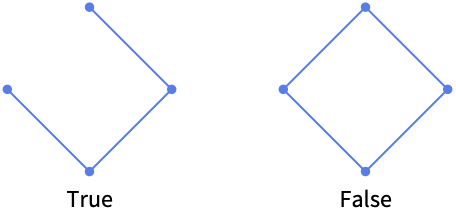
- AcyclicGraphQ checks if a graph is cycle-less. A graph cycle (more properly called a circuit when the cycle is identified using an explicit path with specific endpoints) is a subset of a graph's edge set that forms a connected path such that the first node of the path corresponds to the last. A graph with no cycles is known as an acyclic graph, while a graph containing one or more cycles is called a cyclic graph. AcyclicGraphQ returns True for an acyclic graph (ignoring any self-loops) and False otherwise.
- A simple graph containing no cycles of length three is called a triangle-free graph, and a simple graph containing no cycles of length four is called a square-free graph. Simple acyclic graphs are therefore triangle-free and square-free. They are also non-Hamiltonian (i.e. they contain no Hamiltonian cycles).
- A connected acyclic graph is known as a tree. All trees are therefore acyclic by definition, and TreeGraphQ (which is equivalent to the logical conjunction of AcyclicGraphQ and ConnectedGraphQ) can be used to check if a graph is a tree. Trees appear extensively in computer science and in particular in the implementation of many types of algorithms and data structures, including file and folder storage on disk.
- A not-necessarily-connected acyclic graph is known as a forest. A forest with directed edges is more commonly known as a directed acyclic graph or DAG. A DAG is therefore a graph for which both AcyclicGraphQ and DirectedGraphQ return True. DAGs are important in modeling many different kinds of information, e.g. electronic circuits, information flows, and events and tasks.
- FindCycle can be used to find one or more cycles in graphs that are not acyclic (and returns the empty list {} for graphs that are).
Examples
open all close allBasic Examples (2)
Scope (6)
AcyclicGraphQ works with undirected graphs:
AcyclicGraphQ[[image]]AcyclicGraphQ[[image]]AcyclicGraphQ[[image]]AcyclicGraphQ[[image]]AcyclicGraphQ gives False for expressions that are not graphs:
AcyclicGraphQ[x]AcyclicGraphQ works with large graphs:
GridGraph[{10, 10, 10, 10}];AcyclicGraphQ[%]//TimingApplications (1)
A condensation graph is acyclic:
g = [image];The vertices of the condensation are the strongly connected components:
c = ConnectedComponents[g]HighlightGraph[g, Subgraph[g, #]& /@ c]Construct the condensation graph:
vout = Complement[VertexOutComponent[g, #], #]& /@ c;m = Table[Boole[Intersection[v, s] != {}], {v, vout}, {s, c}];AdjacencyGraph[c, m, VertexShapeFunction -> "Name", EdgeStyle -> Arrowheads[.1]]AcyclicGraphQ[%]Properties & Relations (6)
Use DepthFirstScan to detect cycles in a graph:
g = [image];Catch[DepthFirstScan[g, {"BackEdge" -> (Throw[False]&)}];True]Compare with AcyclicGraphQ:
% == AcyclicGraphQ[g]A CycleGraph is not acyclic:
CycleGraph[5]AcyclicGraphQ[%]A TreeGraph is acyclic:
CompleteKaryTree[3, 3]{TreeGraphQ[%], AcyclicGraphQ[%]}A PathGraph with different start and end vertices is acyclic:
PathGraph[Range[25]]{PathGraphQ[%], AcyclicGraphQ[%]}An acyclic graph is not Hamiltonian:
HamiltonianGraphQ[CompleteKaryTree[3, 3]]A graph with minimal vertex degree greater than 2 is not acyclic:
g = GridGraph[{2, 3}]VertexDegree[g]AcyclicGraphQ[g]Possible Issues (1)
AcyclicGraphQ ignores self-loops:
g = [image];LoopFreeGraphQ[g]AcyclicGraphQ[g]Text
Wolfram Research (2010), AcyclicGraphQ, Wolfram Language function, https://reference.wolfram.com/language/ref/AcyclicGraphQ.html.
CMS
Wolfram Language. 2010. "AcyclicGraphQ." Wolfram Language & System Documentation Center. Wolfram Research. https://reference.wolfram.com/language/ref/AcyclicGraphQ.html.
APA
Wolfram Language. (2010). AcyclicGraphQ. Wolfram Language & System Documentation Center. Retrieved from https://reference.wolfram.com/language/ref/AcyclicGraphQ.html