

FindHamiltonianPath
finds a Hamiltonian path in the graph g with the smallest total length.
FindHamiltonianPath[g,s,t]
finds a Hamiltonian path with the smallest total length from s to t.
Details and Options
- FindHamiltonianPath is also known as the Hamiltonian path problem.
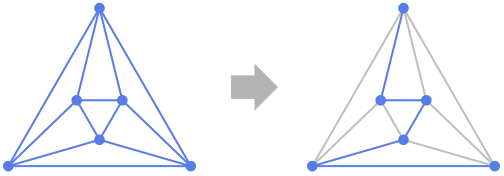
- A Hamiltonian path visits each vertex exactly once.
- FindHamiltonianPath returns the list {} if no Hamiltonian path exists.
Examples
open all close allBasic Examples (2)
Find a Hamiltonian path through vertices in a graph:
g = PolyhedronData["Dodecahedron", "Skeleton"];FindHamiltonianPath[g]HighlightGraph[g, PathGraph[%]]Find a Hamiltonian path between two individual vertices in a graph:
g = PolyhedronData["Dodecahedron", "Skeleton"];FindHamiltonianPath[g, 1, 5]HighlightGraph[g, PathGraph[%]]Scope (3)
FindHamiltonianPath works with undirected graphs:
FindHamiltonianPath[[image]]FindHamiltonianPath[[image]]FindHamiltonianPath works with large graphs:
g = RandomGraph[{1000, 5000}];Timing[FindHamiltonianPath[g]]//ShortOptions (1)
DistanceFunction (1)
This defines a sparse distance matrix among six points:
d = SparseArray[{{1, 2} -> 1, {2, 1} -> 1, {6, 1} -> 1, {6, 2} -> 1, {5, 1} -> 1, {1, 5} -> 1, {2, 6} -> 1, {2, 3} -> 10, {3, 2} -> 10, {3, 5} -> 1, {5, 3} -> 1, {3, 4} -> 1, {4, 3} -> 1, {4, 5} -> 15, {4, 1} -> 1, {5, 4} -> 15, {5, 2} -> 1, {1, 4} -> 1, {2, 5} -> 1, {1, 6} -> 1}, {6, 6}, Infinity];g = [image];path = FindHamiltonianPath[g, DistanceFunction -> (d[[#1, #2]]&)]HighlightGraph[g, PathGraph[path]]Applications (2)
Find a sequence of moves by a knight chess piece that visits each square of an 8×8 chessboard exactly once:
g = KnightTourGraph[8, 8];path = FindHamiltonianPath[g]checkerboard = ArrayPlot[Table[Mod[j + i, 2], {i, 8}, {j, 8}], ColorRules -> {1 -> RGBColor[0, .55, .77], 0 -> RGBColor[.67, .9, .99]}, Frame -> False, DataRange -> {{1, 8}, {1, 8}}];Show[{checkerboard, HighlightGraph[g, PathGraph[path], GraphHighlightStyle -> "DehighlightHide", EdgeStyle -> Directive[Thick, Red]]}]Find a Hamiltonian path of Europe from Greece to Germany:
europe = CountryData["Europe"];Latitude and longitude of geographical centers:
pos = GeoPosition[CountryData[#, "CenterCoordinates"]]& /@ europe;Construct a weighted graph of Europe:
adj = Table[QuantityMagnitude@GeoDistance[i, j], {i, pos}, {j, pos}] /. Quantity[0., _] -> Infinity;g = WeightedAdjacencyGraph[europe, adj];FindHamiltonianPath[g, Entity["Country", "Greece"], Entity["Country", "Germany"]]//ShallowGeoGraphics[{Thick, Red, GeoPath[%]}]Properties & Relations (2)
A graph with a Hamiltonian path may not have a Hamiltonian cycle:
g = [image];FindHamiltonianPath[g]HamiltonianGraphQ[g]A graph with a Hamiltonian cycle has a Hamiltonian path:
g = GraphData["Foster038A"]HamiltonianGraphQ[g]FindHamiltonianPath[g]Text
Wolfram Research (2015), FindHamiltonianPath, Wolfram Language function, https://reference.wolfram.com/language/ref/FindHamiltonianPath.html.
CMS
Wolfram Language. 2015. "FindHamiltonianPath." Wolfram Language & System Documentation Center. Wolfram Research. https://reference.wolfram.com/language/ref/FindHamiltonianPath.html.
APA
Wolfram Language. (2015). FindHamiltonianPath. Wolfram Language & System Documentation Center. Retrieved from https://reference.wolfram.com/language/ref/FindHamiltonianPath.html