

FindIsomers
FindIsomers[chem]
returns a list of molecules with the same chemical formula as chem.
FindIsomers[chem,form]
finds isomers of chem and returns them in the given form.
Details
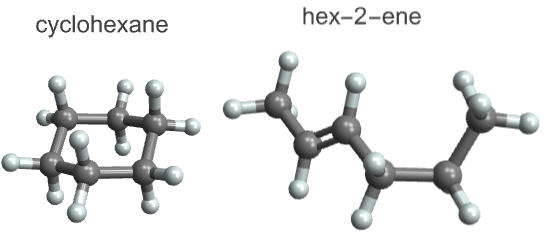
- Isomers are molecules with the same chemical formula but different structures. For example, cyclohexane and hex-2-ene both have the formula C6H12:
- Possible forms for chem include:
-
ChemicalFormula[…] a chemical formula Molecule[…] a molecule Entity["Chemical",…] a chemical entity BioSequence[…] a biomolecular sequence - FindIsomers draws on several sources, including the Wolfram Knowledgebase and external services such as "PubChem". Only those molecules that have entries in these databases will be returned.
- If no result is found, FindIsomers will return an empty list.
- form should be one of the following:
-
"Molecule" a list of molecules "Entity" entities of the type "Chemical" "PubChemCompoundID" a list of ExternalIdentifier objects "SMILES" a list of SMILES strings
Examples
open all close allBasic Examples (3)
FindIsomers[Molecule["pentane"]]MoleculeName /@ %Find isomers given a chemical formula:
FindIsomers[ChemicalFormula["C3H5NO"]]//ShortFind isomers in the Wolfram Knowledgebase
FindIsomers[Molecule[{"Cl", "C", "O", "C", "C", "C", "C"}, {Bond[{1, 2}, "Single"], Bond[{2, 3}, "Double"],
  Bond[{2, 4}, "Single"], Bond[{4, 5}, "Single"], Bond[{4, 6}, "Single"], Bond[{6, 7}, "Single"],
  Bond[{7, 4}, "Single"]}, {}], "Entity"]
Applications (1)
Find isomers of caffeine that have an aromatic bond between oxygen and nitrogen:
mols = Select[FindIsomers[(Entity["Chemical", "Caffeine"])], MoleculeContainsQ[Bond[{Atom["O", "AromaticAtomQ" -> True], Atom["N", "AromaticAtomQ" -> True]}]]];
Length[mols]
Take five random isomers from this list and find their maximum common substructure:
SeedRandom[987654];
selection = RandomSample[mols, 5];
mcs = MoleculeMaximumCommonSubstructure[selection, "CompleteRings"]
View the molecules in 3D, highlighting the common substructure:
MoleculePlot3D[#, mcs]& /@ selectionaligned = MoleculeAlign[First@selection, selection, mcs];
Show[MoleculePlot3D[#, mcs]& /@ aligned]Possible Issues (1)
Some chemical formulas will not have any entry in the sources queried by FindIsomers:
FindIsomers[ChemicalFormula["C6H22"]]Text
Wolfram Research (2021), FindIsomers, Wolfram Language function, https://reference.wolfram.com/language/ref/FindIsomers.html.
CMS
Wolfram Language. 2021. "FindIsomers." Wolfram Language & System Documentation Center. Wolfram Research. https://reference.wolfram.com/language/ref/FindIsomers.html.
APA
Wolfram Language. (2021). FindIsomers. Wolfram Language & System Documentation Center. Retrieved from https://reference.wolfram.com/language/ref/FindIsomers.html