

FindKClique
FindKClique[g,k]
finds a largest k-clique in the graph g.
FindKClique[g,k,n]
finds a k-clique containing at most n vertices.
FindKClique[g,k,{n}]
finds a k-clique containing exactly n vertices.
FindKClique[g,k,{nmin,nmax}]
finds a k-clique containing between nmin and nmax vertices.
FindKClique[g,k,nspec,s]
finds at most s k-cliques.
FindKClique[{g,v},k,…]
finds k-cliques that include the vertex v only.
FindKClique[{vw,…},…]
uses rules vw to specify the graph g.
Details
- A k-clique is a maximal set of vertices that are at a distance no greater than k from each other.
- FindKClique returns a list of k-cliques.
- FindKClique will return an empty list if there is no k-clique.
- FindKClique[…,k,nspec,All] finds all the k-cliques.
- FindKClique works with undirected graphs, directed graphs, multigraphs, and mixed graphs.
Background & Context
- FindKClique finds one or more k-cliques in a graph, returning them as a list of vertices. Here, a k-clique is a maximal set of vertices that are at a distance no greater than k from each other. k-cliques are used in project selection, pattern matching, finance, and network analysis.
- FindKClique can be used to find k-cliques of different sizes, from 1 to the largest possible size (in general n for a graph on n vertices). FindKClique can be used to find a single k-clique of specified size, a specified number of cliques, or all.
- 1-cliques are cliques. All k-clans are k-cliques, but the converse is not always true. Related functions include FindClique, FindKClan, FindKClub, and FindKPlex.
Examples
open all close allBasic Examples (2)
Find a largest 2-clique in a graph:
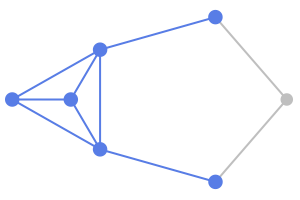
g = [image];FindKClique[g, 2]HighlightGraph[g, Subgraph[g, %]]g = ExampleData[{"NetworkGraph", "ZacharyKarateClub"}];FindKClique[g, 4, Infinity, All]Scope (14)
Specification (8)
FindKClique works with undirected graphs:
FindKClique[[image], 2]FindKClique[[image], 2]FindKClique[[image], 2]FindKClique[[image], 2]FindKClique[[image], 2]Find k-cliques for arbitrary k:
Table[FindKClique[[image], k], {k, 1, 4}]Use rules to specify the graph:
FindKClique[{1 -> 2, 1 -> 5, 2 -> 3, 3 -> 4, 4 -> 5, 3 -> 6, 4 -> 6, 6 -> 3, 6 -> 4, 4 -> 3}, 2]FindKClique works with large graphs:
g = GridGraph[{10, 10, 10, 10}];FindKClique[g, 2]//TimingEnumeration (6)
A 2-clique containing exactly 4 vertices:
FindKClique[[image], 2, {4}]A 2-clique containing at most 4 vertices:
FindKClique[[image], 2, 4]A 2-clique containing between 3 and 5 vertices:
FindKClique[[image], 2, {3, 5}]A largest 2-clique that includes a given vertex:
FindKClique[{[image], 6}, 2]Find all 2-cliques in a graph:
FindKClique[[image], 2, Infinity, All]FindKClique gives an empty list if there is no k-clique:
FindKClique[[image], 2, {3}]Applications (4)
Highlight all 2-cliques of size 5:
g = PolyhedronData["Dodecahedron", "Skeleton"];Table[HighlightGraph[g, Subgraph[g, i]], {i, FindKClique[g, 2, {5}, All]}]A friendship network between members of a karate club. Find the size of a largest group of people who are friends or a friend of a friend:
g = ExampleData[{"NetworkGraph", "ZacharyKarateClub"}];Length[First[FindKClique[g, 2]]]FindKClique[g, 2, {%}, All]HighlightGraph[g, Subgraph[g, #]]& /@ %A network of books linked by the same buyers on Amazon.com. Find a largest selection of books including The Clinton Wars that was frequently bought by buyers who previously bought a common book:
g = ExampleData[{"NetworkGraph", "USPoliticsBooks"}];FindKClique[{g, "The Clinton Wars"}, 2]To prevent data packets from circulating indefinitely in a mobile ad hoc network, a time to live (TTL—the maximum number of edges traversed) value is set to 3. Find all devices that can be reached from device 1:
g = RandomGraph[SpatialGraphDistribution[100, 1, BinormalDistribution[{2, 1.5}, 0.8]]];FindKClique[{g, 1}, 3, Infinity]HighlightGraph[g, Subgraph[g, %]]The best time to live for data packets:
Max[GraphDiameter[Subgraph[g, #]] & /@ ConnectedComponents[g]] - 1Complement[VertexList[g], First[FindKClique[{g, 1}, %, Infinity]]]Properties & Relations (8)
A k-clique in a graph g is a clique in the graph k power of g:
g = [image];FindKClique[g, 2]FindClique[GraphPower[g, 2]]g = [image];FindKClique[g, 1]CompleteGraphQ[g, First[%]]A complete graph is a maximum k-clique:
CompleteGraph[10]FindKClique[%, 2]A star graph is a maximum 2-clique:
StarGraph[10]FindKClique[%, 2]The (k-1)-clique is contained in a k-clique:
g = [image];FindKClique[g, 1]FindKClique[g, 2, Infinity, All]All k-clans are k-cliques. The converse is not always true:
g = [image];FindKClan[g, 2, Infinity, All]FindKClique[g, 2, Infinity, All]A k-club is contained in a k-clique:
g = [image];FindKClub[g, 2]FindKClique[g, 2, 6]The converse is not always true:
FindKClique[{g, 6}, 2, 6]GraphDiameter[Subgraph[g, %]]Find a largest 2-clique that includes a given vertex:
g = [image];FindKClique[{g, 6}, 2]Compare with 2-clan, 2-club, and 2-plex:
FindKClan[{g, 6}, 2]FindKClub[{g, 6}, 2]FindKPlex[{g, 6}, 2]Text
Wolfram Research (2012), FindKClique, Wolfram Language function, https://reference.wolfram.com/language/ref/FindKClique.html (updated 2015).
CMS
Wolfram Language. 2012. "FindKClique." Wolfram Language & System Documentation Center. Wolfram Research. Last Modified 2015. https://reference.wolfram.com/language/ref/FindKClique.html.
APA
Wolfram Language. (2012). FindKClique. Wolfram Language & System Documentation Center. Retrieved from https://reference.wolfram.com/language/ref/FindKClique.html