

GrassmannAlgebra
GrassmannAlgebra[vars]
gives the Grassmann algebra with generators vars.
GrassmannAlgebra[vars,alg]
takes the operation names and monomial order settings from the non-commutative algebra alg.
Details
- GrassmannAlgebra gives a NonCommutativeAlgebra object representing a Grassmann algebra.
- Grassmann algebra is otherwise known as exterior algebra.
- GrassmannAlgebra[{x1,…,xn}] returns a NonCommutativeAlgebra object representing the unitary algebra given by generators {x1,…,xn} and relations
 for
for  and
and 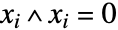 for
for 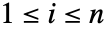 .
. - All elements of the Grassmann algebra can be canonically represented as linear combinations of
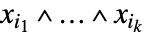 , with
  . NonCommutativeExpand computes the canonical representation of Grassmann algebra elements.
Examples
open all close allBasic Examples (2)
A Grassmann algebra with three generators:
alg = GrassmannAlgebra[{x, y, z}]Compute the canonical form of an element of the algebra:
NonCommutativeExpand[(x + 2y + 3z)⋀(4x + 5y + 6z), alg]A Grassmann algebra with four generators:
alg = GrassmannAlgebra[{e1, e2, e3, e4}]Compute the Gröbner basis of a left ideal in the algebra:
NonCommutativeGroebnerBasis[{e1⋀e2 - e3⋀e4}, alg, Left]Scope (2)
Specify a nondefault multiplication operation:
alg = GrassmannAlgebra[{x, y, z}, "Multiplication" -> NonCommutativeMultiply]NonCommutativeExpand[(x + y + z)**(x - y + z), alg]Collect terms involving the same powers of  :
:
alg = GrassmannAlgebra[{x, y, u, v, w}]NonCommutativeCollect[w⋀u⋀x⋀y + 2v⋀y⋀x⋀w + 3x⋀u⋀w⋀x, x, alg]Applications (1)
Define the exterior algebra in two variables:
ext = GrassmannAlgebra[{x, y}]Confirm the basic relations 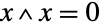 ,
, 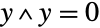 and
and  :
:
NonCommutativeExpand[{x⋀x, y⋀y, x⋀y + y⋀x}, ext]Any product with three or more generators in it will contain a repeated generator and thus be zero:
NonCommutativeExpand[a x⋀y⋀x + b y⋀x⋀y⋀x, ext]The terms  ,
,  ,
,  and
and  are linearly independent—NonCommutativeExpand finds no relations—forming a basis for the algebra:
NonCommutativeExpand[a + b x + c y + d x⋀y, ext]Compute the product of two general linear combinations of the generators:
NonCommutativeExpand[(a x + b y) ⋀(c x + d y), ext]//FactorThe algebra ext can be represented using TensorWedge with the generators  and
and  corresponding to 2-vectors:
$Assumptions = {(x | y)∈Vectors[2], (a | b | c | d)∈Complexes}Confirm the basic relations; in this concrete realization, the product is represented by a zero matrix rather than a zero scalar:
FullSimplify[{xx, yy, xy + yx}]Compute the product of two general vectors; TensorReduce gives a result corresponding to the one found abstractly:
TensorReduce[(a x + b y) (c x + d y)] /. TensorWedge -> Wedge//FactorRepeat the computation with two explicit vectors; the result is an antisymmetric rank-2 array (matrix):
{a, b}{c, d}The entries of the array are 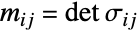 , where
  is the determinant of the coefficients and
  is Signature[i,j]:
%//MatrixFormProperties & Relations (1)
GrassmannAlgebra gives a NonCommutativeAlgebra with Grassmann algebra structure:
GrassmannAlgebra[{x, y, z}]% === NonCommutativeAlgebra[{"Multiplication" -> Wedge, "Structure" -> {"Grassmann", {x, y, z}}}]Text
Wolfram Research (2026), GrassmannAlgebra, Wolfram Language function, https://reference.wolfram.com/language/ref/GrassmannAlgebra.html.
CMS
Wolfram Language. 2026. "GrassmannAlgebra." Wolfram Language & System Documentation Center. Wolfram Research. https://reference.wolfram.com/language/ref/GrassmannAlgebra.html.
APA
Wolfram Language. (2026). GrassmannAlgebra. Wolfram Language & System Documentation Center. Retrieved from https://reference.wolfram.com/language/ref/GrassmannAlgebra.html