

ModularInverse
ModularInverse[k,n]
gives the modular inverse of k modulo n.
Details
- ModularInverse is also known as modular multiplicative inverse.
- Integer mathematical function, suitable for both symbolic and numerical manipulation.
- Typically used in modular arithmetic and cryptography.
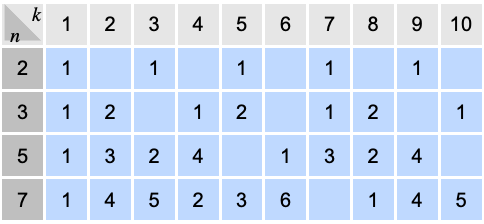
- ModularInverse[k,n] gives the number r such that the remainder of the division of r k by n is equal to 1.
- If k and n are not coprime, no modular inverse exists and ModularInverse[k,n] remains unevaluated.
Examples
open all close allBasic Examples (2)
Scope (2)
Numerical Evaluation (2)
Applications (4)
Basic Applications (2)
Two numbers are modular inverses of each other if their product is 1:
frame = If[# == 1, Style[#, Red], #]&;p = Prime[5];
g = Range[1, p - 1];
t = Table[frame[Mod[a b, p]], {a, g}, {b, g}];TableForm[t, TableHeadings -> {g, g}]Modular computation of a matrix inverse:
A = {{3, 4}, {2, 5}};First compute the matrix adjoint:
MinorMatrix[Mat_List ? MatrixQ] := Map[Reverse, Minors[Mat], {0, 1}]
CofactorMatrix[Mat_List ? MatrixQ] := MapIndexed[#1 (-1) ^ (Plus@@#2)&, MinorMatrix[Mat], {2}]
MatrixAdjoint[Mat_] := Transpose[CofactorMatrix[Mat]];
Then compute the modular inverse of a matrix:
ModularInverseMatrix[Mat_, m_] := Mod[ModularInverse[Det[Mat], m]MatrixAdjoint[Mat], m];
ModularInverseMatrix[A, 13]
Check that the inverse gives the correct result:
Mod[A.%, 13]Number Theory (2)
Build an RSA-like toy encryption scheme. Start with the modulus:
{p, q} = Prime[RandomInteger[{10 ^ 4, 10 ^ 5}, {2}]];
n = p q
Find the universal exponent of the multiplication group modulo n:
λ = CarmichaelLambda[n]d = NestWhile[#1 + 1& , Round[n / 3], GCD[λ, #1] =!= 1&]e = ModularInverse[d, λ]PowerMod[ToCharacterCode["RSA in Mathematica"], e, n]FromCharacterCode[PowerMod[%, d, n]]Create a random number generator that uses the current time as a seed:
x[0] = UnixTime[];
x[k_] := If[x[k - 1] == 0, a, Mod[a ModularInverse[x[k - 1], m] + c, m]]m = 2147483647;
a = 16807;
c = 1891423;Compute 20 random numbers between 0 and 1:
Histogram[Table[x[i] / m, {i, 0, 20}], 10]Properties & Relations (6)
ModularInverse is a periodic function:
{ModularInverse[2, 5], ModularInverse[2 + 5, 5]}ExtendedGCD returns modular inverses:
{g, {a, b}} = ExtendedGCD[3, 5]ModularInverse[3, 5] == aCompute using PowerMod:
{ModularInverse[3, 5], PowerMod[3, -1, 5]}The results have the same sign as the modulus:
ModularInverse[5, 7]ModularInverse[5, -7]If  and
and  are coprime, then
  is invertible modulo
  :
:
CoprimeQ[7, 12]ModularInverse[7, 12]Computing ModularInverse twice yields the original argument:
ModularInverse[ModularInverse[7, 9], 9]Possible Issues (1)
For nonzero integers k and n, ModularInverse[k,n] exists if and only if k and n are coprime:
CoprimeQ[10, 21]ModularInverse[10, 21]ModularInverse[21, 10]However, 10 and 22 are not coprime:
CoprimeQ[10, 22]ModularInverse[10, 22]
ModularInverse[22, 10]
Interactive Examples (1)
Neat Examples (2)
Visualize when a number is invertible modulo 12:
ArrayMesh[Boole[Table[NumberQ[ModularInverse[a + b ^ 2 + c ^ 3, 12]]//Quiet, {a, 10}, {b, 10}, {c, 10}]]]Modular inverses of sums of two squares:
ArrayPlot[Table[ModularInverse[a ^ 2 + b ^ 2, Prime[200]], {b, 100}, {a, 100}], ColorFunction -> "Pastel"]Related Links

 MathWorld
Text
Wolfram Research (2017), ModularInverse, Wolfram Language function, https://reference.wolfram.com/language/ref/ModularInverse.html.
CMS
Wolfram Language. 2017. "ModularInverse." Wolfram Language & System Documentation Center. Wolfram Research. https://reference.wolfram.com/language/ref/ModularInverse.html.
APA
Wolfram Language. (2017). ModularInverse. Wolfram Language & System Documentation Center. Retrieved from https://reference.wolfram.com/language/ref/ModularInverse.html