

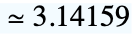


Pi
is  , with numerical value
 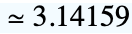 .
.
Details
- Mathematical constant treated as numeric by NumericQ and as a constant by D.
- Pi can be evaluated to any numerical precision using N.
- Pi can be entered in StandardForm and InputForm as π,
 pi
pi ,
,  p
p or \[Pi].
 - In StandardForm, Pi is printed as π.
Background & Context
- Pi is the symbol representing the mathematical constant
 , which can also be input as ∖[Pi]. Pi is defined as the ratio of the circumference of a circle to its diameter and has numerical value
  . Pi arises in many mathematical computations including trigonometric expressions, special function values, sums, products, and integrals as well as in formulas from a wide range of mathematical and scientific fields.
 - When Pi is used as a symbol, it is propagated as an exact quantity. While many expressions involving Pi (e.g. Cos[Pi/10]) are automatically expanded in terms of simpler functions, expansion and simplification of more complicated expressions involving Pi (e.g. Cos[Pi/15]) may require use of functions such as FunctionExpand and FullSimplify.
- Pi is known to be both irrational and transcendental, meaning it can be expressed neither as a ratio of integers nor as the root of any integer polynomial. While it is not known if Pi is normal (meaning the digits in its base-
 expansion are equally distributed) to any base, its known digits are very uniformly distributed.
 - Pi can be evaluated to arbitrary numerical precision by means of the Chudnovsky formula using N. In fact, calculating the first million decimal digits of Pi takes only a fraction of a second on a modern desktop computer. RealDigits can be used to return a list of digits of Pi and ContinuedFraction to obtain terms of its continued fraction expansion.
- Most angle-related functions in the Wolfram Language take radian measures as their arguments and return radian measures as results. The symbol Degree, which is equal to Pi/180, can therefore be used as a multiplier when entering values in degree measures (e.g. Cos[30 Degree]).
Examples
open all close allBasic Examples (3)

 :
:Scope (1)

Applications (5)
Integrate[Boole[x ^ 2 + y ^ 2 ≤ r ^ 2], {x, -Infinity, Infinity}, {y, -Infinity, Infinity}, Assumptions -> r > 0]The first 20 digits of  in base 10:
RealDigits[Pi, 10, 20]The first 20 terms of the continued fraction of Pi:
ContinuedFraction[Pi, 20]Trigonometric functions have arguments in radians:
Sin[Pi / 4]Many mathematical functions and operations give results involving π:
Zeta[2]Integrate[Exp[-x ^ 2], {x, -Infinity, Infinity}]Properties & Relations (2)
Various symbolic relations are automatically used:
Pi > 3Pi∈AlgebraicsPi is treated as a constant in differentiation:
Dt[Pi, x]

 MathWorld
 The Wolfram Functions Site
 An Elementary Introduction to the Wolfram Language
 NKS|Online
Text
Wolfram Research (1988), Pi, Wolfram Language function, https://reference.wolfram.com/language/ref/Pi.html (updated 1996).
CMS
Wolfram Language. 1988. "Pi." Wolfram Language & System Documentation Center. Wolfram Research. Last Modified 1996. https://reference.wolfram.com/language/ref/Pi.html.
APA
Wolfram Language. (1988). Pi. Wolfram Language & System Documentation Center. Retrieved from https://reference.wolfram.com/language/ref/Pi.html