

VertexCoverQ
VertexCoverQ[g,vlist]
yields True if the vertex list vlist is a vertex cover of the graph g, and False otherwise.
Details
- A vertex cover is a set of vertices that are incident to every edge.
- VertexCoverQ works with undirected graphs, directed graphs, multigraphs, and mixed graphs.
Background & Context
- VertexCoverQ tests if a specified set of vertices forms a vertex cover for a given graph, where a vertex cover is a set of vertices satisfying the condition that each edge of the graph is incident to some vertex in the set. VertexCoverQ returns True if the set is a vertex cover and False otherwise.
- The entire vertex set of a graph is always a vertex cover (of maximum possible size). The smallest possible vertex cover for a given graph is known as a minimum vertex cover, and its size is known as the vertex cover number.
- Vertex covers are closely related to independent vertex sets (which are sets of vertices having the property that no two vertices are part of the same edge). In particular, a set of vertices is a vertex cover if and only if its complement forms an independent vertex set. As a result, the counts of vertex covers and independent vertex sets in a graph are the same.
- FindVertexCover can be used to find a single minimum vertex cover or a single vertex cover of any fixed size, but not all vertex covers. A trivial implementation for finding all vertex covers of a graph can be constructed by applying VertexCoverQ to all subsets of a graph's vertices. EdgeCoverQ performs the analogous test to VertexCoverQ for edge covers of a graph. FindIndependentVertexSet can be used to find one or more maximal independent vertex sets in a graph (each of whose complements is a vertex cover).
Examples
open all close allBasic Examples (2)
Scope (6)
VertexCoverQ[[image], {1, 4, 6}]VertexCoverQ[[image], {2, 3, 6}]VertexCoverQ[[image], {1, 4, 6}]VertexCoverQ[[image], {1, 4, 6}]VertexCoverQ gives False for expressions that are not graphs:
VertexCoverQ[x, {1, 3}]VertexCoverQ works with large graphs:
g = GridGraph[{10, 10, 10, 10}];VertexCoverQ[g, {1, 2}]//TimingApplications (2)
Enumerate all vertex covers for a cycle graph:
g = CycleGraph[4, VertexSize -> Small]Enumerate all subsets of vertices and select the ones that are covers:
Subsets[VertexList[g]]vcl = Select[%, VertexCoverQ[g, #]&]Table[HighlightGraph[g, h], {h, vcl}]Enumerate all minimum vertex covers for a Petersen graph:
g = PetersenGraph[5, 2, VertexSize -> Medium]Find the size of a minimum vertex cover:
FindVertexCover[g]n = Length[%]Enumerate all minimum vertex covers:
vcl = Select[Subsets[VertexList[g], {6}], VertexCoverQ[g, #]&]Table[HighlightGraph[g, h], {h, vcl}]Properties & Relations (7)
The VertexList of a graph is a vertex (typically non-minimal) cover:
PetersenGraph[5, 2]VertexCoverQ[%, VertexList[%]]A smallest vertex cover can be found using FindVertexCover:
PetersenGraph[5, 2]VertexCoverQ[%, FindVertexCover[%]]A set of vertices is a vertex cover iff its complement is an independent set:
g = GridGraph[{2, 3}]vc = FindVertexCover[g]Check that the complement set of vertices is independent:
IndependentVertexSetQ[g, Complement[VertexList[g], vc]]The total size of the vertex cover and the largest independent set equals the vertex count:
g = WheelGraph[8]Length[FindVertexCover[g]] + Length[First[FindIndependentVertexSet[g]]] == VertexCount[g]The complement of the vertex cover in GraphComplement is a clique in its original graph:
g = GridGraph[{2, 3}]Compute the complement using the same embedding:
h = GraphComplement[g, VertexCoordinates -> GraphEmbedding[g]]FindVertexCover[h]Complement[VertexList[g], FindVertexCover[h]]Subgraph[g, %]CompleteGraphQ[%]The complete bipartite graph  has a vertex cover of size
 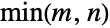 :
:
CompleteGraph[{2, 4}]Length[FindVertexCover[%]] == Min[2, 4]The largest independent edge set in a bipartite graph has the same size as the smallest vertex cover:
g = CycleGraph[6]BipartiteGraphQ[g]Length[FindVertexCover[g]] == Length[FindIndependentEdgeSet[g]]Text
Wolfram Research (2010), VertexCoverQ, Wolfram Language function, https://reference.wolfram.com/language/ref/VertexCoverQ.html (updated 2014).
CMS
Wolfram Language. 2010. "VertexCoverQ." Wolfram Language & System Documentation Center. Wolfram Research. Last Modified 2014. https://reference.wolfram.com/language/ref/VertexCoverQ.html.
APA
Wolfram Language. (2010). VertexCoverQ. Wolfram Language & System Documentation Center. Retrieved from https://reference.wolfram.com/language/ref/VertexCoverQ.html