

WindingCount
WindingCount[contour,p]
gives the count of the number of times a closed curve winds around a point p.
Details and Options
- WindingCount is also known as winding number.
- WindingCount is typically used to define a polygon from self-intersecting closed curves.
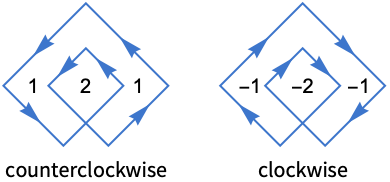
- A counterclockwise revolution has a value 1 and a clockwise revolution has a value -1. For several contours, the number of revolutions around p is the sum of the number of revolutions for each contour.
- The closed curve contour is typically a collection of line segments Line[{{p1,p2},…,{pn-1,pn},{pn,p1}}] and must lie in a plane.
- For a polygon poly, WindingCount[poly,p] gives the number of times the polygon boundary curves wind around the point p.
Examples
open all close allBasic Examples (1)
Scope (2)
Count how many times a closed curve winds around a point:
ℛ = Line[{{0.35, 0.2}, {0.9, 0.75}, {0.1, 0.55}, {0.9, 0.35}, {0.42, 0.9}, {0.35, 0.2}}];WindingCount[ℛ, {0.55, 0.6}]Graphics[{ℛ, Red, Point[{0.55, 0.6}]}]Count how many times a polygon boundary curve winds around a point:
ℛ = Polygon[{{1, 0}, {0, 2}, {-1, 0}, {0, 1}}, {1, 2, 3, 4}];WindingCount[ℛ, {0, 1.5}]Graphics[{ℛ, Red, Point[{0, 1.5}]}]Applications (2)
Find the polygon density of regular star polygons:
starPolygonBoundary[{p_, q_}] :=
Line[CirclePoints[p][[NestList[Mod[# + q, p, 1] &, 1, p]]]]ℛ = starPolygonBoundary[{7, 3}];WindingCount[ℛ, {0, 0}]Graphics[{ℛ, Red, Point[{0, 0}]}]Color points by the winding count of the point around the given contour:
ℛ = IconizedObject[«[image]»];points = RandomReal[{-1, 1}, {10000, 2}];counts = WindingCount[ℛ, points];Graphics[{AbsolutePointSize[1], Point[points, VertexColors -> (ColorData[102] /@ counts)]}]Properties & Relations (1)
CrossingCount is an alternate count function:
contour = Line[{{0.35, 0.2}, {0.42, 0.9}, {0.9, 0.35}, {0.1, 0.55}, {0.9, 0.75}, {0.35, 0.2}}];{CrossingCount[contour, {0.5, 0.5}], WindingCount[contour, {0.5, 0.5}]}Possible Issues (1)
A polygon boundary curve is always given in the counterclockwise orientation with no overlapping:
ℛ = {{(1/2), 1}, {1, 0}, {0, 0}, {(1/2), 1}, {1, 0}, {0, 0}};RegionBoundary[Polygon[ℛ]]WindingCount[Polygon[ℛ], {1 / 2, 1 / 2}]Graphics[{Arrowheads[Medium], Arrow[ℛ], Red, Point[{1 / 2, 1 / 2}]}]Text
Wolfram Research (2019), WindingCount, Wolfram Language function, https://reference.wolfram.com/language/ref/WindingCount.html.
CMS
Wolfram Language. 2019. "WindingCount." Wolfram Language & System Documentation Center. Wolfram Research. https://reference.wolfram.com/language/ref/WindingCount.html.
APA
Wolfram Language. (2019). WindingCount. Wolfram Language & System Documentation Center. Retrieved from https://reference.wolfram.com/language/ref/WindingCount.html