



CloudPut
CloudPut[expr]
writes expr to a new anonymous cloud object.
CloudPut[expr,"uri"]
writes expr to a cloud object at a given URI.
CloudPut[expr,CloudObject["uri"]]
writes expr to a given cloud object.
Details and Options
- CloudPut returns the resulting CloudObject.
- CloudPut[expr, URL["uri"]] is also supported.
- To copy an existing local file to the cloud, use CopyFile.
- CloudPut allows the following options:
-
AppearanceElements All elements to display on the web AutoRemove False whether to schedule the object for deletion CloudBase Automatic what cloud to write to CloudObjectNameFormat $CloudObjectNameFormat format to use for the name portion of the URL CloudObjectURLType $CloudObjectURLType base type of URL to use (obj, env, ...) IconRules Automatic icons to use for the object IncludeDefinitions False whether to automatically include dependencies MetaInformation {} metainformation for the object Permissions Automatic permissions for the object - With IncludeDefinitions->False, CloudPut[expr,…] includes only expr itself in the cloud object it creates.
- With IncludeDefinitions->True, CloudPut[expr,…] automatically includes all definitions needed to evaluate expr in the cloud object it creates.
Examples
open all close allBasic Examples (2)
Scope (2)
Save a named cloud object specified by a string:
CloudPut[47!, "myfile"]Save a named cloud object specified by a CloudObject:
CloudPut[47!, CloudObject["myfile"]]CloudGet["myfile"]Save a named cloud object specified by a URL:
CloudPut[47!, URL["https://www.wolframcloud.com/obj/documentation/myfile"]]CloudGet["myfile"]Save an unevaluated expression:
obj = CloudPut[Unevaluated[DateObject[]]]The expression has been stored in unevaluated form:
FilePrint[obj]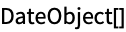
The expression evaluates each time it is read:
t0 = Now;
Table[Get[obj] - t0, {3}]
Options (9)
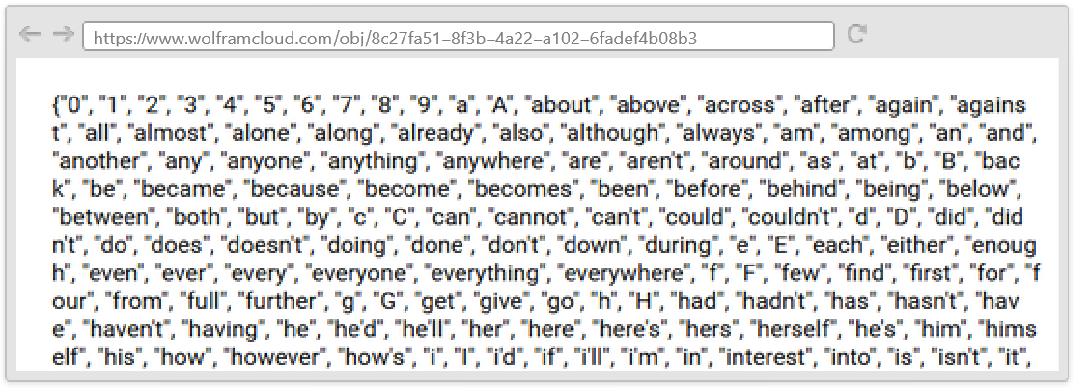
AppearanceElements (1)
AutoRemove (1)
CloudBase (1)
CloudObjectNameFormat (1)
CloudObjectURLType (1)
IconRules (1)
IncludeDefinitions (1)
Write an unevaluated expression that depends on other symbol definitions, and include those definitions:
f[n_] := Boole[Negative[n]] * (n + 1);
obj = CloudPut[Unevaluated[f[Now["Hour"]]], IncludeDefinitions -> True]
The object has been stored unevaluated with the definition for f:
FilePrint[obj]
MetaInformation (1)
Write to a cloud object and include some metainformation:
CloudPut[{$GeoLocationCity, $GeoLocationCountry}, "current-location", MetaInformation -> <|"Source" -> SystemInformation["Kernel", "ProductIDName"], "OperatingSystem" -> $OperatingSystem|>]The metainformation can be read back later:
Options[CloudObject["current-location"], MetaInformation]Properties & Relations (1)
Put with a CloudObject destination is equivalent to CloudPut:
Put[42, CloudObject[]]Use PutAppend with a cloud object to append an expression to a cloud object instead of completely replacing its contents as CloudPut does:
obj = PutAppend[1, CloudObject[]];
ReadList[obj]
Append another expression and read all the expressions in the object:
PutAppend[2, obj];
ReadList[obj]
Possible Issues (1)
Using CloudPut for expressions like APIFunction that have special behavior in the cloud does not activate their special behavior:
api = CloudPut[APIFunction[{"P" -> Number, "r" -> Number, "t" -> Number}, #P(1 + #r * #t)&]]Calling the cloud object does not do any computation since an expression is simply displayed using HTML, which happens to be imported as something readable by URLExecute:
URLExecute[api, {"P" -> 1000, "r" -> 2.3, "t" -> 72}]In order to create a usable APIFunction, it must be deployed with CloudDeploy or CloudPublish:
api = CloudDeploy[APIFunction[{"P" -> Number, "r" -> Number, "t" -> Number}, #P(1 + #r * #t)&]]Now it reads the parameters and evaluates the function when invoked, as intended:
URLExecute[api, {"P" -> 1000, "r" -> 2.3, "t" -> 72}]
 Fast Introduction for Programmers: Cloud Deployment
 An Elementary Introduction to the Wolfram Language
Text
Wolfram Research (2014), CloudPut, Wolfram Language function, https://reference.wolfram.com/language/ref/CloudPut.html (updated 2019).
CMS
Wolfram Language. 2014. "CloudPut." Wolfram Language & System Documentation Center. Wolfram Research. Last Modified 2019. https://reference.wolfram.com/language/ref/CloudPut.html.
APA
Wolfram Language. (2014). CloudPut. Wolfram Language & System Documentation Center. Retrieved from https://reference.wolfram.com/language/ref/CloudPut.html