

DiscreteHilbertTransform
DiscreteHilbertTransform[list]
finds the discrete Hilbert transform of the list list of real numbers.
Details
- Discrete Hilbert transforms have applications in signal processing, communications, acoustics, data compression, seismic ambient data, gravitational waves, etc.
- This transform imparts a
 phase shift to the original sequence for positive frequencies and a
  phase shift for negative frequencies.
 - For a list
 , DiscreteHilbertTransform, calculates its FFT, annihilates negative frequencies and calculates the inverse FFT of the result, of which the imaginary part is
  . »
. » - In signal processing, the complex sequence
 is called the analytic signal, and its magnitude is the envelope:
  can have any positive integer length.
 - If the elements of
 are exact numbers, DiscreteHilbertTransform begins by applying N to them.
  can also be a SparseArray object, resulting in
  , also a SparseArray object.
Examples
open all close allBasic Examples (2)
Scope (9)
x = {1, 0, 0, 1, 0, 0, 1};Compute the discrete Hilbert transform with machine arithmetic:
DiscreteHilbertTransform[x]Compute using 24-digit precision arithmetic:
DiscreteHilbertTransform[N[x, 24]]Compute a 2D discrete Hilbert transform:
DiscreteHilbertTransform[RandomReal[{2, 4}, {3, 6}]]x is a rank-3 tensor with nonzero diagonal:
x = ConstantArray[0, {2, 3, 4}];x[[1, 1, 1]] = 1;x[[2, 2, 2]] = 1;Compute the 3D Discrete Hilbert transform:
DiscreteHilbertTransform[x]x is a SparseArray of real values:
x = SparseArray[{{1, 2} -> -1, {2, 2} -> 2π, {3, 3} -> 1.3, {2, 3} -> 7}];Compute the discrete Hilbert transform and get the result as a SparseArray:
DiscreteHilbertTransform[x]x is a large sparse matrix of real values:
x = SparseArray[Table[3 ^ i -> 1, {i, 10}]];Compute the discrete Hilbert transform and get the result as a SparseArray:
DiscreteHilbertTransform[x]Consider a discrete cosine wave:
discreteCosine = Table[Cos[t], {t, -π, π, π / 25}];DiscreteHilbertTransform applies a  degree phase shift:
discreteHCosine = DiscreteHilbertTransform[discreteCosine];ListPlot[{discreteCosine, discreteHCosine}, ...]Here are the values for the first 10 elements of the discrete signal and its discrete Hilbert transform:
Tabular[(Transpose[{N[discreteCosine], discreteHCosine}])[[ ;; 10]] , {...}]Generate a random sequence of real numbers:
x = RandomReal[1, 200];Compute the discrete Hilbert transform:
dhtx = DiscreteHilbertTransform[x];Plot the original data and its transform together:
ListLinePlot[{x, dhtx}, ...]Consider instead a sinusoidal sequence with some noise:
x = Sin[17 * 2π * Range[0, 1, 0.001]] + RandomVariate[NormalDistribution[0, 0.05], 1001];Compute the discrete Hilbert transform:
dhtx = DiscreteHilbertTransform[x];Plot the original data and its transform together:
ListLinePlot[{x, dhtx}, ...]Data from a Sinc function with noise:
n = 100;
x = Table[Sinc[x - 10], {x, n}] + RandomReal[{-.05, .05}, {n}];ListPlot[x, PlotRange -> All]p = Fourier[x, FourierParameters -> {1, 1}];
ListPlot[Abs[p] ^ 2]Its discrete Hilbert transform:
dHx = DiscreteHilbertTransform[x];It provides the imaginary component for the analytic representation:
a = x + I * dHx;Power spectrum for the analytical signal:
s = Fourier[a, FourierParameters -> {1, 1}];
ListPlot[Abs[s] ^ 2]
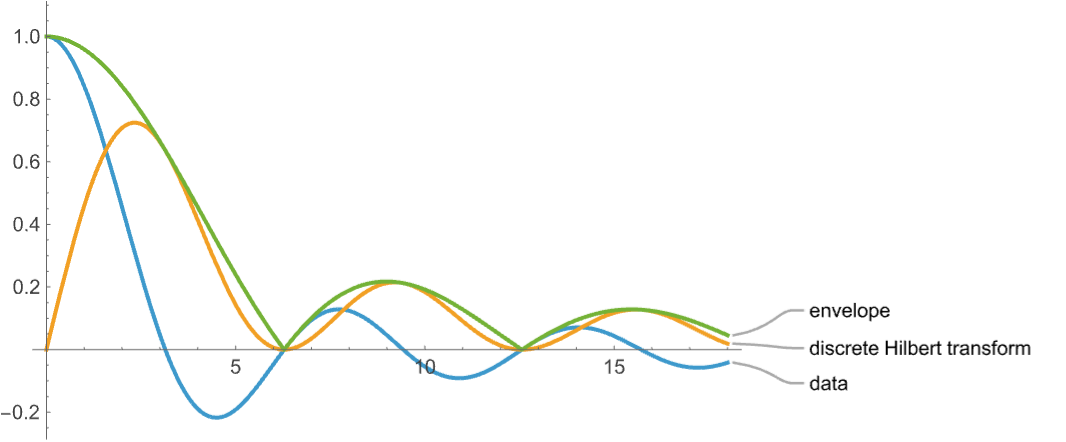
The envelope of an oscillating signal is a curve outlining its extremes, and it is the magnitude of the
analytic representation:
ListLinePlot[{x, dHx, Abs /@ a}, ...]Applications (4)
Communications (1)
Consider the following message signal:
m = Table[Sin[2Pi 5t] + 2Sin[2Pi 7t] + 1 / 2Sin[2Pi 9t], {t, -π / 2, π / 2, π / 100}];
ListLinePlot[m, DataRange -> {-π / 2, π / 2}, ...]
Using  as a message carrier, get the upper side band-suppressed carrier (USB-SC) and lower side band-suppressed carrier (LSB-SC):
c = Table[Cos[2Pi 55t], {t, -π / 2, π / 2, π / 100}];
s = Table[Sin[2Pi 55t], {t, -π / 2, π / 2, π / 100}];
USB = m * c - DiscreteHilbertTransform[m] * s;
LSB = m * c + DiscreteHilbertTransform[m] * s;
ListLinePlot[{USB, LSB}, ...]
ECG Frequency Analysis (1)
Electrocardiogram time-frequency analysis can reveal important information. Consider a patient's ECG data, which provides a voltage versus time graph of the electrical activity of the heart:
ECGData = {...};
ListLinePlot[ECGData, ...]
Filter the data using KaiserWindow:
filteredECG = BandpassFilter[ECGData, {(4π/25), (2π/5)}, Length[ECGData], KaiserWindow];Find its first differential in the discrete domain(sampling frequency of 100Hz):
differentialECG = Differences[filteredECG] / (2 * .01);The discrete Hilbert transform is:
dhDifferentialECG = DiscreteHilbertTransform[differentialECG];Compare the RMS and 18% of the maximum of the discrete Hilbert transform:
{Max[dhDifferentialECG] * .18, RootMeanSquare[dhDifferentialECG]}This will indicate a threshold of 39% of the maximum: with this information, you can now find the location of the R peaks using the Hilbert transform of the first differential:
RpeaksLocation = First /@ FindPeaks[dhDifferentialECG, Automatic, Automatic, Max[dhDifferentialECG] * .39];Visualize R peaks in the ECG data:
RPeaks = Transpose@{RpeaksLocation, ECGData[[RpeaksLocation]]};
ListPlot[{ECGData, RPeaks}, ...]
Wind Speed Prediction (1)
Consider the weather forecast for wind speed and direction in the city of San Juan, Puerto Rico, for the next seven days:
speedDateData = QuantityMagnitude[WeatherForecastData[...]];
directionDateData = (π/180)QuantityMagnitude[WeatherForecastData[...]];
DateListPlot[{speedDateData, directionDateData}, ...]
The predicted wind speed is given by the formula  , where
  is the maximum value of the speed data and
  and
and  are the mean values for the sequences
  and direction data, respectively.
  and
and  are the discrete Hilbert transforms for these sequences, respectively, with their mean values removed:
{...};
DateListPlot[{...}, ...]
Seismic Data Analysis (1)
Consider the following seismic trace, which illustrates how ground motion, resulting from seismic waves, is detected and recorded over time:
trace = {...};
ListLinePlot[trace]
Compute its Hilbert transform:
dhTrace = DiscreteHilbertTransform[trace];complexTrace = trace + I * dhTrace;env = Abs[complexTrace];Plot the trace, its transform and its envelope:
ListLinePlot[{trace, dhTrace, env, -env}, ...]phase = ArcTan[trace, dhTrace];
ListLinePlot[phase, PlotLabel -> "Instantaneous phase for the complex trace"]Properties & Relations (2)

Subscript[f, k] = {1.1, -1.2, 5.5, -4.5};Calculate its fast Fourier transform:
fFourier = Fourier[Subscript[f, k], FourierParameters -> {1, -1}]Annihilate negative frequencies:
anhilation = {1, 2, 1, 0} * fFourierInverseFourier[anhilation, FourierParameters -> {1, -1}]Finally, compare the imaginary part with DiscreteHilbertTransform:
Im[%] == DiscreteHilbertTransform[Subscript[f, k]]For the analytic representation of a real value signal:
{-2.3, -3.14, 1.62, E, Pi} + I DiscreteHilbertTransform[{-2.3, -3.14, 1.62, E, Pi}]The DC component (first position) and the Nyquist component(![TemplateBox[{{n, /, 2}}, Ceiling]](Files/DiscreteHilbertTransform.en/2.png "TemplateBox[{{n, /, 2}}, Ceiling]") position) are always real:
position) are always real:
Fourier[%, FourierParameters -> {1, -1}]//ChopText
Wolfram Research (2026), DiscreteHilbertTransform, Wolfram Language function, https://reference.wolfram.com/language/ref/DiscreteHilbertTransform.html.
CMS
Wolfram Language. 2026. "DiscreteHilbertTransform." Wolfram Language & System Documentation Center. Wolfram Research. https://reference.wolfram.com/language/ref/DiscreteHilbertTransform.html.
APA
Wolfram Language. (2026). DiscreteHilbertTransform. Wolfram Language & System Documentation Center. Retrieved from https://reference.wolfram.com/language/ref/DiscreteHilbertTransform.html