

EdgeChromaticNumber
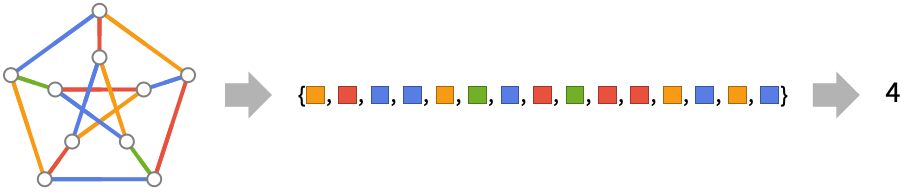
gives the chromatic number for the edges of the graph g.
Details and Options
- EdgeChromaticNumber is also known as chromatic index.
- EdgeChromaticNumber gives the smallest number of colors that can be assigned to the edges of the graph g such that no two adjacent edges have the same color.
Examples
open all close allBasic Examples (2)
Scope (6)
EdgeChromaticNumber works with undirected graphs:
EdgeChromaticNumber[[image]]EdgeChromaticNumber[[image]]EdgeChromaticNumber[[image]]EdgeChromaticNumber[[image]]Use rules to specify the graph:
EdgeChromaticNumber[{1 -> 2, 1 -> 3, 1 -> 4, 1 -> 5, 2 -> 3, 2 -> 5, 3 -> 4, 4 -> 5}]EdgeChromaticNumber works with large graphs:
g = GridGraph[{10, 10, 10}];AbsoluteTiming[EdgeChromaticNumber[g];]Applications (2)
Tournament Schedule (2)
To schedule a round-robin tournament, build a graph where vertices correspond to the competitors in the tournament and the edges correspond to games:
g = [image];Find at least how many rounds need to be scheduled so that each pair of competitors plays each other in one of the rounds:
EdgeChromaticNumber[g]FindEdgeColoring[g, ColorData[3, "ColorList"]]Annotate[g, {EdgeStyle -> Thread[EdgeList[g] -> Thread[{Thickness[0.02], %}]]}]In the National Football League, the pairs of teams that will play each other in a given year are determined based on the teams' records from the previous year. Build a graph where vertices correspond to the teams and the edges correspond to games:
g = [image];Find the minimum number of weekends needed:
EdgeChromaticNumber[g]Assign games to the weekends on which they are played:
FindEdgeColoring[g]Properties & Relations (5)
The chromatic index for a cycle graph is 2 when it has an even number of vertices; otherwise it is 3:
Table[EdgeChromaticNumber[CycleGraph[n]], {n, 4, 7}]The chromatic index for a wheel graph is one less than the number of vertices:
Table[EdgeChromaticNumber[WheelGraph[n]], {n, 4, 7}]Using FindEdgeColoring to compute EdgeChromaticNumber:
g = PetersenGraph[];Max[FindEdgeColoring[g]]EdgeChromaticNumber[g]The chromatic index for a simple graph is either its maximum degree  or
or  :
:
g = Table[RandomGraph[{5, i}], {i, 10}];EdgeChromaticNumber /@ gMax[VertexDegree[#]]& /@ gThe chromatic index for a bipartite graph is its maximum degree:
g = {[image], [image], [image], [image]};BipartiteGraphQ /@ gEdgeChromaticNumber /@ gMax[VertexDegree[#]]& /@ gText
Wolfram Research (2021), EdgeChromaticNumber, Wolfram Language function, https://reference.wolfram.com/language/ref/EdgeChromaticNumber.html.
CMS
Wolfram Language. 2021. "EdgeChromaticNumber." Wolfram Language & System Documentation Center. Wolfram Research. https://reference.wolfram.com/language/ref/EdgeChromaticNumber.html.
APA
Wolfram Language. (2021). EdgeChromaticNumber. Wolfram Language & System Documentation Center. Retrieved from https://reference.wolfram.com/language/ref/EdgeChromaticNumber.html