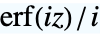




Erfi
Erfi[z]
gives the imaginary error function 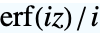 .
.
Details
- Mathematical function, suitable for both symbolic and numerical manipulation.
- For certain special arguments, Erfi automatically evaluates to exact values.
- Erfi can be evaluated to arbitrary numerical precision.
- Erfi automatically threads over lists.
- Erfi can be used with Interval and CenteredInterval objects. »
Examples
open all close allBasic Examples (5)
Erfi[2.5]Plot over a subset of the reals:
Plot[Erfi[x], {x, -2, 2}]Plot over a subset of the complexes:
ComplexPlot3D[Erfi[z], {z, -2 - 2I, 2 + 2I}, PlotLegends -> Automatic]Series expansion about the origin:
Series[Erfi[x], {x, 0, 10}]Series expansion at Infinity:
Series[Erfi[x], {x, ∞, 5}]//NormalScope (39)
Numerical Evaluation (6)
Erfi[0.5]N[Erfi[1 / 2], 50]The precision of the output tracks the precision of the input:
Erfi[0.5000000000000000000000000000000000]Evaluate for complex arguments:
Erfi[1.5 - I]Evaluate Erfi efficiently at high precision:
Erfi[0.5`500]//TimingErfi[0.5`5000];//TimingCompute worst-case guaranteed intervals using Interval and CenteredInterval objects:
Erfi[Interval[{.1, .2}]]Erfi[CenteredInterval[2, 1 / 100]]Or compute average-case statistical intervals using Around:
Erfi[ Around[2, 0.01]]Compute the elementwise values of an array:
Erfi[{{0 , I π / 2}, {I π / 2, 0}}]Or compute the matrix Erfi function using MatrixFunction:
MatrixFunction[Erfi, {{0, I π / 2}, {I π / 2, 0}}]Specific Values (3)
Simple exact values are generated automatically:
Erfi[0]Erfi[{-Infinity, Infinity, I Infinity, -I Infinity}]Find the zero of Erfi:
xzero = Solve[Erfi[x] == 0 && -1 < x < 1, x, Method -> Reduce][[1, 1, 2]]//QuietPlot[Erfi[x], {x, -2, 2}, Epilog -> Style[Point[{xzero, Erfi[xzero]}], PointSize[Large], Red]]Visualization (2)
Plot the Erfi function:
Plot[Erfi[x], {x, -2, 2}]
ComplexContourPlot[Re[Erfi[z]], {z, -2 - 2 I, 2 + 2 I}, Contours -> 20]
ComplexContourPlot[Im[Erfi[z]], {z, -2 - 2 I, 2 + 2 I}, Contours -> 20]Function Properties (10)
Erfi is defined for all real and complex values:
FunctionDomain[Erfi[x], x]FunctionDomain[Erfi[z], z, Complexes]Erfi takes all real values:
FunctionRange[Erfi[x], x, y]Erfi is an odd function:
Erfi[-x]Erfi has the mirror property ![erfi(TemplateBox[{z}, Conjugate])=TemplateBox[{{erfi, (, z, )}}, Conjugate]](Files/Erfi.en/4.png "erfi(TemplateBox[{z}, Conjugate])=TemplateBox[{{erfi, (, z, )}}, Conjugate]") :
:
FullSimplify[Erfi[Conjugate[z]] == Conjugate[Erfi[z]]]Erfi is an analytic function of x:
FunctionAnalytic[Erfi[x], x]It has no singularities or discontinuities:
FunctionSingularities[Erfi[x], x]FunctionDiscontinuities[Erfi[x], x]Erfi is nondecreasing:
FunctionMonotonicity[Erfi[x], x]Erfi is injective:
FunctionInjective[Erfi[x], x]Plot[{Erfi[x], 5}, {x, -5, 5}]Erfi is surjective:
FunctionSurjective[Erfi[x], x]Plot[{Erfi[x], -20}, {x, -5, 5}]Erfi is neither non-negative nor non-positive:
FunctionSign[Erfi[x], x]Erfi is neither convex nor concave:
FunctionConvexity[Erfi[x], x]Differentiation (3)
D[Erfi[x], x]Table[D[Erfi[x], {x, n}], {n, 1, 4}]Plot[Evaluate[%], {x, -1, 1}, PlotLegends -> {"First Derivative", "Second Derivative", "Third Derivative", "Fourth Derivative"}] derivative:
D[Erfi[x], {x, n}]Integration (3)
Indefinite integral of Erfi:
Integrate[Erfi[x], x]Definite integral of an odd integrand over an interval centered at the origin is 0:
Integrate[Erfi[x], {x, -3, 3}]Integrate[x^a - 1Erfi[x], x]//ExpandIntegrate[Erf[x]Erfi[x], x]Integrate[Exp[x]Erfi[x], x]Series Expansions (4)
Taylor expansion for Erfi:
Series[Erfi[x], {x, 0, 7}]Plot the first three approximations for Erfi around  :
:
terms = Normal@Table[Series[Erfi[x], {x, 0, m}], {m, 1, 5, 2}];
Plot[{Erfi[x], terms}, {x, -2, 2}]
General term in the series expansion of Erfi:
SeriesCoefficient[Erfi[x], {x, 0, n}]Asymptotic expansion of Erfi:
Series[Erfi[x], {x, Infinity, 1}]Erfi can be applied to a power series:
Erfi[Exp[-x] + O[x] ^ 5]Function Identities and Simplifications (3)
Integral definition of Erfi:
(2/Sqrt[π])Integrate[Exp[t^2], {t, 0, z}]Erfi of an inverse function:
Erfi[I InverseErf[z]]Argument involving basic arithmetic operations:
Erfi[Sqrt[z^2]]//FunctionExpandErfi[I x]Function Representations (5)
Erfi[z] == -I Erf[I z]Series representation of Erfi:
(2/Sqrt[π])Sum[(z^2k + 1/k!(2k + 1)), {k, 0, Infinity}]Erfi can be represented as a DifferentialRoot:
DifferentialRootReduce[Erfi[x], x]Erfi can be represented in terms of MeijerG:
MeijerGReduce[Erfi[x], x]Activate[%]TraditionalForm formatting:
TraditionalForm[Erfi[x]]Applications (4)
Solve a differential equation:
DSolve[{Derivative[2][w][z] - 2 z Derivative[1][w][z] == 0, w[0] == 0, w'[0] == (2/Sqrt[π])}, w[z], z]An isothermal solution of the force‐free Vlasov equation:
f[x_, v_, t_] := (C[1] + C[2]Sin[k (x - v t)])Exp[-α v ^ 2]D[f[x, v, t], t] + v D[f[x, v, t], x]//SimplifyIntegrating over the particle velocities gives the marginal distribution for the particle density:
Integrate[f[x, v, t], {v, v1, v2}]A solution of the time‐dependent Schrödinger equation for the sudden opening of a shutter:
ψ[k_][x_, t_] = 1 / 2E^I (k x - k^2 t / 2)(1 + I Erfi[(-1)^1 / 4(x - k t) / Sqrt[2 t]])I D[ψ[k][x, t], t] == -(1/2)D[ψ[k][x, t], x, x]//SimplifyThis plots the time‐dependent solution:
Plot3D[Abs[ψ[1][x, t]], {x, -5, 5}, {t, 0, 5}]Integrate along a line from the origin with direction  , expressing with Erfi :
Integrate[Exp[-x ^ 2] / (x ^ 2 - 1), {x, 0, DirectedInfinity[Exp[I Pi / 4]]}]Properties & Relations (1)
Possible Issues (1)
For large arguments, intermediate values may overflow:
With[{x = -5.0 10 ^ 8}, Exp[-x ^ 2]Erfi[x]]

Use DawsonF:
FullSimplify[Exp[-x ^ 2]Erfi[x]]% /. x -> -5.0 10 ^ 8Related Links

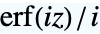 MathWorld
 The Wolfram Functions Site
Text
Wolfram Research (1996), Erfi, Wolfram Language function, https://reference.wolfram.com/language/ref/Erfi.html (updated 2022).
CMS
Wolfram Language. 1996. "Erfi." Wolfram Language & System Documentation Center. Wolfram Research. Last Modified 2022. https://reference.wolfram.com/language/ref/Erfi.html.
APA
Wolfram Language. (1996). Erfi. Wolfram Language & System Documentation Center. Retrieved from https://reference.wolfram.com/language/ref/Erfi.html