



InverseErf
InverseErf[s]
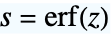
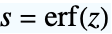
gives the inverse error function obtained as the solution for z in 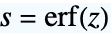 .
.
Details
- Mathematical function, suitable for both symbolic and numerical manipulation.
- Explicit numerical values are given only for real values of s between
 and
and  .
. - InverseErf[z0,s] gives the inverse of the generalized error function Erf[z0,z].
- For certain special arguments, InverseErf automatically evaluates to exact values.
- InverseErf can be evaluated to arbitrary numerical precision.
- InverseErf can be used with Interval and CenteredInterval objects. »
- InverseErf automatically threads over lists.
Examples
open all close allBasic Examples (4)
InverseErf[0.6]Plot over a subset of the reals:
Plot[InverseErf[s], {s, -1, 1}]Series expansion at the origin:
Series[InverseErf[x], {x, 0, 3}]Series expansion at a singular point:
Series[InverseErf[x], {x, 1, 2}, Assumptions -> x > 1]//NormalScope (32)
Numerical Evaluation (5)
Evaluate numerically to high precision:
N[InverseErf[33 / 100], 50]The precision of the output tracks the precision of the input:
InverseErf[0.330000000000000000000000]Evaluate InverseErf efficiently at high precision:
InverseErf[0.33`500]//TimingInverseErf[0.33`5000];//TimingEvaluate numerically the inverse of the generalized error function:
InverseErf[0.4, 0.2]Compute worst-case guaranteed intervals using Interval and CenteredInterval objects:
InverseErf[Interval[{0.5, 0.6}]]InverseErf[CenteredInterval[1 / 2, 1 / 100]]Or compute average-case statistical intervals using Around:
InverseErf[ Around[1 / 2, 0.01]]Compute the elementwise values of an array:
InverseErf[{{0, 1}, {1, 0}}]Or compute the matrix InverseErf function using MatrixFunction:
MatrixFunction[InverseErf, {{0, 1 / 2}, {1, 0}}]//FunctionExpandSpecific Values (2)
Exact results for specific arguments:
InverseErf[-1]InverseErf[0]InverseErf[1]Find a real root of the equation  :
:
f[s_] := InverseErf[s] - 1;
szero = Solve[f[s] == 0 && 0 < s < 1, s][[1, 1, 2]]Plot[f[s], {s, -1, 1}, Epilog -> Style[Point[{szero, f[szero]}], PointSize[Large], Red]]Visualization (3)
Plot the InverseErf function:
Plot[InverseErf[s], {s, -1, 1}]Plot the inverse of the generalized error function for different values of  :
:
Plot[{InverseErf[-2, s], InverseErf[-1, s], InverseErf[0, s], InverseErf[1, s], InverseErf[2, s]}, {s, -2, 2}]Plot the inverse of the generalized error function for different values of  :
:
Plot[{InverseErf[z0, -1], InverseErf[z0, -0.1], InverseErf[z0, 0], InverseErf[z0, 0.1], InverseErf[z0, 1]}, {z0, -3, 3}]Function Properties (9)
InverseErf is defined for all real values from the interval ( ):
):
FunctionDomain[InverseErf[s], s]InverseErf takes all real values:
FunctionRange[InverseErf[s], s, y]InverseErf is an odd function:
Table[-InverseErf[s] == InverseErf[-s], {s, -1, 1, 0.01}]//UnionInverseErf is an analytic function on its domain:
FunctionAnalytic[{InverseErf[x], -1 < x < 1}, x]It is not analytic in general, as it has both singularities and discontinuities:
FunctionSingularities[InverseErf[x], x]FunctionDiscontinuities[InverseErf[x], x]InverseErf is nondecreasing on its domain:
FunctionMonotonicity[{InverseErf[x], -1 < x < 1}, x]InverseErf is injective:
FunctionInjective[InverseErf[x], x]Plot[{InverseErf[x], 2}, {x, -2, 2}]InverseErf is surjective:
FunctionSurjective[InverseErf[x], x]Plot[{InverseErf[x], 3}, {x, -1, 1}]InverseErf is neither non-negative nor non-positive:
FunctionSign[InverseErf[x], x]InverseErf is neither convex nor concave on its domain:
FunctionConvexity[{InverseErf[x], -1 < x < 1}, x]Differentiation (2)
Integration (3)
Indefinite integral of InverseErf:
Integrate[InverseErf[x], x]Definite integral of InverseErf over its real domain:
Integrate[InverseErf[x], {x, -1, 1}]Numerical approximation of the definite integral of InverseErf:
Integrate[InverseErf[x], {x, 0, 0.1}]Series Expansions (2)
Taylor expansion for InverseErf:
Series[InverseErf[x], {x, 0, 8}]Plot the first three approximations for InverseErf around  :
:
terms = Normal@Table[Series[InverseErf[x], {x, 0, m}], {m, 1, 5, 2}];
Plot[{InverseErf[x], terms}, {x, -2, 2}, PlotRange -> {-3, 3}]
Series expansion of the inverse of the generalized error function:
Series[InverseErf[z0, s], {z0, 0, 2}]Function Identities and Simplifications (2)
Function Representations (4)
Primary definition of the inverse error function:
Solve[Erf[z] == s, z]//QuietRelation to the inverse of the generalized error function:
InverseErf[s] == InverseErf[0, s]Relation to the inverse complementary error function:
Table[InverseErf[s] == InverseErfc[1 - s], {s, -1, 1, 0.01}]//UnionTraditionalForm formatting:
InverseErf[x]//TraditionalFormApplications (3)
Generate Gaussian-distributed random numbers:
InverseErf[RandomReal[{-1, 1}, 10]]The number of standard deviations for a 99% confidence interval in the Gaussian distribution:
Sqrt[2]InverseErf[0.99]Plot InverseErf:
Plot3D[InverseErf[z0, z], {z0, -2, 2}, {z, -2, 2}]//QuietProperties & Relations (5)
Solve a transcendental equation:
Solve[InverseErf[x] ^ 3 + 2InverseErf[x] == 1, x]Numerically find a root of a transcendental equation:
FindRoot[InverseErf[z] + z + 1 / 2 == 0, {z, 0}]Obtain InverseErf as the solution of a differential equation:
DSolve[w''[z] - 2 w[z] w'[z] ^ 2 == 0, w[z], z]//QuietInverseErf is a numeric function:
Attributes[InverseErf]NumericQ[InverseErf[1 / Pi, 1 / 2]]In TraditionalForm,  is automatically interpreted as an inverse error function:
erf^-1(z)Possible Issues (1)
InverseErf evaluates numerically only for  :
:
InverseErf[0, 1.3]Neat Examples (1)
Riemann surface of InverseErf:
ParametricPlot3D[Evaluate[{Re[Erf[wr + I wi]], Im[Erf[wr + I wi]], wi}], {wr, -2, 2}, {wi, -2, 2}, PlotStyle -> Opacity[0.66]]Related Links

 MathWorld
 The Wolfram Functions Site
Text
Wolfram Research (1996), InverseErf, Wolfram Language function, https://reference.wolfram.com/language/ref/InverseErf.html (updated 2023).
CMS
Wolfram Language. 1996. "InverseErf." Wolfram Language & System Documentation Center. Wolfram Research. Last Modified 2023. https://reference.wolfram.com/language/ref/InverseErf.html.
APA
Wolfram Language. (1996). InverseErf. Wolfram Language & System Documentation Center. Retrieved from https://reference.wolfram.com/language/ref/InverseErf.html