

MassConcentrationCondition
MassConcentrationCondition[pred,vars,pars]
represents a mass concentration boundary condition for PDEs with predicate pred indicating where it applies, with model variables vars and global parameters pars.
MassConcentrationCondition[pred,vars,pars,lkey]
represents a thermal surface boundary condition with local parameters specified in pars[lkey].
Details
- MassConcentrationCondition specifies a boundary condition for MassTransportPDEComponent.
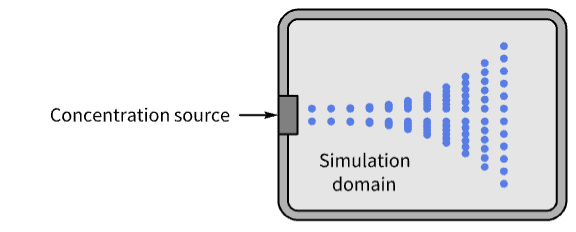
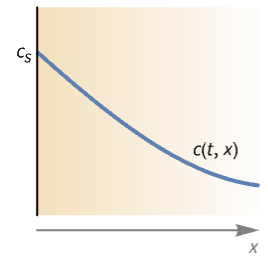
- MassConcentrationCondition is typically used to set a mass species concentration on the boundary. Common examples include a mass species inflow condition.
- MassConcentrationCondition sets a specific mass species concentration on the boundary with dependent variable
 in [
in [![TemplateBox[{InterpretationBox[, 1], {"mol", , "/", , {"m", ^, 3}}, moles per meter cubed, {{(, "Moles", )}, /, {(, {"Meters", ^, 3}, )}}}, QuantityTF]](Files/MassConcentrationCondition.en/3.png "TemplateBox[{InterpretationBox[, 1], {\"mol\", , \"/\", , {\"m\", ^, 3}}, moles per meter cubed, {{(, \"Moles\", )}, /, {(, {\"Meters\", ^, 3}, )}}}, QuantityTF]") ], independent variables
], independent variables  in [
in [![TemplateBox[{InterpretationBox[, 1], "m", meters, "Meters"}, QuantityTF]](Files/MassConcentrationCondition.en/5.png "TemplateBox[{InterpretationBox[, 1], \"m\", meters, \"Meters\"}, QuantityTF]") ] and time variable
] and time variable  in [
in [![TemplateBox[{InterpretationBox[, 1], "s", seconds, "Seconds"}, QuantityTF]](Files/MassConcentrationCondition.en/7.png "TemplateBox[{InterpretationBox[, 1], \"s\", seconds, \"Seconds\"}, QuantityTF]") ].
]. - Stationary variables vars are vars={c[x1,…,xn],{x1,…,xn}}.
- Time-dependent variables vars are vars={c[t,x1,…,xn],t,{x1,…,xn}}.
- The mass concentration condition MassConcentrationCondition models
 .
. - Model parameters pars as specified for MassTransportPDEComponent.
- The following additional model parameters pars can be given:
-
parameter default symbol "MassConcentration" 0  , mass concentration [
![TemplateBox[{InterpretationBox[, 1], {"mol", , "/", , {"m", ^, 3}}, moles per meter cubed, {{(, "Moles", )}, /, {(, {"Meters", ^, 3}, )}}}, QuantityTF]](Files/MassConcentrationCondition.en/11.png "TemplateBox[{InterpretationBox[, 1], {\"mol\", , \"/\", , {\"m\", ^, 3}}, moles per meter cubed, {{(, \"Moles\", )}, /, {(, {\"Meters\", ^, 3}, )}}}, QuantityTF]") ]
] - MassConcentrationCondition evaluates to a DirichletCondition.
- The boundary predicate pred can be specified as in DirichletCondition.
- If the MassConcentrationCondition depends on parameters
 that are specified in the association pars as …,keypi…,pivi,…, the parameters
  are replaced with
  .
.
Examples
open all close allBasic Examples (2)
Set up a mass concentration boundary condition:
MassConcentrationCondition[x ≥ 0, {c[t, x, y], t, {x, y}}, <|"MassConcentration" -> Subscript[c, s][t, x, y]|>]Set up a system of mass concentration boundary conditions:
MassConcentrationCondition[x ≥ 0, {{Subscript[c, 1][x], Subscript[c, 2][x]}, {x}}, <|"MassConcentration" -> {Subscript[c, s1][x], Subscript[c, s2][x]}|>]Scope (7)
Basic Uses (2)
Define model variables vars for a transient species field with model parameters pars and a specific boundary condition parameter:
vars = {c[t, x, y], t, {x, y}};
pars = <|"DiffusionCoefficient" -> 0.026, "MassConvectionVelocity" -> {0.1}, "BoundaryCondition1" -> <|"MassConcentration" -> c1|>|>;
MassConcentrationCondition[x == 1, vars, pars, "BoundaryCondition1"]
Define model variables vars for a transient species field with model parameters pars and multiple specific parameter boundary conditions:
vars = {c[t, x, y], t, {x, y}};

pars = <|"DiffusionCoefficient" -> 0.026, "MassConvectionVelocity" -> {0.1}, "BoundaryCondition1" -> <|"MassConcentration" -> c1|>, "BoundaryCondition2" -> <|"MassConcentration" -> c2|>|>;MassConcentrationCondition[x == 0, vars, pars, "BoundaryCondition1"]MassConcentrationCondition[x == 1, vars, pars, "BoundaryCondition2"]1D (1)
Model a 1D chemical species field in an incompressible fluid whose right side and left side are subjected to a mass concentration and inflow condition, respectively:

Set up the stationary mass transport model variables  :
:
vars = {c[x], {x}};
Ω = Line[{{0}, {1}}];Specify the mass transport model parameters species diffusivity  and fluid flow velocity
  :
:
pars = <|"DiffusionCoefficient" -> 0.026, "MassConvectionVelocity" -> {0.1}|>;Specify a species flux boundary condition:
Subscript[Γ, flux] = MassFluxValue[x == 0, vars, pars, <|"MassFlux" -> 1|>]Specify a mass concentration boundary condition:
Subscript[Γ, C] = MassConcentrationCondition[x == 1, vars, pars, <|"MassConcentration" -> 0|>]eqn = MassTransportPDEComponent[vars, pars] == Subscript[Γ, flux]cfun = NDSolveValue[{eqn, Subscript[Γ, C]}, c, x∈Ω];Plot[cfun[x], x∈Ω, Rule[...]]2D (1)
Model mass transport of a pollutant in a 2D rectangular region in an isotropic homogeneous medium. Initially, the pollutant concentration is zero throughout the region of interest. A concentration of 3000  is maintained at a strip with dimension 0.2
  located at center of the left boundary, while the right boundary is subject to a parallel species flow with constant concentration of 1500
  , allowing for mass transfer. A pollutant outflow of 100
  is applied at both the top and bottom boundaries. A diffusion coefficient of 0.833
  is distributed uniformly with a uniform horizontal velocity of 0.01
  :
:

Set up the mass transport model variables  :
:
vars = {c[x, y], {x, y}};Set up a rectangular domain with a width of  and a height of
  :
:
Ω = Rectangle[{0, 0}, {20, 10}];Specify model parameters species diffusivity  and fluid flow velocity
  :
:
pars = <|"DiffusionCoefficient" -> 0.833, "MassConvectionVelocity" -> {0.01, 0}|>;Set up a species concentration source of 0.2  in length at the center of the left surface:
Subscript[Γ, concentration] = MassConcentrationCondition[x == 0 && y ≤ 5.1 && y ≥ 4.9, vars, pars, <|"MassConcentration" -> 3000|>]Set up a mass transfer boundary on the right surface:
Subscript[Γ, transfer] = MassTransferValue[x == 20, vars, pars, <|"AmbientConcentration" -> 1500, "MassTransferCoefficient" -> 5|>]Set up an outflow flux q of  on the top and bottom surfaces:
Subscript[Γ, flux] = MassFluxValue[y == 0 || y == 10, vars, pars, <|"MassFlux" -> -100|>]eqn = MassTransportPDEComponent[vars, pars] == Subscript[Γ, transfer] + Subscript[Γ, flux]cfun = NDSolveValue[{eqn, Subscript[Γ, concentration]}, c, {x, y}∈Ω];ContourPlot[cfun[x, y], {x, y}∈Ω, ...]3D (1)
Model a non-conservative chemical species field in a unit cubic domain, with two mass conditions at two lateral surfaces and a mass inflow through a circle with radius 0.2  at the center of the top surface, as well as an orthotropic mass diffusivity
  :
:

Set up the mass transport model variables  :
:
vars = {c[x, y, z], {x, y, z}};
Ω = Cuboid[{0, 0, 0}, {1, 1, 1}];Specify a diffusivity  and a flow velocity field
  :
:
pars = <|"DiffusionCoefficient" -> {{1, 0, 0}, {0, 5, 0}, {0, 0, 10}}, "MassConvectionVelocity" -> {0, 10, 0}|>;Subscript[Γ, CC] = {MassConcentrationCondition[x == 0, vars, <|"MassConcentration" -> 0|>], MassConcentrationCondition[x == 1, vars, <|"MassConcentration" -> 1|>]}Specify a flux condition  of
of  through a regional circle on the top surface:
Subscript[Γ, flux] = MassFluxValue[z == 1 && (x - 0.5) ^ 2 + (y - 0.5) ^ 2 ≤ 0.04, vars, pars, <|"MassFlux" -> 100|>]eqn = MassTransportPDEComponent[vars, pars] == Subscript[Γ, flux]cfun = NDSolveValue[{eqn, Subscript[Γ, CC]}, c, {x, y, z}∈Ω];GraphicsRow[Table[SliceContourPlot3D[cfun[x, y, z], sl, {x, y, z}∈Ω, ...], {...}]]Material Regions (1)
Model a 1D chemical species transport through different material with a reaction rate in one. The right side and left side are subjected to a mass concentration and inflow condition, respectively:

Set up the stationary mass transport model variables  :
:
vars = {c[x], {x}};
Ω = Line[{{0}, {1}}];Specify the mass transport model parameters species diffusivity  and a reaction rate
  active in the region
  :
:
pars = <|"DiffusionCoefficient" -> 0.01, "MassReactionRate" -> If[x > 1 / 2, 1, 0]|>;Specify a species flux boundary condition:
Subscript[Γ, flux] = MassFluxValue[x == 0, vars, pars, <|"MassFlux" -> 1|>]Specify a mass concentration boundary condition:
Subscript[Γ, C] = MassConcentrationCondition[x == 1, vars, pars, <|"MassConcentration" -> 0|>]eqn = MassTransportPDEComponent[vars, pars] == Subscript[Γ, flux]cfun = NDSolveValue[{eqn, Subscript[Γ, C]}, c, x∈Ω];Show[Plot[cfun[x], x∈Ω, Rule[...]], Graphics[...]]Nonlinear Time Dependent (1)
Model a 1D non-conservative chemical species field with a nonlinear diffusivity coefficient  and an outflow condition through part of the boundary, which is expressed as follows:

Set up the mass transport model variables  :
:
vars = {c[t, x], t, {x}};
Ω = Line[{{0}, {1}}];Specify a nonlinear species diffusivity  and fluid flow velocity
  :
:
pars = <|"DiffusionCoefficient" -> {{0.001 * Log[c[t, x] ^ 2 + 1]}}, "MassConvectionVelocity" -> {0.02}|>;Specify an outflow flux  of
of  applied at the right end:
Subscript[Γ, flux] = MassFluxValue[x == 1, vars, pars, <|"MassFlux" -> -1|>]Specify a time-dependent mass concentration surface condition:
Subscript[Γ, C] = MassConcentrationCondition[x == 0, vars, pars, <|"MassConcentration" -> 100 + 0.1 * t|>]ics = c[0, x] == 100;eqn = MassTransportPDEComponent[vars, pars] == Subscript[Γ, flux]cfun = NDSolveValue[{eqn, ics, Subscript[Γ, C]}, c, {t, 0, 500}, x∈Ω];Manipulate[Show[Plot[cfun[t, x], ...], Graphics[...]], {{t, 30}, 0, 500, 1}, Rule[...]]Applications (2)
Compute the mass concentration with model variables  and parameters
  with a mass concentration
  of
of  at the left boundary:
vars = {c[t, x], t, {x}};
pars = <|"MassDiffsivity" -> 0.026, "MassConcentration" -> Sin[π t / 300]|>;eqn = {MassTransportPDEComponent[vars, pars] == 0, MassConcentrationCondition[x == 0, vars, pars]}cfun = NDSolveValue[{eqn, c[0, x] == 0}, c, {t, 0, 600}, x∈Line[{{0}, {1 / 5}}]];Visualize the solution and note the sinusoidal mass change on the left:
Manipulate[Plot[Tfun[t, x], {x, 0, 1 / 5}, ...], {{t, 360}, 0, 600, 20}, Rule[...]]Model mass transport of a pollutant in a 2D rectangular region in an isotropic homogeneous medium. Initially, the pollutant concentration is zero throughout the region of interest. A concentration of 3000  is maintained at a strip with dimension 0.2
  located at center of left boundary, while a pollutant outflow of 100
  is applied at both the top and bottom boundaries. A diffusion coefficient of 0.833
  is distributed uniformly, but both horizontal and vertical velocity are spatial dependent:

Set up the mass transport model variables  :
:
vars = {c[x, y], {x, y}};Set up a rectangular domain with a width of  and a height of
  :
:
Ω = Rectangle[{0, 0}, {20, 10}];Specify model parameters species diffusivity  and fluid flow velocity
  :
:
pars = <|"DiffusionCoefficient" -> 0.833, "MassConvectionVelocity" -> {0.01x ^ 2, -0.02y}|>;Set up a species concentration source of 0.2  in length at the center of the left surface:
Subscript[Γ, C] = MassConcentrationCondition[x == 0 && 4.9 ≤ y ≤ 5.1, vars, pars, <|"MassConcentration" -> 3000|>]Set up an outflow flux  of
of  on the top and bottom surfaces:
Subscript[Γ, flux] = MassFluxValue[y == 0 || y == 10, vars, pars, <|"MassFlux" -> -10|>]eqn = {MassTransportPDEComponent[vars, pars] == Subscript[Γ, flux], Subscript[Γ, C]}cfun = NDSolveValue[eqn, c, {x, y}∈Ω];ContourPlot[cfun[x, y], {x, y}∈Ω, Rule[...]]Text
Wolfram Research (2020), MassConcentrationCondition, Wolfram Language function, https://reference.wolfram.com/language/ref/MassConcentrationCondition.html.
CMS
Wolfram Language. 2020. "MassConcentrationCondition." Wolfram Language & System Documentation Center. Wolfram Research. https://reference.wolfram.com/language/ref/MassConcentrationCondition.html.
APA
Wolfram Language. (2020). MassConcentrationCondition. Wolfram Language & System Documentation Center. Retrieved from https://reference.wolfram.com/language/ref/MassConcentrationCondition.html