

MellinConvolve
MellinConvolve[f,g,x,y]
gives the Mellin convolution with respect to x of the expressions f and g.
MellinConvolve[f,g,{x1,x2,…},{y1,y2,…}]
gives the multidimensional Mellin convolution.
Details and Options
- The Mellin convolution
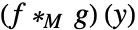 of two functions
  and
and  is given by
  .
. - The multidimensional Mellin convolution of two functions
 and
and  is given by
  .
. - The following options can be given:
-
Assumptions $Assumptions assumptions to make about parameters GenerateConditions False whether to generate conditions on parameters Method Automatic method to use
Examples
open all close allBasic Examples (2)
MellinConvolve[UnitBox[x - 3 / 2], 2UnitBox[x - 2], x, y]Plot[{UnitBox[y - 3 / 2], 2UnitBox[y - 2], %}//Evaluate, {y, 0, 6}, Filling -> Axis, Exclusions -> None, PlotRange -> All]Perform a multivariate convolution:
MellinConvolve[3UnitBox[s - 3 / 2, t - 7 / 4], 2UnitBox[s - 1, t - 1], {s, t}, {m, n}]Plot3D[{3UnitBox[m - 3 / 2, n - 7 / 4], 2UnitBox[m - 1, n - 1], %}//Evaluate, {m, 0, 3}, {n, 0, 3}, PlotRange -> All, Filling -> Axis, PlotPoints -> 50, Exclusions -> None, PlotStyle -> Opacity[0.4], Ticks -> None, Mesh -> None]Scope (8)
Basic Uses (3)
Compute a Mellin convolution for a symbolic parameter y:
MellinConvolve[E ^ (-x), 1 / (x + 1), x, y]Use an exact value for the parameter:
MellinConvolve[E ^ (-x), 1 / (x + 1), x, 1]Use an inexact value for the parameter:
MellinConvolve[E ^ (-x), 1 / (x + 1), x, 0.3]Obtain the condition of validity for a Mellin convolution:
MellinConvolve[E ^ (-a x), 1 / (x + 1), x, y, GenerateConditions -> True]Specify assumptions on a parameter:
MellinConvolve[E ^ (-x), UnitBox[x - a], x, y, Assumptions -> a > 1 / 2]Specify a different assumption:
MellinConvolve[E ^ (-x), UnitBox[x - a], x, y, Assumptions -> 0 < a < 1 / 2]Univariate Convolution (3)
MellinConvolve[Sin[x], Cos[x], x, y]Plot[{Sin[y], Cos[y], %}, {y, 0, 30}, Filling -> Axis]MellinConvolve[BesselJ[0, x], BesselJ[1, x], x, y]Plot[{BesselJ[0, y], BesselJ[1, y], %}//Evaluate, {y, 0, 10}, Filling -> Axis, PlotLegends -> "Expressions"]MellinConvolve[UnitTriangle[x - 2], UnitBox[x - 7 / 4], x, y]Plot[{UnitTriangle[y - 2], UnitBox[y - 7 / 4], %}//Evaluate, {y, 0, 10}, Filling -> Axis, PlotRange -> All, Exclusions -> None]Multivariate Convolution (2)
MellinConvolve[3Sin[s + t], 4Sin[s - t], {s, t}, {m, n}]Plot3D[{3Sin[m + n], 4Sin[m - n], %}//Evaluate, {m, 1, 7}, {n, 1, 7}, PlotRange -> All, Filling -> Axis, PlotPoints -> 50, Exclusions -> None, PlotStyle -> Opacity[0.4], Ticks -> None, Mesh -> None, PlotLegends -> "Expressions"]MellinConvolve[2UnitTriangle[x - 2], 3UnitBox[x - 1, y - 1], {x, y}, {m, n}]Plot3D[{2UnitTriangle[m - 2], 3UnitBox[m - 1, n - 1], %}//Evaluate, {m, 0, 3}, {n, 0, 3}, PlotRange -> All, Filling -> Axis, PlotPoints -> 50, Exclusions -> None, PlotStyle -> Opacity[0.3], Ticks -> None, Mesh -> None]Options (2)
Assumptions (1)
Applications (2)
Compute the PDF for the product of two random variables:
𝒟1 = UniformDistribution[];𝒟2 = TriangularDistribution[{1 / 2, 2}];f[x_] = PDF[𝒟1, x]g[x_] = PDF[𝒟2, x]MellinConvolve gives the PDF for the product of these random variables:
p1 = MellinConvolve[f[x], g[x], x, t]Plot[{f[t], g[t], %}//Evaluate, {t, 0, 3}, Filling -> Axis, PlotRange -> All, Exclusions -> None]Compare with the result from TransformedDistribution:
p2 = PDF[TransformedDistribution[x y, {x𝒟1, y𝒟2}, Assumptions -> t > 0], t]Simplify[p1 - p2, t > 0]The integral  depends on the parameter α. Find the value of α that lies between 0 and 5 and maximizes the integral. The given integral can be regarded as a Mellin convolution of two functions:
f[x_] := x(2 - x) ^ α UnitBox[(x - 1) / 2]g[x_] := Sin[x]Compute the Mellin convolution of f[x] and g[x]:
(mc = MellinConvolve[f[x], g[x], x, α])//TraditionalFormCompare with the result given by Integrate:
Integrate[(2 - x) ^ α Sin[α / x], {x, 0, 2}, Assumptions -> α > 0]//TraditionalFormPlot the integral as a function of α:
Plot[mc//Evaluate, {α, 0, 4.99}, PlotStyle -> Red]Compute the argument that maximizes the integral in 0≤α≤5 using FindArgMax:
N[FindArgMax[mc, {α, 1}, WorkingPrecision -> 100][[1]], 20]Properties & Relations (8)
MellinConvolve computes the integral  :
:
f[x_] := UnitBox[x]g[x_] := E ^ (-x)MellinConvolve[f[x], g[x], x, y]Integrate[ f[x]g[y / x] / x, {x, 0, Infinity}, Assumptions -> y ≥ 0]MellinConvolve[a r[x], s[x], x, y]MellinConvolve[r[x], a s[x], x, y]f[x_] := UnitBox[x]g[x_] := E ^ (-x)MellinConvolve[f[x], g[x], x, y]MellinConvolve[g[x], f[x], x, y]MellinConvolve[h[x], i[x] + j[x], x, y]MellinConvolve[h[x] + i[x], j[x], x, y]Convolution with DiracDelta:
MellinConvolve[f[x], DiracDelta[x - a], x, y]Derivatives of DiracDelta:
MellinConvolve[DiracDelta'[x - 1], f[x], x, y]MellinConvolve[DiracDelta''[x - 1], f[x], x, y]The Mellin transform of a convolution is the product of the individual Mellin transforms:
MellinTransform[MellinConvolve[f[t], g[t], t, x], x, y]Derivative of MellinConvolve with respect to y:
D[MellinConvolve[f[x], g[x], x, y], y]Relation between MellinConvolve, MellinTransform, and InverseMellinTransform:
f[x_] := UnitBox[x]g[x_] := E ^ (-x)MellinConvolve[f[x], g[x], x, y] == InverseMellinTransform[MellinTransform[f[x], x, s] MellinTransform[g[x], x, s] , s, y]Text
Wolfram Research (2016), MellinConvolve, Wolfram Language function, https://reference.wolfram.com/language/ref/MellinConvolve.html.
CMS
Wolfram Language. 2016. "MellinConvolve." Wolfram Language & System Documentation Center. Wolfram Research. https://reference.wolfram.com/language/ref/MellinConvolve.html.
APA
Wolfram Language. (2016). MellinConvolve. Wolfram Language & System Documentation Center. Retrieved from https://reference.wolfram.com/language/ref/MellinConvolve.html