



NewMoon
Details and Options
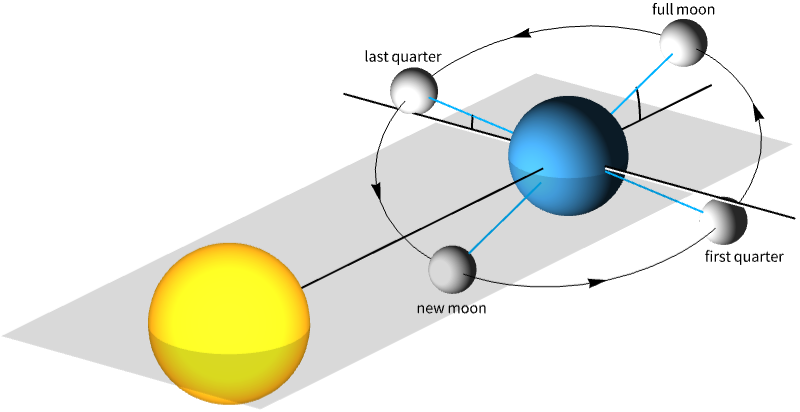
- The instant of new moon is defined by the conjunction of the Moon and the Sun in ecliptic longitude.
- In NewMoon[date], date can be any DateObject expression.
- Options of NewMoon include:
-
CalendarType Automatic calendar used to return dates DateFormat Automatic format used to display output dates DateGranularity Automatic calendar granularity of output dates Method "EclipticLongitude" method to define moon phases TimeDirection 1 whether to return the next or last new moon TimeSystem Automatic time system of output dates TimeZone $TimeZone time zone of output dates - Possible settings for the Method option include:
-
"Illumination" phase defined by fraction of illumination of the Moon "EclipticLongitude" phase defined by Moon‐Sun ecliptic longitude difference
Examples
open all close allBasic Examples (2)
Scope (3)
NewMoon[]Find the next new moon after a given date:
NewMoon[DateObject[{2024, 3, 21}]]Find new moons very far in the past:
NewMoon[DateObject[{-10000, 1, 1}]]Find new moons very far in the future:
NewMoon[DateObject[{10000, 1, 1}]]Options (7)
CalendarType (1)
NewMoon returns dates in the Gregorian calendar by default:
NewMoon[]Return dates in the Jewish calendar:
NewMoon[CalendarType -> "Jewish"]DateFormat (1)
NewMoon returns dates in a long format by default:
NewMoon[]NewMoon[DateFormat -> {"Day", "/", "Month", "/", "Year"}]DateGranularity (1)
NewMoon returns dates with granularity "Instant" by default:
NewMoon[]Return dates with "Day" granularity:
NewMoon[DateGranularity -> "Day"]Method (1)
NewMoon uses differences of ecliptic longitudes between the Sun and the Moon by default:
NewMoon[]NewMoon[Method -> "EclipticLongitude"]Use the minimum value of illumination to define the instant of new moon instead:
NewMoon[Method -> "Illumination"]TimeDirection (1)
NewMoon finds the next new moon by default:
NewMoon[]NewMoon[TimeDirection -> -1]TimeSystem (1)
NewMoon returns dates in universal time by default:
NewMoon[]Return dates in "TT" time instead:
NewMoon[TimeSystem -> "TT"]TimeZone (1)
NewMoon returns dates in your local time zone by default:
NewMoon[]Return dates in the GMT time zone:
NewMoon[TimeZone -> "GMT"]Applications (1)
Properties & Relations (9)
At the instant of new moon, the Moon and the Sun have the same ecliptic longitude:
date = NewMoon[]AstroPosition[Entity["Star", "Sun"], {"Ecliptic", date}]AstroPosition[Entity["PlanetaryMoon", "Moon"], {"Ecliptic", date}]newmoons = NestList[NewMoon[# + Quantity[1, "Days"]]&, NewMoon[], 19]The distance between new moons is called a synodic month, and varies between 29.26 and 29.80 days:
luns = Differences[newmoons]ListPlot[luns]The average synodic month is about 29.53 days:
MeanAround[luns]UnitConvert[Quantity[1, "SynodicMonths"], "Days"]NewMoon returns the date of the next new moon:
NewMoon[]Use FullMoon to find the date of the next full moon, which may be before or after that new moon:
FullMoon[]Use MoonPhaseDate to find the date of any phase of the Moon:
MoonPhaseDate["FirstQuarter"]MoonPhase computes the phase fraction of illumination, which is close to zero for a new moon:
date = DateObject[{2025, 1, 1}];newmoon = NewMoon[date]MoonPhase[newmoon]The minimum of illumination is given by this alternative method of computation:
newmoon0 = NewMoon[date, Method -> "Illumination"]MoonPhase[newmoon0]This curve represents fraction of illumination for an hour around the minimum, with newmoon in red:
Plot[MoonPhase[newmoon0 + Quantity[m, "Minutes"]], {m, -30, 30}, GridLines -> {{QuantityMagnitude[newmoon - newmoon0, "Minutes"]}}, GridLinesStyle -> Red]New moons correspond to integer lunation numbers:
NewMoon[]LunationNumber[%]Therefore, an alternative way of finding new moons is calling FromLunationNumber with integers:
FromLunationNumber[%]NewMoon[date] is equivalent to FindAstroEvent["NewMoon",date]:
NewMoon[]FindAstroEvent["NewMoon"]NewMoon defines Moon phases as observed from Earth's center:
NewMoon[]This is also the default in FindAstroEvent:
FindAstroEvent["NewMoon"]FindAstroEvent will take parallax effects into account if an observer location is specified:
FindAstroEvent["NewMoon", Now, Entity["City", {"LosAngeles", "California", "UnitedStates"}]]New moons are conjunctions of the Moon with the Sun, as observed from the center of the Earth:
NewMoon[]FindAstroEvent[{"Conjunction", "Moon", "Sun"}]Every solar eclipse happens within a few minutes of a new moon:
SolarEclipse[]{NewMoon[%, TimeDirection -> -1], NewMoon[%, TimeDirection -> 1]}Only 2 to 5 of the 12 or 13 new moons in a year are close to solar eclipses:
SolarEclipse[{NewMoon[DateObject[{2020, 1, 1}]], NewMoon[DateObject[{2021, 1, 1}]], All}]Text
Wolfram Research (2024), NewMoon, Wolfram Language function, https://reference.wolfram.com/language/ref/NewMoon.html (updated 2025).
CMS
Wolfram Language. 2024. "NewMoon." Wolfram Language & System Documentation Center. Wolfram Research. Last Modified 2025. https://reference.wolfram.com/language/ref/NewMoon.html.
APA
Wolfram Language. (2024). NewMoon. Wolfram Language & System Documentation Center. Retrieved from https://reference.wolfram.com/language/ref/NewMoon.html