

PartialFractionElements
PartialFractionElements[expr,x]
gives the data elements related to a partial fraction decomposition of the rational function expr in x.
PartialFractionElements[expr,x,prop]
gives the data elements for property prop.
Details and Options
- Partial fraction decompositions, or partial fraction expansions, have applications in the integration of rational functions and other calculus operations.
- Let
 be a rational function of
  with numerator
  and denominator
  . Then the complete partial fraction decomposition of
  has the form:
 -
![r(x)=sum_(i=1)^pgamma_i TemplateBox[{x, i}, Superscript]+sum_(i=1)^msum_(j=1)^(k_i)(a(i,j))/((x-beta_i)^j)](Files/PartialFractionElements.en/6.png "r(x)=sum_(i=1)^pgamma_i TemplateBox[{x, i}, Superscript]+sum_(i=1)^msum_(j=1)^(k_i)(a(i,j))/((x-beta_i)^j)")
- where

![sum_(i=1)^pgamma_i TemplateBox[{x, i}, Superscript]](Files/PartialFractionElements.en/8.png "sum_(i=1)^pgamma_i TemplateBox[{x, i}, Superscript]") is the polynomial part of the decomposition,
is the polynomial part of the decomposition, 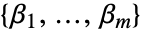 are the poles of
  (i.e. the roots of
  ) with multiplicities
  , and
, and  is the fractional part of the decomposition.
 - PartialFractionElements returns an Association with data related to the above partial fraction decomposition of
 , as determined by PartialFractions. The returned data is of the following two kinds:
 - Data related to the algebraic expression for the partial fraction decomposition:
-
"Decomposition" 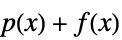
"FractionalPart" 
"PolynomialPart" 
- Data related to the coefficients appearing in the partial fraction decomposition:
-
"FractionalCoefficients" 
"PoleMultiplicities" 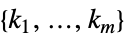
"Poles" 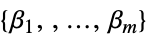
"PolynomialCoefficients" 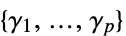
Examples
open all close allBasic Examples (2)
Compute the partial fraction elements for a rational function:
PartialFractionElements[x ^ 3 / (x ^ 2 + 3x + 2), x]Obtain the polynomial part of a decomposition:
PartialFractionElements[x ^ 3 / (x + 2), x, "PolynomialPart"]Obtain the fractional part of the decomposition:
PartialFractionElements[x ^ 3 / (x + 2), x, "FractionalPart"]Compare with the result from PartialFractions:
PartialFractions[x ^ 3 / (x + 2), x]Scope (1)
Compute all elements for a partial fraction decomposition:
PartialFractionElements[x ^ 2 / (x ^ 2 + x - 2), x]Compute just the decomposition:
pfd = PartialFractionElements[x ^ 2 / (x ^ 2 + x - 2), x, "Decomposition"]Check that it is equivalent to the rational function input:
Together[pfd - x ^ 2 / (x ^ 2 + x - 2)]Get the polynomial part of the decomposition:
PartialFractionElements[x ^ 2 / (x ^ 2 + x - 2), x, "PolynomialPart"]PartialFractionElements[x ^ 2 / (x ^ 2 + x - 2), x, "FractionalPart"]PartialFractionElements[x ^ 2 / (x ^ 2 + x - 2), x, "Poles"]PartialFractionElements[x ^ 2 / (x ^ 2 + x - 2), x, "PoleMultiplicities"]Obtain the lists of {pole,mult,coeffs} with the coefficients ordered from degree 1 to the full multiplicity for each pole:
PartialFractionElements[x ^ 2 / (x ^ 2 + x - 2), x, "FractionalCoefficients"]Similarly, obtain the coefficient list for the polynomial part:
PartialFractionElements[x ^ 2 / (x ^ 2 + x - 2), x, "PolynomialCoefficients"]Properties & Relations (1)
rat = (1 + x ^ 2 - x ^ 4 + 4 * x ^ 7) / ((x ^ 2 + 2 x + 1) * (x ^ 2 - 1) ^ 2);PartialFractionElements[rat, x, "Decomposition"]The decomposition is also the result of PartialFractions:
PartialFractions[rat, x]Apart will also give the same result when a denominator fully factors over the rationals:
Apart[rat, x]Now use a denominator that does not factor over the rationals:
rat2 = (1 + x ^ 2 - x ^ 4 + 4 * x ^ 7) / ((x ^ 2 + 2  x + 1) * (x ^ 2 + 1) ^ 2);
PartialFractionElements[rat2, x, "Decomposition"]
This time, Apart gives a different result:
Apart[rat2, x]Text
Wolfram Research (2026), PartialFractionElements, Wolfram Language function, https://reference.wolfram.com/language/ref/PartialFractionElements.html.
CMS
Wolfram Language. 2026. "PartialFractionElements." Wolfram Language & System Documentation Center. Wolfram Research. https://reference.wolfram.com/language/ref/PartialFractionElements.html.
APA
Wolfram Language. (2026). PartialFractionElements. Wolfram Language & System Documentation Center. Retrieved from https://reference.wolfram.com/language/ref/PartialFractionElements.html