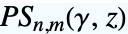


SpheroidalPS
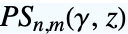
SpheroidalPS[n,m,γ,z]
gives the angular spheroidal function 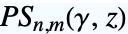 of the first kind.
Details
- Mathematical function, suitable for both symbolic and numerical manipulation.
- The angular spheroidal functions satisfy the differential equation
 with the spheroidal eigenvalue
  given by SpheroidalEigenvalue[n,m,γ].
 - SpheroidalPS[n,m,0,z] is equivalent to LegendreP[n,m,z].
- SpheroidalPS[n,m,a,γ,z] gives spheroidal functions of type
 . The types are specified as for LegendreP.
 - For certain special arguments, SpheroidalPS automatically evaluates to exact values.
- SpheroidalPS can be evaluated to arbitrary numerical precision.
- SpheroidalPS automatically threads over lists. »
Examples
open all close allBasic Examples (5)
SpheroidalPS[3, 2, 1, 0.5]Expansion about the spherical case:
Series[SpheroidalPS[n, m, γ, x], {γ, 0, 3}]Plot 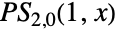 over a subset of the reals:
Plot[SpheroidalPS[2, 0, 1, x], {x, -1, 1}]Series expansion at Infinity:
Series[SpheroidalPS[3 / 2, 1 / 2, 1, x], {x, ∞, 2}, Assumptions -> x > 1]//NormalSeries expansion at a singular point:
Series[SpheroidalPS[3 / 2, 1 / 2, 1, x], {x, 1, 2}]//Normal//FullSimplifyScope (25)
Numerical Evaluation (6)
SpheroidalPS[5, 1, 0, .3]SpheroidalPS[1, 0, 4, 2.]N[SpheroidalPS[7, 5, 4, 0], 50]N[SpheroidalPS[2, 1, 1 / 3, 1 / 2], 20]The precision of the output tracks the precision of the input:
SpheroidalPS[2, 2, 1 / 6, .211111111000111111111]N[SpheroidalPS[3, 5 - I, 1 / 3, I + 1]]Evaluate efficiently at high precision:
SpheroidalPS[31, 5, 1 / 6, 2`100]//TimingSpheroidalPS[7, 5, 1, 2 / 7`1000];//TimingCompute the elementwise values of an array using automatic threading:
SpheroidalPS[1 / 2, 1 / 2, 0, {{1 / 2, 0}, {0, 1 / 2}}]Or compute the matrix SpheroidalPS function using MatrixFunction:
MatrixFunction[SpheroidalPS[1 / 2, 1 / 2, 0, #]&, {{1 / 2, 0}, {0, 1 / 2}}]Compute average-case statistical intervals using Around:
SpheroidalPS[1 / 2, 1 / 2, 0, Around[1 / 2, 0.01]]Specific Values (4)
SpheroidalPS[n, m, 0, x]//FunctionExpandFind the first positive minimum of SpheroidalPS[4,0,1/2,x]:
xmin = x /. FindRoot[D[SpheroidalPS[4, 0, 1 / 2, x], x] == 0, {x, .5}]Plot[SpheroidalPS[4, 0, 1 / 2, x], {x, -1, 1.5}, Epilog -> Style[Point[{xmin, SpheroidalPS[4, 0, 1 / 2, xmin ]}], PointSize[Large], Red]]Evaluate the SpheroidalPS function for half-integer parameters:
SpheroidalPS[3 / 2, 1 / 2, 1, x]SpheroidalPS[1 / 2, 1 / 2, 0, x]Different SpheroidalPS types give different symbolic forms:
Table[SpheroidalPS[n, m, 0, x], {m, 0, 2}, {n, 0, 2}]Visualization (3)
Plot the SpheroidalPS function for various orders:
Plot[{SpheroidalPS[1, 0, 1, x], SpheroidalPS[2, 0, 1, x], SpheroidalPS[3, 0, 1, x], SpheroidalPS[4, 0, 1, x]}, {x, -1, 1}]![TemplateBox[{3, 0, 1, z}, SpheroidalPS]](Files/SpheroidalPS.en/6.png "TemplateBox[{3, 0, 1, z}, SpheroidalPS]")
ComplexContourPlot[Re[SpheroidalPS[3, 0, 1, z]], {z, -1 - I, 1 + I}, Contours -> 24]![TemplateBox[{3, 0, 1, z}, SpheroidalPS]](Files/SpheroidalPS.en/7.png "TemplateBox[{3, 0, 1, z}, SpheroidalPS]")
ComplexContourPlot[Im[SpheroidalPS[3, 0, 1, z]], {z, -1 - I, 1 + I}, Contours -> 24]Types 2 and 3 of SpheroidalPS functions have different branch cut structures:
Plot3D[Im[SpheroidalPS[2, 1, 2, x + I y]], {x, -1.5, 1.5}, {y, -0.5, 0.5}, Exclusions -> {{y == 0, Abs[x] > 1}}]Plot3D[Im[SpheroidalPS[2, 1, 3, x + I y]], {x, -1.5, 1.5}, {y, -0.5, 0.5}, Exclusions -> {{y == 0, -1 < x < 1}}]Function Properties (8)
![TemplateBox[{1, 2, 2, x}, SpheroidalPS]](Files/SpheroidalPS.en/8.png "TemplateBox[{1, 2, 2, x}, SpheroidalPS]")
FunctionDomain[SpheroidalPS[1, 2, 2, x], x]![TemplateBox[{1, 2, 2, x}, SpheroidalPS]](Files/SpheroidalPS.en/9.png "TemplateBox[{1, 2, 2, x}, SpheroidalPS]")
FunctionDomain[SpheroidalPS[1, 2, 2, z], z, Complexes]![TemplateBox[{1, 2, gamma, 3}, SpheroidalPS]](Files/SpheroidalPS.en/10.png "TemplateBox[{1, 2, gamma, 3}, SpheroidalPS]") is an even function with respect to
is an even function with respect to  :
:
SpheroidalPS[1, 2, -γ, 3] == -SpheroidalPS[1, 2, γ, 3]![TemplateBox[{1, 2, gamma, 3}, SpheroidalPS]](Files/SpheroidalPS.en/12.png "TemplateBox[{1, 2, gamma, 3}, SpheroidalPS]")
![TemplateBox[{1, 2, 3, {z, }}, SpheroidalPS]=TemplateBox[{1, 2, 3, z}, SpheroidalPS]](Files/SpheroidalPS.en/13.png "TemplateBox[{1, 2, 3, {z, }}, SpheroidalPS]=TemplateBox[{1, 2, 3, z}, SpheroidalPS]")
SpheroidalPS[1, 2, 3, Conjugate[z]] == Conjugate[SpheroidalPS[1, 2, 3, z]]![TemplateBox[{2, 0, 1, x}, SpheroidalPS]](Files/SpheroidalPS.en/14.png "TemplateBox[{2, 0, 1, x}, SpheroidalPS]") has no singularities or discontinuities:
has no singularities or discontinuities:
FunctionSingularities[SpheroidalPS[2, 0, 1, x], x]//QuietFunctionDiscontinuities[SpheroidalPS[2, 0, 1, x], x]//Quiet![TemplateBox[{2, 0, 1, x}, SpheroidalPS]](Files/SpheroidalPS.en/15.png "TemplateBox[{2, 0, 1, x}, SpheroidalPS]") is neither non-decreasing nor non-increasing:
is neither non-decreasing nor non-increasing:
FunctionMonotonicity[SpheroidalPS[2, 0, 1, x], x]![TemplateBox[{2, 0, 1, x}, SpheroidalPS]](Files/SpheroidalPS.en/16.png "TemplateBox[{2, 0, 1, x}, SpheroidalPS]")
FunctionInjective[SpheroidalPS[2, 0, 1, x], x]Plot[{SpheroidalPS[2, 0, 1, x], 4}, {x, -5, 5}]![TemplateBox[{2, 0, 1, x}, SpheroidalPS]](Files/SpheroidalPS.en/17.png "TemplateBox[{2, 0, 1, x}, SpheroidalPS]") is neither non-negative nor non-positive:
is neither non-negative nor non-positive:
FunctionSign[SpheroidalPS[2, 0, 1, x], x]TraditionalForm formatting:
SpheroidalPS[n, m, c, η]//TraditionalFormDifferentiation (2)
The first derivative with respect to z:
D[SpheroidalPS[n, m, γ, z], z]Higher derivatives with respect to z:
Table[D[SpheroidalPS[n, m, γ, z], {z, k}], {k, 1, 3}]//FullSimplifyPlot the higher derivatives with respect to z when n=10, m=2 and γ=1/3:
Plot[Evaluate[% /. { n -> 10, m -> 2, γ -> 1 / 3}], {z, -3, 3}, PlotLegends -> {"First Derivative", "Second Derivative", "Third Derivative"}]Series Expansions (2)
Find the Taylor expansion using Series:
Series[SpheroidalPS[n, m, γ, x], {x, 0, 3}]Plots of the first three approximations around  :
:
terms = Normal@Table[Series[SpheroidalPS[2, 0, 3, x], {x, 0, m}], {m, 1, 5, 2}]//N;
Plot[{SpheroidalPS[2, 0, 3, x], terms}, {x, -1, 1}, PlotRange -> {-1.5, 1.5}]
The Taylor expansion at a generic point:
Series[SpheroidalPS[n, m, γ, x], {x, x0, 2}]// FullSimplifyGeneralizations & Extensions (1)
The different types of SpheroidalPS have different branch cut structures:
SpheroidalPS[n, m, 1, 0, x]SpheroidalPS[n, m, 2, 0, x]Applications (4)
Solve the spheroidal differential equation in terms of SpheroidalPS:
DSolve[(1 - x ^ 2)y''[x] - 2x y'[x] + (SpheroidalEigenvalue[n, m, c] + c ^ 2(1 - x ^ 2) - (m ^ 2/1 - x ^ 2))y[x] == 0, y, x]Plot prolate and oblate versions of the same angular function:
Plot[{SpheroidalPS[2, 1, 3, x], SpheroidalPS[2, 1, 3I, x]}, {x, -1, 1}]SpheroidalPS is a band-limited function with bandwidth proportional to  :
:
fourierCenter[f_List] := RotateLeft[f, Quotient[Length[f], 2]]
With[{γ = 4.`20}, ListLinePlot[Abs[Fourier[Table[SpheroidalPS[2, 0, γ, x], {x, -10, 10, 1 / 10}]]]//fourierCenter, PlotRange -> All]]For spheroidicity parameter  , the bandwidth is higher:
With[{γ = 8.`20}, ListLinePlot[Abs[Fourier[Table[SpheroidalPS[2, 0, γ, x], {x, -10, 10, 1 / 10}]]]//fourierCenter, PlotRange -> All]]Build a near-spherical approximation to 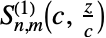 :
:
nsLimitS1[n_, m_, z_, {c_, ord_Integer}] :=
	(Normal[Series[SpheroidalPS[n1, -m1, c, x], {c, 0, ord}] /. LegendreP[k_, -m1, 2, x] :> SphericalBesselJ[k, z]](1 - c ^ 2 / z ^ 2)^m / 2 / SpheroidalRadialFactor[n, -m, c]) /. {n1 -> n, m1 -> m}
First few terms of the approximation:
nsLimitS1[n, m, z, {c, 3}]//TraditionalForm(Table[nsLimitS1[3, 1, 1`30, {c, k}], {k, 2, 10, 2}] - SpheroidalS1[3, 1, c, 1 / c]) /. {c -> 1 / 100}Properties & Relations (1)
Spheroidal angular harmonics are eigenfunctions of the Sinc transform on the interval  :
:
Integrate[Sinc[c (t - x)]SpheroidalPS[2, 0, c, x], {x, -1, 1}]//TraditionalFormPossible Issues (2)
Spheroidal functions do not evaluate for half-integer values of  or generic values of
  :
:
SpheroidalPS[3 / 2, 1, 1, 0.5]Angular spheroidal harmonics in the Wolfram Language adopt the Meixner–Schaefke normalization scheme:
With[{c = 1}, Table[NIntegrate[SpheroidalPS[n, m, c, x] ^ 2, {x, -1, 1}], {n, 0, 2}, {m, -n, n}]]//Rationalize% == Table[(2/2n + 1)((n + m)!/(n - m)!), {n, 0, 2}, {m, -n, n}]Flammer normalization is also common:
FlammerSpheroidalS[n_Integer, m_Integer, c_, eta_] := SpheroidalPS[n, m, c, eta]If[EvenQ[n - m], LegendreP[n, m, 0] / SpheroidalPS[n, m, c, 0], Derivative[0, 0, 1][LegendreP][n, m, 0] / SpheroidalPSPrime[n, m, c, 0]]Reconstruct table entries from Abramowitz and Stegun table 21.2:
With[{m = 0}, Table[NumberForm[FlammerSpheroidalS[n, m, 1., Cos[th Degree]], {4, 4}], {n, m, m + 5}, {th, {0, 30, 45, 60, 90}}]]//TableFormWith[{m = 1}, Table[NumberForm[FlammerSpheroidalS[n, m, 1., Cos[th Degree]], {4, 4}], {n, m, m + 5}, {th, {0, 30, 45, 60, 90}}]]//TableFormRelated Links

 MathWorld
Text
Wolfram Research (2007), SpheroidalPS, Wolfram Language function, https://reference.wolfram.com/language/ref/SpheroidalPS.html.
CMS
Wolfram Language. 2007. "SpheroidalPS." Wolfram Language & System Documentation Center. Wolfram Research. https://reference.wolfram.com/language/ref/SpheroidalPS.html.
APA
Wolfram Language. (2007). SpheroidalPS. Wolfram Language & System Documentation Center. Retrieved from https://reference.wolfram.com/language/ref/SpheroidalPS.html