



SpheroidalRadialFactor
SpheroidalRadialFactor[n,m,c]
gives the spheroidal radial factor with degree  and order
  .
.
Details
- Mathematical function, suitable for both symbolic and numerical manipulation.
- SpheroidalRadialFactor can be evaluated to arbitrary numerical precision.
- SpheroidalRadialFactor automatically threads over lists.
Examples
open all close allBasic Examples (2)
Scope (11)
Numerical Evaluation (4)
SpheroidalRadialFactor[5, 1, 7.]SpheroidalRadialFactor[1, 0.5, -5]N[SpheroidalRadialFactor[7, 0, 1 / 4], 50]N[SpheroidalRadialFactor[2, 1, 1 / 3], 20]The precision of the output tracks the precision of the input:
SpheroidalRadialFactor[2, 2, 1.211111111000111111111]N[SpheroidalRadialFactor[3, 5 - I, 1 / 3 + I]]Evaluate efficiently at high precision:
SpheroidalRadialFactor[31, 5, 1 / 6`100]//TimingSpheroidalRadialFactor[31, 50, 1 / 7`100];//Timing//QuietSpecific Values (2)
SpheroidalRadialFactor[0, 0, 0.]Find the first positive maximum of SpheroidalRadialFactor[3,2,x]:
xmax = x /. FindRoot[D[SpheroidalRadialFactor[3, 2, x], x] == 0, {x, 3}]Plot[SpheroidalRadialFactor[3, 2, x], {x, 0, 5}, Epilog -> Style[Point[{xmax, SpheroidalRadialFactor[3, 2, xmax ]}], PointSize[Large], Red]]//QuietVisualization (2)
Plot the SpheroidalRadialFactor function:
Plot[{SpheroidalRadialFactor[2, 2, x], SpheroidalRadialFactor[3, 2, x], SpheroidalRadialFactor[4, 2, x]}, {x, -5, 5}]Plot the real part of SpheroidalRadialFactor[2,1,x+ y]:
ContourPlot[Re[SpheroidalRadialFactor[2, 1, x + I y]], {x, -3, 3}, {y, -6, 6}, Contours -> 24]Plot the imaginary part of SpheroidalRadialFactor[2,1,x+ y]:
ContourPlot[Im[SpheroidalRadialFactor[2, 1, x + I y]], {x, -3, 3}, {y, -6, 6}, Contours -> 24]Function Properties (3)
 has no singularities or discontinuities:
FunctionSingularities[SpheroidalRadialFactor[3, 2, x], x]//QuietFunctionDiscontinuities[SpheroidalRadialFactor[3, 2, x], x]//Quiet is neither nondecreasing nor nonincreasing:
FunctionMonotonicity[SpheroidalRadialFactor[3, 2, x], x] is neither convex nor concave:
FunctionConvexity[SpheroidalRadialFactor[3, 2, x], x]Applications (1)
Build a near-spherical approximation to 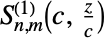 :
:
nsLimitS1[n_, m_, z_, {c_, ord_Integer}] :=
	(Normal[Series[SpheroidalPS[n1, -m1, c, x], {c, 0, ord}] /. LegendreP[k_, -m1, 2, x] :> SphericalBesselJ[k, z]](1 - c ^ 2 / z ^ 2)^m / 2 / SpheroidalRadialFactor[n, -m, c]) /. {n1 -> n, m1 -> m}
First few terms of the approximation:
nsLimitS1[n, m, z, {c, 3}]//TraditionalForm(Table[nsLimitS1[3, 1, 1`30, {c, k}], {k, 2, 10, 2}] - SpheroidalS1[3, 1, c, 1 / c]) /. {c -> 1 / 100}Text
Wolfram Research (2007), SpheroidalRadialFactor, Wolfram Language function, https://reference.wolfram.com/language/ref/SpheroidalRadialFactor.html.
CMS
Wolfram Language. 2007. "SpheroidalRadialFactor." Wolfram Language & System Documentation Center. Wolfram Research. https://reference.wolfram.com/language/ref/SpheroidalRadialFactor.html.
APA
Wolfram Language. (2007). SpheroidalRadialFactor. Wolfram Language & System Documentation Center. Retrieved from https://reference.wolfram.com/language/ref/SpheroidalRadialFactor.html