

ContrastiveLossLayer
represents a loss layer that computes a loss based on a distance metric and a target that specifies whether the distance should be minimized or maximized.
ContrastiveLossLayer[margin]
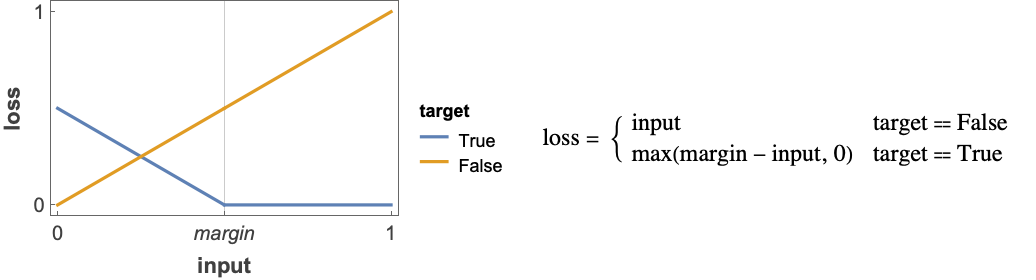
specifies a distance above which the loss is zero for True targets.
Details and Options
- ContrastiveLossLayer is typically used in conjunction with NetPairEmbeddingOperator in order to learn an embedding from an input into a vector space, such that similar inputs cluster together in the vector space and dissimilar inputs are separated.
- ContrastiveLossLayer exposes the following ports for use in NetGraph etc.:
-
"Input" a real number representing a distance "Target" True if the distance should be maximized, False if it should be minimized "Loss" a real number - ContrastiveLossLayer[margin] computes the following loss:
- ContrastiveLossLayer[…][<"Input"in,"Target"target>] explicitly computes the loss from applying the layer.
- ContrastiveLossLayer[…][<"Input"{in1,in2,…},"Target"{target1,target2,…}>] explicitly computes losses for each of the ini and targeti.
- When given a NumericArray as input, the output will be a NumericArray.
- ContrastiveLossLayer is typically used inside NetGraph to construct a training network for a learned embedding.
- A ContrastiveLossLayer[…] can be provided as the third argument to NetTrain when training a specific network.
- When appropriate, ContrastiveLossLayer is automatically used by NetTrain if an explicit loss specification is not provided.
- Options[ContrastiveLossLayer] gives the list of default options to construct the layer. Options[ContrastiveLossLayer[…]] gives the list of default options to evaluate the layer on some data.
- Information[ContrastiveLossLayer[…]] gives a report about the layer.
- Information[ContrastiveLossLayer[…],prop] gives the value of the property prop of ContrastiveLossLayer[…]. Possible properties are the same as for NetGraph.
Examples
open all close allBasic Examples (2)
Create a ContrastiveLossLayer with a given margin:
ContrastiveLossLayer[1.5]Create a ContrastiveLossLayer:
loss = ContrastiveLossLayer[]loss[<|"Input" -> 0.1, "Target" -> True|>]If the target is True, the loss is nonzero only when the input distance is less than the default margin of 0.5:
loss[<|"Input" -> 0.1, "Target" -> True|>]
loss[<|"Input" -> 0.6, "Target" -> True|>]
If the target is False, the loss is proportional to the input distance:
loss[<|"Input" -> 0.1, "Target" -> False|>]Applications (1)
Train a multilayer perceptron to embed a synthetic dataset based only on its topology. First, create the training data on a spiral-like manifold that is dense in the plane:
points = Table[r -> AngleVector[{r + RandomReal[5.5], r + RandomReal[0.1]}] / 15, {r, 0, 6Pi, .002}];Graphics[Point[Values@points], Frame -> True]mlp = NetChain[{200, Ramp, 100, Ramp, 20, Tanh, 1}, "Input" -> 2];Create a loss network to measure the performance of the embedding:
lossNet = NetPairEmbeddingOperator[mlp]Create a generator that will sample pairs of points and associate them with True if their parameterization on the manifold differs by more than Pi:
sampler[n_] := Block[{a, b},
	a = RandomSample[points, n];
	b = RandomSample[points, n];
Thread[Transpose[Values /@ {a, b}] -> Thread[Abs[Keys[a] - Keys[b]] > Pi]]];sampler[4]Train the network, using a generator to sample pairs of points, and classify them as the same if their original parameterization was close:
trained = NetTrain[lossNet, sampler[#BatchSize]&, LossFunction -> ContrastiveLossLayer[], BatchSize -> 512, TimeGoal -> 120]Extract the embedding from the net:
trainedMlp = NetExtract[trained, "Net"];Plot the 1D embedding learned by the net as a color map:
ArrayPlot[Flatten /@ trainedMlp /@ CoordinateBoundsArray[1.3 * {{-1, 1}, {-1, 1}}, .05], ColorFunction -> Hue
]Text
Wolfram Research (2017), ContrastiveLossLayer, Wolfram Language function, https://reference.wolfram.com/language/ref/ContrastiveLossLayer.html.
CMS
Wolfram Language. 2017. "ContrastiveLossLayer." Wolfram Language & System Documentation Center. Wolfram Research. https://reference.wolfram.com/language/ref/ContrastiveLossLayer.html.
APA
Wolfram Language. (2017). ContrastiveLossLayer. Wolfram Language & System Documentation Center. Retrieved from https://reference.wolfram.com/language/ref/ContrastiveLossLayer.html