

ElectrostaticPDEComponent
ElectrostaticPDEComponent[vars,pars]
yields an electrostatic PDE term with variables vars and parameters pars.
Details
- ElectrostaticPDEComponent is typically used to generate an electrostatic equation with model variables vars and model parameters pars.
- ElectrostaticPDEComponent returns a sum of differential operators to be used as a part of partial differential equations:
- ElectrostaticPDEComponent models static electric fields produced by stationary charges in insulating, or dielectric materials.
- ElectrostaticPDEComponent models electrostatic phenomena with the dependent variable
 , the electric scalar potential.
  is in units of volt [
![TemplateBox[{InterpretationBox[, 1], "V", volts, "Volts"}, QuantityTF]](Files/ElectrostaticPDEComponent.en/5.png "TemplateBox[{InterpretationBox[, 1], \"V\", volts, \"Volts\"}, QuantityTF]") ], independent variables
], independent variables  in units of [
![TemplateBox[{InterpretationBox[, 1], "m", meters, "Meters"}, QuantityTF]](Files/ElectrostaticPDEComponent.en/7.png "TemplateBox[{InterpretationBox[, 1], \"m\", meters, \"Meters\"}, QuantityTF]") ].
]. - Stationary variables vars are vars={V[x1,…,xn],{x1,…,xn}}.
- ElectrostaticPDEComponent generally does not produces a time-dependent PDE.
- ElectrostaticPDEComponent is based on a diffusion, a source and a derivative PDE term:
 is the vacuum permittivity in units of [
![TemplateBox[{InterpretationBox[, 1], {"F", , "/", , "m"}, farads per meter, {{(, "Farads", )}, /, {(, "Meters", )}}}, QuantityTF]](Files/ElectrostaticPDEComponent.en/10.png "TemplateBox[{InterpretationBox[, 1], {\"F\", , \"/\", , \"m\"}, farads per meter, {{(, \"Farads\", )}, /, {(, \"Meters\", )}}}, QuantityTF]") ],
],  the polarization vector in units of [
![TemplateBox[{InterpretationBox[, 1], {"C", , "/", , {"m", ^, 2}}, coulombs per meter squared, {{(, "Coulombs", )}, /, {(, {"Meters", ^, 2}, )}}}, QuantityTF]](Files/ElectrostaticPDEComponent.en/12.png "TemplateBox[{InterpretationBox[, 1], {\"C\", , \"/\", , {\"m\", ^, 2}}, coulombs per meter squared, {{(, \"Coulombs\", )}, /, {(, {\"Meters\", ^, 2}, )}}}, QuantityTF]") ] and
] and  the volume charge density in units of [
![TemplateBox[{InterpretationBox[, 1], {"C", , "/", , {"m", ^, 3}}, coulombs per meter cubed, {{(, "Coulombs", )}, /, {(, {"Meters", ^, 3}, )}}}, QuantityTF]](Files/ElectrostaticPDEComponent.en/14.png "TemplateBox[{InterpretationBox[, 1], {\"C\", , \"/\", , {\"m\", ^, 3}}, coulombs per meter cubed, {{(, \"Coulombs\", )}, /, {(, {\"Meters\", ^, 3}, )}}}, QuantityTF]") ].
]. - The polarization vector
 specifies the density of permanent or induced electric dipole moments inside a material.
 - The volume charge density
 models charge distributions, negative or positive.
 - ElectrostaticPDEComponent can produce different equations, depending on the constitutive relationship.
- For linear materials, the ElectrostaticPDEComponent equation simplifies to:
 is the unitless relative permittivity.
 can be isotropic, orthotropic or anisotropic.
- For nonlinear non-hysteresis ferroelectric materials, the ElectrostaticPDEComponent equation is given as:
 is the remanent polarization vector in units of [
![TemplateBox[{InterpretationBox[, 1], {"C", , "/", , {"m", ^, 2}}, coulombs per meter squared, {{(, "Coulombs", )}, /, {(, {"Meters", ^, 2}, )}}}, QuantityTF]](Files/ElectrostaticPDEComponent.en/22.png "TemplateBox[{InterpretationBox[, 1], {\"C\", , \"/\", , {\"m\", ^, 2}}, coulombs per meter squared, {{(, \"Coulombs\", )}, /, {(, {\"Meters\", ^, 2}, )}}}, QuantityTF]") ].
].- The implicit default boundary condition for the electrostatic model is a 0 ElectricFluxDensityValue.
- The units of the electrostatic model terms are in [
![TemplateBox[{InterpretationBox[, 1], {"C", , "/", , {"m", ^, 3}}, coulombs per meter cubed, {{(, "Coulombs", )}, /, {(, {"Meters", ^, 3}, )}}}, QuantityTF]](Files/ElectrostaticPDEComponent.en/23.png "TemplateBox[{InterpretationBox[, 1], {\"C\", , \"/\", , {\"m\", ^, 3}}, coulombs per meter cubed, {{(, \"Coulombs\", )}, /, {(, {\"Meters\", ^, 3}, )}}}, QuantityTF]") ], or equivalently in [
], or equivalently in [![TemplateBox[{InterpretationBox[, 1], {"s", , "A", , "/", , {"m", ^, 3}}, second amperes per meter cubed, {{(, {"Amperes", , "Seconds"}, )}, /, {(, {"Meters", ^, 3}, )}}}, QuantityTF]](Files/ElectrostaticPDEComponent.en/24.png "TemplateBox[{InterpretationBox[, 1], {\"s\", , \"A\", , \"/\", , {\"m\", ^, 3}}, second amperes per meter cubed, {{(, {\"Amperes\", , \"Seconds\"}, )}, /, {(, {\"Meters\", ^, 3}, )}}}, QuantityTF]") ].
]. - The following parameters pars can be given:
-
parameter default symbol "Polarization" {0,…}  , polarization vector in [
![TemplateBox[{InterpretationBox[, 1], {"C", , "/", , {"m", ^, 2}}, coulombs per meter squared, {{(, "Coulombs", )}, /, {(, {"Meters", ^, 2}, )}}}, QuantityTF]](Files/ElectrostaticPDEComponent.en/26.png "TemplateBox[{InterpretationBox[, 1], {\"C\", , \"/\", , {\"m\", ^, 2}}, coulombs per meter squared, {{(, \"Coulombs\", )}, /, {(, {\"Meters\", ^, 2}, )}}}, QuantityTF]") ]
]"RegionSymmetry" None 
"RelativePermittivity" 1  , unitless relative permittivity
"RemanentPolarization" {0,…}  , remanent polarization vector in [
![TemplateBox[{InterpretationBox[, 1], {"C", , "/", , {"m", ^, 2}}, coulombs per meter squared, {{(, "Coulombs", )}, /, {(, {"Meters", ^, 2}, )}}}, QuantityTF]](Files/ElectrostaticPDEComponent.en/30.png "TemplateBox[{InterpretationBox[, 1], {\"C\", , \"/\", , {\"m\", ^, 2}}, coulombs per meter squared, {{(, \"Coulombs\", )}, /, {(, {\"Meters\", ^, 2}, )}}}, QuantityTF]") ]
]"Thickness" 1  , thickness in [
![TemplateBox[{InterpretationBox[, 1], "m", meters, "Meters"}, QuantityTF]](Files/ElectrostaticPDEComponent.en/32.png "TemplateBox[{InterpretationBox[, 1], \"m\", meters, \"Meters\"}, QuantityTF]") ]
] "CrossSectionalArea" 1  , cross-sectional area in [
![TemplateBox[{InterpretationBox[, 1], {{"m", ^, 2}}, meters squared, {"Meters", ^, 2}}, QuantityTF]](Files/ElectrostaticPDEComponent.en/34.png "TemplateBox[{InterpretationBox[, 1], {{\"m\", ^, 2}}, meters squared, {\"Meters\", ^, 2}}, QuantityTF]") ]
] "VacuumPermittivity" 
 , vacuum permittivity in [
![TemplateBox[{InterpretationBox[, 1], {"F", , "/", , "m"}, farads per meter, {{(, "Farads", )}, /, {(, "Meters", )}}}, QuantityTF]](Files/ElectrostaticPDEComponent.en/37.png "TemplateBox[{InterpretationBox[, 1], {\"F\", , \"/\", , \"m\"}, farads per meter, {{(, \"Farads\", )}, /, {(, \"Meters\", )}}}, QuantityTF]") ]
] "VolumeChargeDensity" 0  , volume charge density in [
![TemplateBox[{InterpretationBox[, 1], {"C", , "/", , {"m", ^, 3}}, coulombs per meter cubed, {{(, "Coulombs", )}, /, {(, {"Meters", ^, 3}, )}}}, QuantityTF]](Files/ElectrostaticPDEComponent.en/39.png "TemplateBox[{InterpretationBox[, 1], {\"C\", , \"/\", , {\"m\", ^, 3}}, coulombs per meter cubed, {{(, \"Coulombs\", )}, /, {(, {\"Meters\", ^, 3}, )}}}, QuantityTF]") ]
] - All parameters may depend on the spacial variable
 and dependent variable
  .
. - The number of independent variables
 determines the dimensions of
  or
or  and the length of vectors
  and
and  .
. - A possible choice for the parameter "RegionSymmetry" is "Axisymmetric".
- "Axisymmetric" region symmetry represents a truncated cylindrical coordinate system where the cylindrical coordinates are reduced by removing the angle variable as follows:
-
dimension reduction equation 1D 

2D 

- In 2D, when a "Thickness"
 is specified, the ElectrostaticPDEComponent equation is given as:
 - In 1D, when a "CrossSectionalArea"
 is specified, the ElectrostaticPDEComponent equation is given as:
 - In a 1D axisymmetric, when a "Thickness"
 is specified, the ElectrostaticPDEComponent equation is given as:
 - The input specification for the parameters is exactly the same as for their corresponding operator terms.
- If no parameters are specified, the default electrostatic PDE is:
- If the ElectrostaticPDEComponent depends on parameters
 that are specified in the association pars as …,keypi…,pivi,…, the parameters
  are replaced with
  .
.

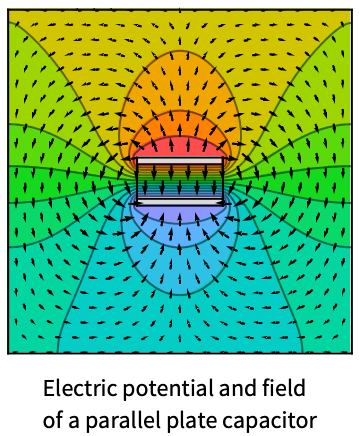







Examples
open all close allBasic Examples (3)
Define an electrostatic model  :
:
ElectrostaticPDEComponent[{V[x], {x}}, <||>]Set up an electrostatic model with particular material parameters:
ElectrostaticPDEComponent[{V[x, y], {x, y}}, <|"RelativePermittivity" -> Subscript[ϵ, 𝓇], "VolumeChargeDensity" -> Subscript[ρ, v]|>]Specify model variables and electrostatic parameters:
vars = {V[x], {x}};
pars = <|"RelativePermittivity" -> 1, "VolumeChargeDensity" -> -10*^-8|>;
Set up and solve an electrostatic PDE:
Vfun = NDSolveValue[{ElectrostaticPDEComponent[vars, pars] == 0, {ElectricPotentialCondition[x == 0, vars, pars, <|"ElectricPotential" -> 1|>], ElectricPotentialCondition[x == 0.08, vars, pars]}}, V, {x, 0, 0.08}]Plot[Vfun[x], {x, 0, 0.08}]Scope (14)
1D (4)
Define a 1D electrostatic model with a cross-sectional area  :
:
ElectrostaticPDEComponent[{V[x], {x}}, <|"VacuumPermittivity" -> Subscript[ϵ, 0], "RelativePermittivity" -> Subscript[ϵ, 𝓇] * IdentityMatrix[1], "CrossSectionalArea" -> A, "VolumeChargeDensity" -> Subscript[ρ, s]|>]Model an electric potential field with two electric potential conditions at the sides.
Specify model variables and electrostatic parameters:
vars = {V[x], {x}};
pars = <|"RelativePermittivity" -> 2|>;
Set up and solve an electrostatic PDE:
Vfun = NDSolveValue[{ElectrostaticPDEComponent[vars, pars] == 0, {ElectricPotentialCondition[x == 0, vars, pars, <|"ElectricPotential" -> 10|>], ElectricPotentialCondition[x == 1 / 5, vars, pars, <|"ElectricPotential" -> 0|>]}}, V, x∈Line[{{0}, {1 / 5}}]];Plot[Vfun[x], {x, 0, 1 / 5}, AxesLabel -> {"x", "V"}]Model an electric potential field with two electric potential conditions at the sides and a discontinuous relative permittivity.
Specify model variables and electrostatic parameters:
vars = {V[x], {x}};
pars = <|"RelativePermittivity" -> Piecewise[{{2, x <= 1 / 10}}, 1]|>;
Set up and solve an electrostatic PDE:
Vfun = NDSolveValue[{ElectrostaticPDEComponent[vars, pars] == 0, {ElectricPotentialCondition[x == 0, vars, pars, <|"ElectricPotential" -> 10|>], ElectricPotentialCondition[x == 1 / 5, vars, pars, <|"ElectricPotential" -> 0|>]}}, V, x∈Line[{{0}, {1 / 5}}]];Plot[Vfun[x], {x, 0, 1 / 5}, AxesLabel -> {"x", "V"}]2D (5)
Define a 2D electrostatic model with a polarization vector:
ElectrostaticPDEComponent[{V[x, y], {x, y}}, <|"VacuumPermittivity" -> Subscript[ϵ, 0] * IdentityMatrix[2], "Polarization" -> {Px[x, y], Py[x, y]}|>]Define a 2D nonlinear electrostatic model with a remanent polarization vector:
ElectrostaticPDEComponent[{V[x, y], {x, y}}, <|"VacuumPermittivity" -> Subscript[ϵ, 0], "RelativePermittivity" -> Subscript[ϵ, 𝓇] * IdentityMatrix[2], "RemanentPolarization" -> {Prx[x, y], Pry[x, y]}|>]Define a 2D electrostatic model with a thickness  :
:
ElectrostaticPDEComponent[{V[x, y], {x, y}}, <|"VacuumPermittivity" -> Subscript[ϵ, 0], "RelativePermittivity" -> Subscript[ϵ, 𝓇] * IdentityMatrix[2], "Thickness" -> d|>]Define an orthotropic relative permittivity:
ElectrostaticPDEComponent[{V[x, y], {x, y}}, <|"VacuumPermittivity" -> Subscript[ϵ, 0], "RelativePermittivity" -> {{Subscript[ϵ, r11], 0}, {0, Subscript[ϵ, r12]}}|>]Define a fully anisotropic relative permittivity:
ElectrostaticPDEComponent[{V[x, y], {x, y}}, <|"VacuumPermittivity" -> Subscript[ϵ, 0], "RelativePermittivity" -> {{Subscript[ϵ, r11], Subscript[ϵ, r12]}, {Subscript[ϵ, r21], Subscript[ϵ, r12]}}|>]2D Axisymmetric (2)
Define a 2D axisymmetric electrostatic model:
ElectrostaticPDEComponent[{V[r, z], {r, z}}, <|"VacuumPermittivity" -> Subscript[ϵ, 0], "RelativePermittivity" -> Subscript[ϵ, 𝓇] * IdentityMatrix[2], "RegionSymmetry" -> "Axisymmetric"|>]Define a 2D axisymmetric orthotropic electrostatic model:
ElectrostaticPDEComponent[{V[r, z], {r, z}}, <|"VacuumPermittivity" -> Subscript[ϵ, 0], "RelativePermittivity" -> {{Subscript[ϵ, 𝓇𝓇], 0}, {0, Subscript[ϵ, zz]}}, "RegionSymmetry" -> "Axisymmetric"|>]3D (1)
Model an electric potential field in a hollow ball with electric potential conditions at the inner and outer radii.
Specify model variables and electrostatic parameters:
vars = {V[x, y, z], {x, y, z}};
pars = <|"RelativePermittivity" -> 3.9|>;
Set up and solve an electrostatic PDE:
Vfun = NDSolveValue[{ElectrostaticPDEComponent[vars, pars] == 0, {ElectricPotentialCondition[x ^ 2 + y ^ 2 + z ^ 2 <= (3 / 1000) ^ 2, vars, pars, <|"ElectricPotential" -> 32|>], ElectricPotentialCondition[x ^ 2 + y ^ 2 + z ^ 2 >= (9 / 1000) ^ 2, vars, pars, <|"ElectricPotential" -> 0|> ]}}, V, {x, y, z} ∈ RegionDifference[Ball[{0, 0, 0}, 10 / 1000], Ball[{0, 0, 0}, 3 / 1000]]];SliceContourPlot3D[Vfun[x, y, z], "CenterPlanes", {x, -10 / 1000, 10 / 1000}, {y, -10 / 1000, 10 / 1000}, {z, -10 / 1000, 10 / 1000}, ColorFunction -> "Rainbow"]Multi-material (2)
Set up an electrostatic model for several material regions:
ElectrostaticPDEComponent[{V[x, y], {x, y}}, <|"RelativePermittivity" -> Piecewise[{{7, y <= 1}, {2, y > 1}}]|>]Model an electric potential field with two electric potential conditions at the sides and a discontinuous relative permittivity.
Specify model variables and electrostatic parameters:
vars = {V[x], {x}};
pars = <|"RelativePermittivity" -> Piecewise[{{2, x <= 1 / 10}}, 1]|>;
Set up and solve an electrostatic PDE:
Vfun = NDSolveValue[{ElectrostaticPDEComponent[vars, pars] == 0, {ElectricPotentialCondition[x == 0, vars, pars, <|"ElectricPotential" -> 10|>], ElectricPotentialCondition[x == 1 / 5, vars, pars, <|"ElectricPotential" -> 0|>]}}, V, x∈Line[{{0}, {1 / 5}}]];Plot[Vfun[x], {x, 0, 1 / 5}, AxesLabel -> {"x", "V"}]Applications (4)
1D (2)
Compute the electric potential distribution between two parallel plates separated by a distance  [
[![TemplateBox[{InterpretationBox[, 1], "cm", centimeters, "Centimeters"}, QuantityTF]](Files/ElectrostaticPDEComponent.en/65.png "TemplateBox[{InterpretationBox[, 1], \"cm\", centimeters, \"Centimeters\"}, QuantityTF]") ] and positioned normal to the
] and positioned normal to the  axis. The left plate is maintained at a constant potential
  [
[![TemplateBox[{InterpretationBox[, 1], "V", volts, "Volts"}, QuantityTF]](Files/ElectrostaticPDEComponent.en/68.png "TemplateBox[{InterpretationBox[, 1], \"V\", volts, \"Volts\"}, QuantityTF]") ], whereas the right plate is grounded,
], whereas the right plate is grounded,  [
[![TemplateBox[{InterpretationBox[, 1], "V", volts, "Volts"}, QuantityTF]](Files/ElectrostaticPDEComponent.en/70.png "TemplateBox[{InterpretationBox[, 1], \"V\", volts, \"Volts\"}, QuantityTF]") ]. The region between the plates is characterized by a relative permittivity
]. The region between the plates is characterized by a relative permittivity  and a uniform electron charge density
  [
[![TemplateBox[{InterpretationBox[, 1], {"C", , "/", , {"m", ^, 3}}, coulombs per meter cubed, {{(, "Coulombs", )}, /, {(, {"Meters", ^, 3}, )}}}, QuantityTF]](Files/ElectrostaticPDEComponent.en/73.png "TemplateBox[{InterpretationBox[, 1], {\"C\", , \"/\", , {\"m\", ^, 3}}, coulombs per meter cubed, {{(, \"Coulombs\", )}, /, {(, {\"Meters\", ^, 3}, )}}}, QuantityTF]") ]. The equation to model is given by:
]. The equation to model is given by:

Set up the electrostatic model variables  :
:
vars = {V[x], {x}};
Ω = Line[{{0}, {0.08}}];Specify electrostatic model parameters:
pars = <|"RelativePermittivity" -> 1, "VolumeChargeDensity" -> -10*^-8|>;Specify the electric potential conditions:
Subscript[Γ, v] = {ElectricPotentialCondition[x == 0, vars, pars, <|"ElectricPotential" -> 1|>], ElectricPotentialCondition[x == 0.08, vars, pars]};eqn = ElectrostaticPDEComponent[vars, pars] == 0Vfun = NDSolveValue[{eqn, Subscript[Γ, v]}, V, x∈Ω]Plot[Vfun[x], x∈Ω]Compute the electrical potential distribution between two parallel plates with the same distance and boundary conditions as in the previous example, but now with a nonuniform charge distribution given by: 
Set up the electrostatic model variables  :
:
vars = {V[x], {x}};
Ω = Line[{{0}, {0.08}}];Specify electrostatic model parameters:
pars = <|"RelativePermittivity" -> 1, "VolumeChargeDensity" -> -10*^-8 * (1 - (x/0.08))^2|>;Specify the electric potential conditions:
Subscript[Γ, v] = {ElectricPotentialCondition[x == 0, vars, pars, <|"ElectricPotential" -> 1|>], ElectricPotentialCondition[x == 0.08, vars, pars]};eqn = ElectrostaticPDEComponent[vars, pars] == 0Vfun = NDSolveValue[{eqn, Subscript[Γ, v]}, V, x∈Ω]Plot[Vfun[x], x∈Ω]2D (1)
Model an infinitely long rectangular box with metallic walls. The box has a width of  [
[![TemplateBox[{InterpretationBox[, 1], "m", meters, "Meters"}, QuantityTF]](Files/ElectrostaticPDEComponent.en/81.png "TemplateBox[{InterpretationBox[, 1], \"m\", meters, \"Meters\"}, QuantityTF]") ], and a height of
], and a height of  [
[![TemplateBox[{InterpretationBox[, 1], "m", meters, "Meters"}, QuantityTF]](Files/ElectrostaticPDEComponent.en/83.png "TemplateBox[{InterpretationBox[, 1], \"m\", meters, \"Meters\"}, QuantityTF]") ]. The side and bottom walls are maintained at zero electric potential, whereas the top wall has a fixed electric potential of
]. The side and bottom walls are maintained at zero electric potential, whereas the top wall has a fixed electric potential of  . The region inside the box is free of charge
  . The equation to model is given by:

Define the model variables and parameters:
vars = {V[x, y], {x, y}};
pars = <|"RelativePermittivity" -> 1|>;w = 1;
h = 2;
Ω = Rectangle[{0, 0}, {w, h}];Set up a 2D electrostatic model:
op = ElectrostaticPDEComponent[vars, pars];The bottom and parts of the side walls at  are maintained at a zero electric potential:
Subscript[Γ, ground] = ElectricPotentialCondition[y <= 1, vars, pars];The top wall at  is fixed with an electric potential of
  [
[![TemplateBox[{InterpretationBox[, 1], "V", volts, "Volts"}, QuantityTF]](Files/ElectrostaticPDEComponent.en/90.png "TemplateBox[{InterpretationBox[, 1], \"V\", volts, \"Volts\"}, QuantityTF]") ]:
]:
V0 = 1;
Subscript[Γ, potential] = ElectricPotentialCondition[y == h, vars, pars, <|"ElectricPotential" -> V0|>];eqn = {op == 0, Subscript[Γ, ground], Subscript[Γ, potential]};Vfun = NDSolveValue[eqn, V, {x, y}∈Ω];Legended[ContourPlot[Vfun[x, y], {x, y}∈Ω, ...], BarLegend[...]]3D (1)
Model a dielectric material of a cylindrical capacitor with two electric potential conditions at the upper and lower boundaries, which represent the capacitor electrodes. The equation to model is given by:

Set up the electrostatic model variables  :
:
vars = {V[x, y, z], {x, y, z}};
r0 = 0.01;
h = 0.001;
Ω = Cylinder[{{0, 0, 0}, {0, 0, h}}, r0];
Specify a relative permittivity  :
:
pars = <|"RelativePermittivity" -> 2|>;Specify ground potential at the lower boundary:
Subscript[Γ, ground] = ElectricPotentialCondition[z == 0, vars, pars];Specify an electric potential of  [
[![TemplateBox[{InterpretationBox[, 1], "V", volts, "Volts"}, QuantityTF]](Files/ElectrostaticPDEComponent.en/96.png "TemplateBox[{InterpretationBox[, 1], \"V\", volts, \"Volts\"}, QuantityTF]") ] at the upper boundary:
] at the upper boundary:
Subscript[Γ, potential] = ElectricPotentialCondition[z == h, vars, pars, <|"ElectricPotential" -> 1|>];eqn = ElectrostaticPDEComponent[vars, pars] == 0Vfun = NDSolveValue[{eqn, Subscript[Γ, ground], Subscript[Γ, potential]}, V, {x, y, z}∈Ω]SliceDensityPlot3D[Vfun[x, y, z], "CenterPlanes", {x, y, z}∈Ω, ...]Possible Issues (1)
For symbolic computation, the "VacuumPermittivity" or "RelativePermittivity" parameter should be given as a matrix:
ElectrostaticPDEComponent[{V[x, y], {x, y}}, <|"VacuumPermittivity" -> Subscript[ϵ, 0], "RelativePermittivity" -> {{Subscript[ϵ, r11], 0}, {0, Subscript[ϵ, r12]}}|>]//ActivateFor numeric values, the "VacuumPermittivity" or "RelativePermittivity" parameter is automatically converted to a matrix of proper dimensions:
ElectrostaticPDEComponent[{V[x, y], {x, y}}, <|"RelativePermittivity" -> 1|>]This automatic conversion is not possible for symbolic input:
ElectrostaticPDEComponent[{V[x], {x}}, <|"VacuumPermittivity" -> Subscript[ϵ, 0]|>]Not providing the properly dimensioned matrix will result in an error:
%//Activate
Text
Wolfram Research (2024), ElectrostaticPDEComponent, Wolfram Language function, https://reference.wolfram.com/language/ref/ElectrostaticPDEComponent.html (updated 2024).
CMS
Wolfram Language. 2024. "ElectrostaticPDEComponent." Wolfram Language & System Documentation Center. Wolfram Research. Last Modified 2024. https://reference.wolfram.com/language/ref/ElectrostaticPDEComponent.html.
APA
Wolfram Language. (2024). ElectrostaticPDEComponent. Wolfram Language & System Documentation Center. Retrieved from https://reference.wolfram.com/language/ref/ElectrostaticPDEComponent.html