

ElectricSymmetryValue
ElectricSymmetryValue[pred,vars,pars]
represents an electric symmetry boundary condition for PDEs with predicate pred indicating where it applies, with model variables vars and global parameters pars.
ElectricSymmetryValue[pred,vars,pars,lkey]
represents an electric symmetry boundary condition with local parameters specified in pars[lkey].
Details
- ElectricSymmetryValue specifies a symmetry boundary condition for ElectrostaticPDEComponent and ElectricCurrentPDEComponent.
- ElectricSymmetryValue specifies a boundary condition for ElectrostaticPDEComponent and ElectricCurrentPDEComponent, and is used as part of the modeling equation:
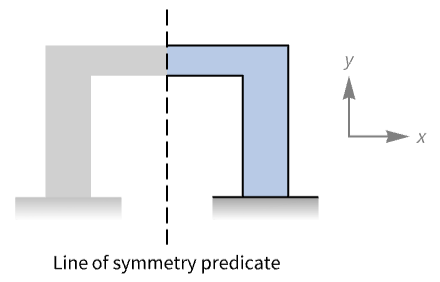
- ElectricSymmetryValue is typically used to model a boundary with mirror symmetry along an axis.
- ElectricSymmetryValue models a boundary with mirror symmetry with dependent variable
 , independent variables
  and time variable
  .
. - Stationary variables vars are vars={V[x1,…,xn],{x1,…,xn}}.
- Frequency-dependent variables vars are vars={V[x1,…,xn],ω,{x1,…,xn}}.
- The polarized form of ElectrostaticPDEComponent with vacuum permittivity
 in units of [
![TemplateBox[{InterpretationBox[, 1], {"F", , "/", , "m"}, farads per meter, {{(, "Farads", )}, /, {(, "Meters", )}}}, QuantityTF]](Files/ElectricSymmetryValue.en/8.png "TemplateBox[{InterpretationBox[, 1], {\"F\", , \"/\", , \"m\"}, farads per meter, {{(, \"Farads\", )}, /, {(, \"Meters\", )}}}, QuantityTF]") ], polarization vector
], polarization vector  in units of [
![TemplateBox[{InterpretationBox[, 1], {"C", , "/", , {"m", ^, 2}}, coulombs per meter squared, {{(, "Coulombs", )}, /, {(, {"Meters", ^, 2}, )}}}, QuantityTF]](Files/ElectricSymmetryValue.en/10.png "TemplateBox[{InterpretationBox[, 1], {\"C\", , \"/\", , {\"m\", ^, 2}}, coulombs per meter squared, {{(, \"Coulombs\", )}, /, {(, {\"Meters\", ^, 2}, )}}}, QuantityTF]") ] and volume charge density
] and volume charge density  in units of [
![TemplateBox[{InterpretationBox[, 1], {"C", , "/", , {"m", ^, 3}}, coulombs per meter cubed, {{(, "Coulombs", )}, /, {(, {"Meters", ^, 3}, )}}}, QuantityTF]](Files/ElectricSymmetryValue.en/12.png "TemplateBox[{InterpretationBox[, 1], {\"C\", , \"/\", , {\"m\", ^, 3}}, coulombs per meter cubed, {{(, \"Coulombs\", )}, /, {(, {\"Meters\", ^, 3}, )}}}, QuantityTF]") ] is given by:
] is given by: - ElectricSymmetryValue with boundary unit normal
 models:
 - Model parameters pars as specified for ElectrostaticPDEComponent.
- The general stationary electric current model ElectricCurrentPDEComponent with electrical conductivity
 in units of [
 , an externally generated current density vector
  in units of [
![TemplateBox[{InterpretationBox[, 1], {"A", , "/", , {"m", ^, 2}}, amperes per meter squared, {{(, "Amperes", )}, /, {(, {"Meters", ^, 2}, )}}}, QuantityTF]](Files/ElectricSymmetryValue.en/19.png "TemplateBox[{InterpretationBox[, 1], {\"A\", , \"/\", , {\"m\", ^, 2}}, amperes per meter squared, {{(, \"Amperes\", )}, /, {(, {\"Meters\", ^, 2}, )}}}, QuantityTF]") ] and current source
] and current source  in units of [
![TemplateBox[{InterpretationBox[, 1], {"A", , "/", , {"m", ^, 3}}, amperes per meter cubed, {{(, "Amperes", )}, /, {(, {"Meters", ^, 3}, )}}}, QuantityTF]](Files/ElectricSymmetryValue.en/21.png "TemplateBox[{InterpretationBox[, 1], {\"A\", , \"/\", , {\"m\", ^, 3}}, amperes per meter cubed, {{(, \"Amperes\", )}, /, {(, {\"Meters\", ^, 3}, )}}}, QuantityTF]") ] is given by:
] is given by: - ElectricSymmetryValue with boundary unit normal
 models:
 - Model parameters pars are specified as for ElectrostaticPDEComponent or ElectricCurrentPDEComponent.
- ElectricSymmetryValue is effectively the same as ElectricFluxDensityValue with an electric flux of 0.
- ElectricSymmetryValue is effectively the same as ElectricCurrentDensityValue with a normal current density of 0.
- The boundary predicate pred can be specified as in NeumannValue.
- If the ElectricSymmetryValue depends on parameters
 that are specified in the association pars as …,keypi…,pivi,…, the parameters
  are replaced with
  .
.






Examples
open all close allBasic Examples (1)
Scope (2)
Set up an electric symmetry boundary condition in 3D:
ElectricSymmetryValue[x ≥ 0, {V[x, y, z], {x, y, z}}, <||>]Define model variables vars for a electric field with model parameters pars and a specific parameter boundary condition:
vars = {V[x, y], {x, y}};
pars = <|"BoundaryCondition1" -> <||>|>;
Evaluate the boundary condition:
ElectricSymmetryValue[x == 1 / 5, vars, pars, "BoundaryCondition1"]Applications (1)
Model the right half of a dielectric region of a capacitor. Set up the electrostatic model variables  :
:
vars = {V[x, y], {x, y}};Set up the right half-region  :
:
Ω = Rectangle[{0, -0.1}, {0.25, 0.1}];Specify electrostatic model parameter relative permittivity  :
:
pars = <|"RelativePermittivity" -> 7|>;Set up an electric potential at the upper boundary:
Subscript[Γ, potential] = ElectricPotentialCondition[y == 0.1, vars, pars, <|"ElectricPotential" -> 1*^4|>];Subscript[Γ, ground] = ElectricPotentialCondition[y == -0.1, vars, pars];Set up a symmetry boundary for the dependent variable  at
at  :
:
Subscript[Γ, es] = ElectricSymmetryValue[x == 0, vars, pars];pde = {ElectrostaticPDEComponent[vars, pars] == Subscript[Γ, es], {Subscript[Γ, ground], Subscript[Γ, potential]}};Vfun = NDSolveValue[pde, V, {x, y}∈Ω];Show[DensityPlot[Vfun[Abs@x, y], {x, -0.25, 0.25}, {y, -0.1, 0.1}, ...], Graphics[...]]Text
Wolfram Research (2024), ElectricSymmetryValue, Wolfram Language function, https://reference.wolfram.com/language/ref/ElectricSymmetryValue.html (updated 2024).
CMS
Wolfram Language. 2024. "ElectricSymmetryValue." Wolfram Language & System Documentation Center. Wolfram Research. Last Modified 2024. https://reference.wolfram.com/language/ref/ElectricSymmetryValue.html.
APA
Wolfram Language. (2024). ElectricSymmetryValue. Wolfram Language & System Documentation Center. Retrieved from https://reference.wolfram.com/language/ref/ElectricSymmetryValue.html