




InverseGudermannian
gives the inverse Gudermannian function  .
.
Details
- Mathematical function, suitable for both symbolic and numerical manipulation.
- The inverse Gudermannian function is defined by
 .
. - InverseGudermannian[z] has branch cut discontinuities in the complex
 plane running from
 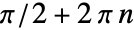 to
to  for integers
  .
. - InverseGudermannian can be evaluated to arbitrary numerical precision.
- InverseGudermannian automatically threads over lists. »
- InverseGudermannian can be used with Interval and CenteredInterval objects. »
Examples
open all close allBasic Examples (5)
InverseGudermannian[.5]Plot over a subset of the reals:
Plot[InverseGudermannian[x], {x, -Pi / 2, Pi / 2}]Plot over a subset of the complexes:
ComplexPlot3D[InverseGudermannian[z], {z, -2 - 2I, 2 + 2I}, PlotLegends -> Automatic]Series expansion at the origin:
Series[InverseGudermannian[x], {x, 0, 5}]Asymptotic expansion at a singular point:
Series[InverseGudermannian[x], {x, π, 3}]//Normal//FullSimplifyScope (31)
Numerical Evaluation (6)
InverseGudermannian[.46]N[InverseGudermannian[4 / 3], 50]The precision of the output tracks the precision of the input:
InverseGudermannian[1.11111111111111111111111]N[InverseGudermannian[I Pi + 5]]Evaluate efficiently at high precision:
InverseGudermannian[.9`100]//TimingInverseGudermannian[58.`10000];//TimingCompute the elementwise values of an array using automatic threading:
InverseGudermannian[{{.1, -.1}, {0, .2}}]Or compute the matrix InverseGudermannian function using MatrixFunction:
MatrixFunction[InverseGudermannian[#]&, {{.1, -.1}, {0, .2}}]Compute worst-case guaranteed intervals using Interval and CenteredInterval objects:
InverseGudermannian[Interval[{0.3, 0.4}]]InverseGudermannian[CenteredInterval[1, 1 / 100]]Or compute average-case statistical intervals using Around:
InverseGudermannian[Around[3, 0.01]]Specific Values (4)
InverseGudermannian[0]InverseGudermannian[E]//NInverseGudermannian[x + 2Pi]Find a value of x for which the InverseGudermannian[x]=0.8 using Solve:
xval = x /. Solve[InverseGudermannian[x] == 0.8 , x][[1]]//QuietPlot[InverseGudermannian[x], {x, -10, 10}, Epilog -> Style[Point[{xval, InverseGudermannian[xval]}], PointSize[Large], Red]]Visualization (3)
Plot the InverseGudermannian function:
Plot[InverseGudermannian[x], {x, -π / 2, π / 2}]Plot the real part of InverseGudermannian:
ComplexContourPlot[Re[InverseGudermannian[z]], {z, -π - π I, π + π I}, IconizedObject[«PlotOptions»]]Plot the imaginary part of InverseGudermannian:
ComplexContourPlot[Im[InverseGudermannian[z]], {z, -π - π I, π + π I}, IconizedObject[«PlotOptions»]]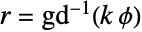
Table[PolarPlot[InverseGudermannian[k ϕ], {ϕ, -π, π}, Frame -> True, FrameTicks -> {{{-1, 0, 1}, None}, {{-1, 0, 1}, None}}, PlotLabel -> "k=" <> ToString[k], PlotRange -> {{-5, 5}, {-5, 5}}], {k, 1, 4}]Function Properties (10)
InverseGudermannian is defined on disjoint intervals of real axis:
FunctionDomain[InverseGudermannian[x], x]//SimplifyInverseGudermannian is defined for all integer complex values:
FunctionDomain[InverseGudermannian[z], z, Complexes]InverseGudermannian achieves all real values:
FunctionRange[InverseGudermannian[x], x, y]InverseGudermannian is not an analytic function:
FunctionAnalytic[InverseGudermannian[x], x]FunctionMeromorphic[InverseGudermannian[x], x]InverseGudermannian is neither non-decreasing nor non-increasing:
FunctionMonotonicity[InverseGudermannian[x], x]InverseGudermannian is not injective:
FunctionInjective[InverseGudermannian[x], x]Plot[{InverseGudermannian[x], 2}, {x, -5 π / 2, 5 π / 2}]InverseGudermannian is surjective:
FunctionSurjective[InverseGudermannian[x], x]Plot[{InverseGudermannian[x], 10}, {x, -π / 2, π / 2}]InverseGudermannian is neither non-negative nor non-positive:
FunctionSign[InverseGudermannian[x], x]InverseGudermannian has both singularity and discontinuity in [π/2, 3π/2]:
FunctionSingularities[InverseGudermannian[x], x]FunctionDiscontinuities[InverseGudermannian[x], x]InverseGudermannian is neither convex nor concave:
FunctionConvexity[InverseGudermannian[x], x]TraditionalForm formatting:
InverseGudermannian[x]//TraditionalFormDifferentiation (2)
The first derivative with respect to x:
D[InverseGudermannian[x], x]Higher derivatives with respect to x:
Table[D[InverseGudermannian[x], {x, k}], {k, 1, 4}]//FullSimplifyPlot the higher derivatives with respect to x:
Plot[%, {x, -Pi / 2, Pi / 2}, PlotLegends -> {"First Derivative", "Second Derivative", "Third Derivative", "Fourth Derivative"}]Integration (3)
Compute the indefinite integral using Integrate:
Integrate[InverseGudermannian[x], x]// FullSimplifyIntegrate[InverseGudermannian[x], {x, 0, Pi / 3}]The definite integral of InverseGudermannian over a period is 0:
Integrate[InverseGudermannian[x], {x, -Pi / 2, Pi / 2}]Integrate[E ^ x InverseGudermannian[x] , x]// FullSimplifyIntegrate[Sin[x] InverseGudermannian[x] , {x, 0, Pi / 6}]// FullSimplifySeries Expansions (3)
Find the Taylor expansion using Series:
Series[InverseGudermannian[x], {x, 0, 10}]Plots of the first three approximations around  :
:
terms = Normal@Table[Series[InverseGudermannian[x], {x, 0, m}], {m, 1, 5, 2}];
Plot[{InverseGudermannian[x], terms}, {x, 0, 10}, PlotRange -> {{0, 5}, {0, 10}}]FourierSeries[InverseGudermannian[x], x, 1]// FullSimplifyInverseGudermannian can be applied to a power series:
InverseGudermannian[x + O[x] ^ 4]Applications (2)
Mercator projection map of the world:
Graphics[{EdgeForm[StandardGray], FaceForm[GrayLevel[0.8]], Polygon[
	CountryData[#, "SchematicCoordinates"] /. {y_ ? NumberQ, x_} :> {x, InverseGudermannian[Min[y, 85] Degree] / Degree}
	]}& /@ CountryData[]]
Solve a differential equation with the inverse Gudermannian function as the inhomogeneous part:
DSolve[y'[x] + InverseGudermannian[x] == 0, y[x], x]//FullSimplifyProperties & Relations (2)
Derivative of the inverse Gudermannian function:
D[InverseGudermannian[x], x]Use FunctionExpand to expand InverseGudermannian in terms of elementary functions:
FunctionExpand[InverseGudermannian[x]]Related Links

 MathWorld
Text
Wolfram Research (2008), InverseGudermannian, Wolfram Language function, https://reference.wolfram.com/language/ref/InverseGudermannian.html.
CMS
Wolfram Language. 2008. "InverseGudermannian." Wolfram Language & System Documentation Center. Wolfram Research. https://reference.wolfram.com/language/ref/InverseGudermannian.html.
APA
Wolfram Language. (2008). InverseGudermannian. Wolfram Language & System Documentation Center. Retrieved from https://reference.wolfram.com/language/ref/InverseGudermannian.html