



InverseJacobiSN
InverseJacobiSN[v,m]
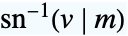
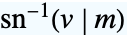
gives the inverse Jacobi elliptic function 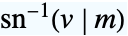 .
.
Details
- Mathematical function, suitable for both symbolic and numerical manipulation.
 gives the value of
  for which
  .
. - InverseJacobiSN has branch cut discontinuities in the complex v plane with branch points at
 and infinity, and in the complex m plane with branch points at
  and infinity.
 - The inverse Jacobi elliptic functions are related to elliptic integrals.
- For certain special arguments, InverseJacobiSN automatically evaluates to exact values.
- InverseJacobiSN can be evaluated to arbitrary numerical precision.
- InverseJacobiSN automatically threads over lists.
Examples
open all close allBasic Examples (5)
InverseJacobiSN[0.5, 0.3]JacobiSN[%, 0.3]Plot the function at different values of the modulus m:
Plot[{InverseJacobiSN[x, 0], InverseJacobiSN[x, 1 / 2], InverseJacobiSN[x, 2 / 3]}, {x, 0, 1}]Plot over a subset of the complexes:
ComplexPlot3D[InverseJacobiSN[z, 1 / 3], {z, -2 - 2I, 2 + 2I}, PlotLegends -> Automatic]Series expansions at the origin:
Series[InverseJacobiSN[x, m], {x, 0, 5}]Series[InverseJacobiSN[x, m], {m, 0, 1}]Series expansion at Infinity:
Series[InverseJacobiSN[2, m], {m, ∞, 3}]//Normal//FullSimplifyScope (29)
Numerical Evaluation (5)
N[InverseJacobiSN[1 / 2, 1 / 2], 50]The precision of the input tracks the precision of the output:
InverseJacobiSN[1 / 2, 0.50000000000000000000000000000000]Evaluate for complex arguments:
InverseJacobiSN[0.2 + I, 0.1 - 0.3I]Evaluate InverseJacobiSN efficiently at high precision:
InverseJacobiSN[1 / 2, 0.5`500]//TimingInverseJacobiSN[1 / 2, 0.5`50000];//TimingCompute average-case statistical intervals using Around:
InverseJacobiSN[Around[1 / 2, 0.01], 2]Compute the elementwise values of an array:
InverseJacobiSN[1, {{-1, 1 / 2}, {1 / 2, -1}}]//FunctionExpandOr compute the matrix InverseJacobiSN function using MatrixFunction:
MatrixFunction[InverseJacobiSN[1, #]&, {{-1, 1 / 2}, {1 / 2, -1}}]Specific Values (4)
Simple exact values are generated automatically:
{InverseJacobiSN[ν, 0], InverseJacobiSN[ν, 1]}{InverseJacobiSN[-1, m], InverseJacobiSN[0, m], InverseJacobiSN[1, m]}InverseJacobiSN[ν, Infinity]Find a real root of the equation ![TemplateBox[{x, {1, /, 3}}, InverseJacobiSN]=1](Files/InverseJacobiSN.en/7.png "TemplateBox[{x, {1, /, 3}}, InverseJacobiSN]=1") :
:
f[x_] := InverseJacobiSN[x, 1 / 3] - 1;
xzero = Solve[f[x] == 0 && 0 < x < 1.0, x][[1, 1, 2]]//QuietPlot[f[ν], {ν, 0, 1}, Epilog -> Style[Point[{xzero, f[xzero]}], PointSize[Large], Red]]Parity transformation is automatically applied:
InverseJacobiSN[-ν, m]Visualization (3)
Plot InverseJacobiSN for various values of the second parameter  :
:
Plot[{InverseJacobiSN[ν, -2], InverseJacobiSN[ν, 0], InverseJacobiSN[ν, 1], InverseJacobiSN[ν, 2]}, {ν, -1.1, 1.1}]Plot InverseJacobiSN as a function of its parameter  :
:
Plot[{InverseJacobiSN[-1, m], InverseJacobiSN[-1 / 2, m], InverseJacobiSN[1 / 2, m], InverseJacobiSN[1, m]}, {m, -10, 5}]![TemplateBox[{z, 2}, InverseJacobiSN]](Files/InverseJacobiSN.en/10.png "TemplateBox[{z, 2}, InverseJacobiSN]")
ComplexContourPlot[Re[InverseJacobiSN[z, 2]], {z, -3 - 3I, 3 + 3I}, Contours -> 20]![TemplateBox[{z, 2}, InverseJacobiSN]](Files/InverseJacobiSN.en/11.png "TemplateBox[{z, 2}, InverseJacobiSN]")
ComplexContourPlot[Im[InverseJacobiSN[z, 2]], {z, -3 - 3I, 3 + 3I}, IconizedObject[«PlotOptions»]]Function Properties (6)
InverseJacobiSN is not an analytic function:
FunctionAnalytic[InverseJacobiSN[x, m], {x, m}]It has both singularities and discontinuities:
FunctionSingularities[InverseJacobiSN[x, 1 / 3], x]//QuietFunctionDiscontinuities[InverseJacobiSN[x, 1 / 3], x]//Quiet![TemplateBox[{x, {1, /, 3}}, InverseJacobiSN]](Files/InverseJacobiSN.en/12.png "TemplateBox[{x, {1, /, 3}}, InverseJacobiSN]") is nondecreasing on its real domain:
is nondecreasing on its real domain:
FunctionMonotonicity[{InverseJacobiSN[x, 1 / 3], -1 <= x <= 1}, x]![TemplateBox[{x, {1, /, 3}}, InverseJacobiSN]](Files/InverseJacobiSN.en/13.png "TemplateBox[{x, {1, /, 3}}, InverseJacobiSN]")
FunctionInjective[InverseJacobiSN[x, 1 / 3], x]Plot[{InverseJacobiSN[x, 1 / 3], .3}, {x, -5, 5}]![TemplateBox[{x, {1, /, 3}}, InverseJacobiSN]](Files/InverseJacobiSN.en/14.png "TemplateBox[{x, {1, /, 3}}, InverseJacobiSN]")
FunctionSurjective[InverseJacobiSN[x, 1 / 3], x]Plot[{InverseJacobiSN[x, 1 / 3], 2}, {x, -2, 2}]![TemplateBox[{x, {1, /, 3}}, InverseJacobiSN]](Files/InverseJacobiSN.en/15.png "TemplateBox[{x, {1, /, 3}}, InverseJacobiSN]") is neither non-negative nor non-positive on its real domain:
is neither non-negative nor non-positive on its real domain:
FunctionSign[{InverseJacobiSN[x, 1 / 3], -1 <= x <= 1}, x]![TemplateBox[{x, {1, /, 3}}, InverseJacobiSN]](Files/InverseJacobiSN.en/16.png "TemplateBox[{x, {1, /, 3}}, InverseJacobiSN]") is neither convex nor concave on its real domain:
is neither convex nor concave on its real domain:
FunctionConvexity[{InverseJacobiSN[x, 1 / 3], -1 <= x <= 1}, x]Differentiation and Integration (4)
D[InverseJacobiSN[ν, m], ν]derivs = Table[D[InverseJacobiSN[ν, m], {ν, n}], {n, 1, 3}]//Simplify
Plot[Evaluate[derivs /. m -> 1 / 3], {ν, -1, 1}, PlotLegends -> {"First Derivative", "Second Derivative", "Third Derivative"}]Differentiate InverseJacobiSN with respect to the second argument  :
:
D[InverseJacobiSN[ν, m], m]Definite integral of an odd function over an interval centered at the origin is 0:
Integrate[InverseJacobiSN[ν, m], {ν, -ν0, ν0}, Assumptions -> ν0∈Reals]Series Expansions (2)
![TemplateBox[{nu, m}, InverseJacobiSN]](Files/InverseJacobiSN.en/19.png "TemplateBox[{nu, m}, InverseJacobiSN]")

Series[InverseJacobiSN[ν, m], {ν, 0, 6}]Plot the first three approximations for ![TemplateBox[{nu, 2}, InverseJacobiSN]](Files/InverseJacobiSN.en/21.png "TemplateBox[{nu, 2}, InverseJacobiSN]") around
around  :
:
terms = Normal@Table[Series[InverseJacobiSN[ν, 2], {ν, 0, n}], {n, 1, 6, 2}];
Plot[{InverseJacobiSN[ν, 2], terms}, {ν, -0.8, 0.8}]![TemplateBox[{nu, m}, InverseJacobiSN]](Files/InverseJacobiSN.en/23.png "TemplateBox[{nu, m}, InverseJacobiSN]")

Series[InverseJacobiSN[ν, m], {m, 0, 3}]//SimplifyPlot the first three approximations for ![TemplateBox[{{1, /, 2}, m}, InverseJacobiSN]](Files/InverseJacobiSN.en/25.png "TemplateBox[{{1, /, 2}, m}, InverseJacobiSN]") around
around  :
:
terms = Normal@Table[Series[InverseJacobiSN[1 / 2, m], {m, 0, n}], {n, 1, 3}];
Plot[{InverseJacobiSN[1 / 2, m], terms}, {m, -3, 3}]
Function Identities and Simplifications (2)
InverseJacobiSN is the inverse function of JacobiSN:
Solve[ν == JacobiSN[u, m], u][[1, 1]]//QuietCompose with inverse function:
{InverseJacobiSN[JacobiSN[ν, m], m], JacobiSN[InverseJacobiSN[ν, m], m]}Use PowerExpand to disregard multivaluedness of the inverse function:
PowerExpand[%]Other Features (3)
InverseJacobiSN threads elementwise over lists:
InverseJacobiSN[{ν1, ν2}, m]InverseJacobiSN can be applied to a power series:
InverseJacobiSN[Sin[ν] + O[ν] ^ 10, m]// SimplifyTraditionalForm formatting:
InverseJacobiSN[ν, m]//TraditionalFormGeneralizations & Extensions (1)
InverseJacobiSN can be applied to a power series:
InverseJacobiSN[Sin[x] + O[x] ^ 10, m]Applications (1)
Properties & Relations (1)
Obtain InverseJacobiSN from solving equations containing elliptic functions:
Solve[JacobiSN[x, m]^2 + 2JacobiSN[x, m] == a, x]
Related Links

 MathWorld
Text
Wolfram Research (1988), InverseJacobiSN, Wolfram Language function, https://reference.wolfram.com/language/ref/InverseJacobiSN.html.
CMS
Wolfram Language. 1988. "InverseJacobiSN." Wolfram Language & System Documentation Center. Wolfram Research. https://reference.wolfram.com/language/ref/InverseJacobiSN.html.
APA
Wolfram Language. (1988). InverseJacobiSN. Wolfram Language & System Documentation Center. Retrieved from https://reference.wolfram.com/language/ref/InverseJacobiSN.html