

RadonTransform
RadonTransform[expr,{x,y},{p,ϕ}]
gives the Radon transform of expr.
Details and Options
- The Radon transform of a function
 is defined to be
  .
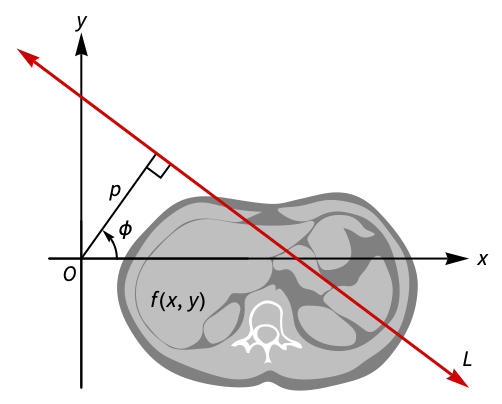
. - Geometrically, the Radon transform represents the integral of
 along a line
  given in normal form by the equation
  , with -∞<p<∞ and -π/2<ϕ<π/2.
 - The following options can be given:
-
Assumptions $Assumptions assumptions on parameters GenerateConditions False whether to generate results that involve conditions on parameters Method Automatic what method to use - In TraditionalForm, RadonTransform is output using
![TemplateBox[{{f, (, {x, ,, y}, )}, x, y, p, phi}, RadonTransform]](Files/RadonTransform.en/7.png "TemplateBox[{{f, (, {x, ,, y}, )}, x, y, p, phi}, RadonTransform]") .
.
Examples
open all close allBasic Examples (1)
Compute the Radon transform of a function:
RadonTransform[(x^2 + 5y^2) E^-x^2 - y^2, {x, y}, {p, ϕ}]Plot the function along with the transform:
{DensityPlot[(x^2 + 5 y^2) E^-x^2 - y^2, {x, -2, 2}, {y, -2, 2}, Frame -> None, Ticks -> None], DensityPlot[%, {ϕ, -π / 2, π / 2}, {p, -3, 3}, Frame -> None, Ticks -> None]}Scope (10)
Basic Uses (2)
Compute the Radon transform of a function for symbolic parameter values:
RadonTransform[x E ^ (-x ^ 2 - y ^ 2), {x, y}, {p, ϕ}]Use exact values for the parameters:
RadonTransform[x E ^ (-x ^ 2 - y ^ 2), {x, y}, {3, π / 3}]Use inexact values for the parameters:
RadonTransform[x E ^ (-x ^ 2 - y ^ 2), {x, y}, {3.1, 0.8}]Obtain the condition for validity of a Radon transform:
RadonTransform[y E ^ (-a(x ^ 2 + y ^ 2)), {x, y}, {p, ϕ}, GenerateConditions -> True]RadonTransform[y E ^ (-a(x ^ 2 + y ^ 2)), {x, y}, {p, ϕ}, GenerateConditions -> True, Assumptions -> a > 0]Gaussian Functions (5)
Radon transform of a circular Gaussian function:
RadonTransform[ E^-x^2 - y^2, {x, y}, {p, ϕ}]Plot the function along with the transform:
{DensityPlot[E^-x^2 - y^2, {x, -2, 2}, {y, -2, 2}, Frame -> None, Ticks -> None], DensityPlot[%, {ϕ, -π / 2, π / 2}, {p, -2, 2}, Frame -> None, Ticks -> None]}Radon transform of an elliptic Gaussian function:
RadonTransform[E^-(x^2/25) - (y^2/16), {x, y}, {p, ϕ}]Plot the function along with the transform:
{DensityPlot[E^-(x^2/25) - (y^2/16), {x, -3, 3}, {y, -3, 3}, Frame -> None, Ticks -> None, Frame -> None, Ticks -> None], DensityPlot[%, {ϕ, -π / 2, π / 2}, {p, -5, 5}, Frame -> None, Ticks -> None]}Product of a polynomial with a Gaussian function:
RadonTransform[(x^2 + y^2) E^-x^2 - y^2, {x, y}, {p, ϕ}]{DensityPlot[(x^2 + y^2) E^-x^2 - y^2, {x, -2, 2}, {y, -2, 2}, Frame -> None, Ticks -> None], DensityPlot[%, {ϕ, -π / 2, π / 2}, {p, -5, 5}, Frame -> None, Ticks -> None]}Product of Hermite polynomials and a Gaussian function:
RadonTransform[HermiteH[1, x] HermiteH[2, y] E^-x^2 - y^2, {x, y}, {p, ϕ}]{DensityPlot[HermiteH[1, x] HermiteH[2, y] E^-x^2 - y^2, {x, -2, 2}, {y, -2, 2}, Frame -> None, Ticks -> None], DensityPlot[%, {ϕ, -π / 2, π / 2}, {p, -2, 2}, Frame -> None, Ticks -> None]}Products of trigonometric functions with Gaussian functions:
RadonTransform[Cos[x + y] E^-x^2 - y^2, {x, y}, {p, ϕ}]{DensityPlot[Cos[x + y] E^-x^2 - y^2, {x, -2, 2}, {y, -2, 2}, PlotRange -> All, Frame -> None, Ticks -> None], DensityPlot[%, {ϕ, -π / 2, π / 2}, {p, -2, 2}, PlotRange -> All, Frame -> None, Ticks -> None]}RadonTransform[Sin[2x + y] E^-x^2 - y^2, {x, y}, {p, ϕ}]{DensityPlot[Sin[2x + y] E^-x^2 - y^2 , {x, -2, 2}, {y, -2, 2}, Frame -> None, Ticks -> None], DensityPlot[%, {ϕ, -π / 2, π / 2}, {p, -2, 2}, Frame -> None, Ticks -> None]}Piecewise and Generalized Functions (3)
Radon transform of the characteristic function for the unit disk:
RadonTransform[UnitStep[1 - x ^ 2 - y ^ 2], {x, y}, {p, ϕ}]{DensityPlot[UnitStep[1 - x ^ 2 - y ^ 2], {x, -2, 2}, {y, -2, 2}, PlotRange -> All, PlotPoints -> 200, Frame -> None, Ticks -> None], DensityPlot[%, {ϕ, -π / 2, π / 2}, {p, -2, 2}, PlotRange -> All, PlotPoints -> 200, Frame -> None, Ticks -> None]}Products of polynomials with the characteristic function for the unit disk:
RadonTransform[x UnitStep[1 - x ^ 2 - y ^ 2], {x, y}, {p, ϕ}]{DensityPlot[x UnitStep[1 - x ^ 2 - y ^ 2], {x, -2, 2}, {y, -2, 2}, PlotRange -> All, PlotPoints -> 200, Frame -> None, Ticks -> None], DensityPlot[%, {ϕ, -π / 2, π / 2}, {p, -2, 2}, PlotRange -> All, PlotPoints -> 200, Frame -> None, Ticks -> None]}RadonTransform[(x ^ 2 + y ^ 2) UnitStep[1 - x ^ 2 - y ^ 2], {x, y}, {p, ϕ}]{DensityPlot[(x ^ 2 + y ^ 2) UnitStep[1 - x ^ 2 - y ^ 2], {x, -2, 2}, {y, -2, 2}, PlotRange -> All, PlotPoints -> 200, Frame -> None, Ticks -> None], DensityPlot[%, {ϕ, -π / 2, π / 2}, {p, -2, 2}, PlotRange -> All, PlotPoints -> 200, Frame -> None, Ticks -> None]}Radon transforms for expressions involving DiracDelta:
RadonTransform[DiracDelta[x - a, y - b], {x, y}, {p, ϕ}]RadonTransform[x DiracDelta[1 - x ^ 2 - y ^ 2], {x, y}, {p, ϕ}]Options (2)
Assumptions (1)
Applications (2)
Compute the symbolic Radon transform for the characteristic function of a disk:
RadonTransform[UnitStep[1 - x ^ 2 - y ^ 2], {x, y}, {p, ϕ}]{DensityPlot[UnitStep[1 - x ^ 2 - y ^ 2], {x, -2, 2}, {y, -2, 2}, PlotRange -> All, PlotPoints -> 200, Frame -> None, Ticks -> None, Background -> None], DensityPlot[%, {ϕ, -π / 2, π / 2}, {p, -Sqrt[8], Sqrt[8]}, PlotRange -> All, Frame -> None, Ticks -> None, Background -> None]}Obtain the same result using Radon:
disk = Image[DiskMatrix[50, 201], "Bit"];{disk, Radon[disk, {201, 201}]}Use the Radon transform to solve a Poisson equation:
peqn = Laplacian[u[x, y], {x, y}] == E^-x^2 - y^2 x (-2 + x^2 + y^2);Apply RadonTransform to the equation:
RadonTransform[peqn, {x, y}, {p, m}]Solve the ordinary differential equation using DSolveValue:
DSolveValue[% /. {RadonTransform[u[x, y], {x, y}, {p, m}] -> f[p]}, f[p], p]Set the arbitrary constants in the solution to 0:
% /. {C[i_] -> 0}Obtain the solution for the original equation using InverseRadonTransform:
sol = InverseRadonTransform[%, {p, m}, {x, y}]peqn /. {u -> Function[{x, y}, Evaluate[sol]]}//SimplifyPlot3D[sol, {x, -3, 3}, {y, -3, 3}, PlotRange -> All]Properties & Relations (10)
RadonTransform computes the integral  :
:
RadonTransform[E^-x^2 - y^2, {x, y}, {p, ϕ}]Obtain the same result using Integrate:
f[x_, y_] := E^-x^2 - y^2Subsuperscript[∫, -∞, ∞]f[p Cos[ϕ] - s Sin[ϕ], p Sin[ϕ] + s Cos[ϕ]]ⅆsRadonTransform and InverseRadonTransform are mutual inverses:
InverseRadonTransform[RadonTransform[f[x, y], {x, y}, {p, ϕ}], {p, ϕ}, {x, y}]RadonTransform[InverseRadonTransform[g[p, ϕ], {p, ϕ}, {x, y}], {x, y}, {p, ϕ}]RadonTransform is a linear operator:
RadonTransform[a f[x, y] + b g[x, y], {x, y}, {p, ϕ}]The shifting property for RadonTransform:
f[x_, y_] := E ^ (-x ^ 2 - y ^ 2)a = 2;b = 5;RadonTransform[f[x - a, y - b], {x, y}, {p, ϕ}] == RadonTransform[f[x, y], {x, y}, {p - a Cos[ϕ] - b Sin[ϕ], ϕ}]The symmetry property for RadonTransform:
f[x_, y_] := E ^ (-x ^ 2 / 25 - y ^ 2 / 16)a = 2;b = 5;Express the Radon transform of  in terms of a unit vector:
s1 = RadonTransform[f[x, y], {x, y}, {p, ϕ}] /. {Sin[a_] :> TrigExpand[Sin[a]]} /. {Cos[ϕ] -> Subscript[u, 1], Sin[ϕ] -> Subscript[u, 2]}(s1 /. {p -> -p, Subscript[u, 1] -> -Subscript[u, 1], Subscript[u, 2] -> -Subscript[u, 2]}) == s1//SimplifyThe homogeneity property for RadonTransform:
f[x_, y_] := E ^ (-x ^ 2 / 25 - y ^ 2 / 16)a = 2;b = 5;Express the Radon transform of  in terms of a unit vector:
s1 = RadonTransform[f[x, y], {x, y}, {p, ϕ}] /. {Sin[a_] :> TrigExpand[Sin[a]]} /. {Cos[ϕ] -> Subscript[u, 1], Sin[ϕ] -> Subscript[u, 2]}Verify the homogeneity property:
k = 7;(s1 /. {p -> k p, Subscript[u, 1] -> k Subscript[u, 1], Subscript[u, 2] -> k Subscript[u, 2]}) == 1 / Abs[k] s1//SimplifyThe scaling property for RadonTransform:
f[x_, y_] := E ^ (-x ^ 2 / 25 - y ^ 2 / 16)a = 2;b = 5;Express the Radon transform of  in terms of a unit vector:
s1 = RadonTransform[f[x, y], {x, y}, {p, ϕ}] /. {Sin[a_] :> TrigExpand[Sin[a]]} /. {Cos[ϕ] -> Subscript[u, 1], Sin[ϕ] -> Subscript[u, 2]}Express the Radon transform of 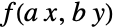 in terms of a unit vector:
s2 = RadonTransform[f[a x, b y], {x, y}, {p, ϕ}] /. {Sin[a_] :> TrigExpand[Sin[a]]} /. {Cos[ϕ] -> Subscript[u, 1], Sin[ϕ] -> Subscript[u, 2]}1 / Abs[a b] (s1 /. {Subscript[u, 1] -> Subscript[u, 1] / a, Subscript[u, 2] -> Subscript[u, 2] / b}) == s2//SimplifyRadonTransform of derivatives:
RadonTransform[D[f[x, y], x], {x, y}, {p, ϕ}]RadonTransform[D[f[x, y], y], {x, y}, {p, ϕ}]RadonTransform of the Laplacian:
RadonTransform[Laplacian[f[x, y], {x, y}], {x, y}, {p, ϕ}]RadonTransform can be computed using Fourier transforms:
f[x_, y_] := (x ^ 2 + y ^ 2)E ^ (-Pi(x ^ 2 + y ^ 2))Compute the Fourier transform of f in polar coordinates:
FourierTransform[f[x, y], {x, y}, {u, v}, FourierParameters -> {0, -2Pi}] /. {u -> r Cos[ϕ], v -> r Sin[ϕ]}//SimplifyCompute the inverse Fourier transform to obtain the Radon transform:
InverseFourierTransform[%, r, p, FourierParameters -> {0, -2Pi}]Obtain the same result directly using RadonTransform:
RadonTransform[f[x, y], {x, y}, {p, ϕ}]Neat Examples (1)
Create a table of basic Radon transforms:
flist = {E ^ (-x ^ 2 - y ^ 2), x E ^ (-x ^ 2 - y ^ 2), y E ^ (-x ^ 2 - y ^ 2), (x ^ 2 + y ^ 2) E ^ (-x ^ 2 - y ^ 2), E ^ (-(x / a) ^ 2 - (y / b) ^ 2), DiracDelta[x - a, y - b], UnitStep[1 - x ^ 2 - y ^ 2], (x ^ 2 + y ^ 2)UnitStep[1 - x ^ 2 - y ^ 2]};Grid[Prepend[{#, RadonTransform[#1, {x, y}, {p, ϕ}]}& /@ flist, {"Function", "Radon Transform"}], IconizedObject[«Grid options»]]//TraditionalFormText
Wolfram Research (2017), RadonTransform, Wolfram Language function, https://reference.wolfram.com/language/ref/RadonTransform.html.
CMS
Wolfram Language. 2017. "RadonTransform." Wolfram Language & System Documentation Center. Wolfram Research. https://reference.wolfram.com/language/ref/RadonTransform.html.
APA
Wolfram Language. (2017). RadonTransform. Wolfram Language & System Documentation Center. Retrieved from https://reference.wolfram.com/language/ref/RadonTransform.html