


RamanujanTauL
gives the Ramanujan tau Dirichlet L-function  .
.
Details
- Mathematical function, suitable for both symbolic and numerical manipulation.
- For
 ,
,  is given by the Dirichlet series
 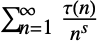 , where
  is the Ramanujan
  function.
 - RamanujanTauL can be evaluated to arbitrary numerical precision.
- RamanujanTauL automatically threads over lists.
Examples
open all close allBasic Examples (2)
Scope (20)
Numerical Evaluation (6)
RamanujanTauL[5.]RamanujanTauL[17.]N[RamanujanTauL[7 / 4], 50]N[RamanujanTauL[2 / 3], 20]The precision of the output tracks the precision of the input:
RamanujanTauL[21.211111111000111111111]RamanujanTauL[21.211111111000111111111111111111]N[RamanujanTauL[3 - I]]Evaluate efficiently at high precision:
RamanujanTauL[3`100]//TimingRamanujanTauL[7`1000];//TimingCompute average-case statistical intervals using Around:
RamanujanTauL[ Around[2, 0.01]]Compute the elementwise values of an array:
RamanujanTauL[{{.1, -1.2}, {0., .12}}]Or compute the matrix RamanujanTauL function using MatrixFunction:
MatrixFunction[RamanujanTauL, {{.1, -1.2}, {0., .12}}]//FullSimplifySpecific Values (2)
RamanujanTauL[0]//N//QuietFind a value of x for which RamanujanTauL[x]=0.8:
xval = x /. FindRoot[RamanujanTauL[x] == 0.8, {x, 5}]//QuietPlot[RamanujanTauL[x], {x, 0, 20}, Epilog -> Style[Point[{xval, RamanujanTauL[xval]}], PointSize[Large], Red]]//QuietVisualization (2)
Plot the RamanujanTauL:
Plot[RamanujanTauL[t], {t, 0, 10}]//QuietPlot the real part of RamanujanTauL function:
ContourPlot[Re[RamanujanTauL[x + I y]], {x, -4, 4}, {y, -4, 4}, Contours -> 24]//QuietPlot the imaginary part of RamanujanTauL function:
ContourPlot[Im[RamanujanTauL[x + I y]], {x, -4, 4}, {y, -4, 4}, Contours -> 24]//QuietFunction Properties (10)
RamanujanTauL is defined for all real values:
FunctionDomain[RamanujanTauL[x], x]FunctionDomain[RamanujanTauL[z], z, Complexes]Bounds on the function range of RamanujanTauL:
FunctionRange[RamanujanTauL[x], x, y]RamanujanTauL threads over lists:
RamanujanTauL[{-0.1, 3.1 + 2.7 I, 1.0}]RamanujanTauL is an analytic function of x:
FunctionAnalytic[RamanujanTauL[x], x]RamanujanTauL is neither non-increasing nor non-decreasing:
FunctionMonotonicity[RamanujanTauL[x], x]RamanujanTauL is not injective:
FunctionInjective[RamanujanTauL[x], x]Plot[{RamanujanTauL[x], 1}, {x, -5, 20}]RamanujanTauL is surjective:
FunctionSurjective[RamanujanTauL[x], x]Plot[{RamanujanTauL[x], 5}, {x, -20, 20}]RamanujanTauL is neither non-negative nor non-positive:
FunctionSign[RamanujanTauL[x], x]RamanujanTauL has no singularities or discontinuities:
FunctionSingularities[RamanujanTauL[x], x]FunctionDiscontinuities[RamanujanTauL[x], x]RamanujanTauL is neither convex nor concave:
FunctionConvexity[RamanujanTauL[x], x]Applications (5)
Plot[Abs[RamanujanTauL[6 + I x]], {x, 0, 20}]Find a zero of RamanujanTauL:
FindRoot[RamanujanTauL[t] == 0, {t, 6 + 9I}]The number of zeros on the critical strip from 0 to  :
:
n[t_] := (RamanujanTauTheta[t] + Im[Log[RamanujanTauL[6 + I t]]]) / PiTable[Chop[n[t]], {t, 0., 20}]Plot3D[Re[RamanujanTauL[x + I y]], {x, -5, 1}, {y, -2, 1}]Define and visualize the Ramanujan  function:
Subscript[τ, z][t_] := Gamma[6 + I t](2 Pi) ^ (-I t) / (RamanujanTauL[6 + I t] Sqrt[Sinh[Pi t] / (Pi t Product[k ^ 2 + t ^ 2, {k, 1, 5}])])Plot[Abs[Subscript[τ, z][t]], {t, -5, 5}]Properties & Relations (5)
a[s_] := RamanujanTauL[s]Gamma[s] / (2Pi) ^ sWith[{s = 2.5}, a[s] == a[12 - s]]Approximate RamanujanTauL using an Euler product formula:
With[{s = 7.5, n = 500}, Product[1 / (1 - RamanujanTau[p]p ^ (-s) + p ^ (11 - 2s)), {p, Prime[Range[n]]}]]RamanujanTauL[7.5]On the critical line, RamanujanTauL can be split into RamanujanTauTheta and RamanujanTauZ:
With[{s = 9.22`20}, RamanujanTauL[6 + I s] == RamanujanTauZ[s]Exp[-I RamanujanTauTheta[s]]]Evaluate derivatives numerically:
RamanujanTauL'[6. + I]RamanujanTauL''[6. + I]RamanujanTauZ can be expressed using RamanujanTauL:
RamanujanTauZ[5 I]Text
Wolfram Research (2007), RamanujanTauL, Wolfram Language function, https://reference.wolfram.com/language/ref/RamanujanTauL.html.
CMS
Wolfram Language. 2007. "RamanujanTauL." Wolfram Language & System Documentation Center. Wolfram Research. https://reference.wolfram.com/language/ref/RamanujanTauL.html.
APA
Wolfram Language. (2007). RamanujanTauL. Wolfram Language & System Documentation Center. Retrieved from https://reference.wolfram.com/language/ref/RamanujanTauL.html