


RamanujanTauTheta
gives the Ramanujan tau theta function  .
.
Details
- Mathematical function, suitable for both symbolic and numerical manipulation.
 for real
  .
.  arises in the study of the Ramanujan L-function on the critical line. It is closely related to the number of zeros of
 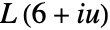 for
for  .
. - Apart from a sign,
 gives the phase of the Ramanujan L-function
 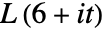 .
.  is an analytic function of
  except for branch cuts on the imaginary axis running from
  to
to  .
. - For certain special arguments, RamanujanTauTheta automatically evaluates to exact values.
- RamanujanTauTheta can be evaluated to arbitrary numerical precision.
- RamanujanTauTheta automatically threads over lists.
Examples
open all close allBasic Examples (5)
RamanujanTauTheta[9.22]Plot over a subset of the reals:
Plot[RamanujanTauTheta[t], {t, -10, 10}]Plot over a subset of the complexes:
ComplexPlot3D[RamanujanTauTheta[z ^ 2], {z, -1 - I, 1 + I}, PlotLegends -> Automatic]Series expansion at the origin:
Series[RamanujanTauTheta[x], {x, 0, 3}]Series expansion at Infinity:
Series[RamanujanTauTheta[x], {x, ∞, 5}]Scope (28)
Numerical Evaluation (7)
RamanujanTauTheta[5.]RamanujanTauTheta[17.]N[RamanujanTauTheta[7 / 4], 50]N[RamanujanTauTheta[2 / 3], 20]The precision of the output tracks the precision of the input:
RamanujanTauTheta[21.211111111000111111111]N[RamanujanTauTheta[3 - I]]N[RamanujanTauTheta[5I]]Evaluate efficiently at high precision:
RamanujanTauTheta[3`100]//TimingRamanujanTauTheta[7`1000];//TimingCompute average-case statistical intervals using Around:
RamanujanTauTheta[ Around[2, 0.01]]Compute the elementwise values of an array:
RamanujanTauTheta[{{1.1, 0.1}, {-1.1, -1.2}}]Or compute the matrix RamanujanTauTheta function using MatrixFunction:
MatrixFunction[RamanujanTauTheta, {{1.1, 0.1}, {-1.1, -1.2}}]Specific Values (2)
RamanujanTauTheta[0]//NFind positive minimum of RamanujanTauTheta[x]:
xmin = x /. FindRoot[D[RamanujanTauTheta[x], x] == 0, {x, 2}]//QuietPlot[RamanujanTauTheta[x], {x, -10, 10}, Epilog -> Style[Point[{xmin, RamanujanTauTheta[xmin]}], PointSize[Large], Red]]Visualization (2)
Plot the RamanujanTauTheta:
Plot[RamanujanTauTheta[t], {t, -10, 10}]Plot the real part of RamanujanTauTheta function:
ContourPlot[Re[RamanujanTauTheta[x + I y]], {x, -5, 5}, {y, -5, 5}, IconizedObject[«PlotOptions»]]Plot the imaginary part of RamanujanTauTheta function:
ContourPlot[Im[RamanujanTauTheta[x + I y]], {x, -5, 5}, {y, -5, 5}, IconizedObject[«PlotOptions»]]Function Properties (10)
RamanujanTauTheta is defined for all real values:
FunctionDomain[RamanujanTauTheta[x], x]FunctionDomain[RamanujanTauTheta[z], z, Complexes]Function range of RamanujanTauTheta:
FunctionRange[RamanujanTauTheta[x], x, y]//QuietRamanujanTauTheta threads over lists:
RamanujanTauTheta[{1.5, 1.6, 1.8}]RamanujanTauTheta is an analytic function of x:
FunctionAnalytic[RamanujanTauTheta[x], x]RamanujanTauTheta is neither non-increasing nor non-decreasing:
FunctionMonotonicity[RamanujanTauTheta[x], x]RamanujanTauTheta is not injective:
FunctionInjective[RamanujanTauTheta[x], x]Plot[{RamanujanTauTheta[x], .2}, {x, -10, 10}]RamanujanTauTheta is surjective:
FunctionSurjective[RamanujanTauTheta[x], x]Plot[{RamanujanTauTheta[x], 5}, {x, -20, 20}]RamanujanTauTheta is neither non-negative nor non-positive:
FunctionSign[RamanujanTauTheta[x], x]RamanujanTauTheta has no singularities or discontinuities:
FunctionSingularities[RamanujanTauTheta[x], x]FunctionDiscontinuities[RamanujanTauTheta[x], x]RamanujanTauTheta is neither convex nor concave:
FunctionConvexity[RamanujanTauTheta[x], x]Differentiation (2)
First derivative with respect to  :
:
D[RamanujanTauTheta[t] , t]Higher derivatives with respect to  :
:
Table[D[RamanujanTauTheta[t], {t, k}], {k, 1, 3}]//SimplifyPlot the higher derivatives with respect to  :
:
Plot[%, {t, -20, 20}, PlotLegends -> {"First Derivative", "Second Derivative", "Third Derivative"}]Series Expansions (5)
Find the Taylor expansion using Series:
Series[RamanujanTauTheta[t], {t, 0, 4}]Plots of the first three approximations around  :
:
terms = Normal@Table[Series[RamanujanTauTheta[t], {t, 2, m}], {m, 1, 5, 2}];
Plot[{RamanujanTauTheta[t], terms}//Flatten//Evaluate, {t, -10, 10}]
Find the series expansion at Infinity:
Series[RamanujanTauTheta[t], {t, Infinity, 1}]Find the series expansion for an arbitrary symbolic direction  :
:
Series[RamanujanTauTheta[t], {t, DirectedInfinity[z], 1}, Assumptions -> t > 0]// FullSimplifyTaylor expansion at a generic point:
Series[RamanujanTauTheta[t], {t, t0, 2}]// FullSimplifySeries expansion at a singular point:
Series[RamanujanTauTheta[x], {x, -6I, 2}, Assumptions -> x > 0]//FullSimplifyApplications (4)
Contour plot of the absolute value of RamanujanTauTheta:
ContourPlot[Abs[RamanujanTauTheta[x + I y]], {x, -5, 5}, {y, -5, 5}]The first 10 Gram points of RamanujanTauL:
gp = Table[g /. FindRoot[RamanujanTauTheta[g] - n Pi, {g, 0, 7}], {n, 0, 10}]Plot of RamanujanTauZ and Gram points:
Plot[RamanujanTauZ[t], {t, 0, 30}, Epilog -> {PointSize[.02], Red, Point[{#, 0}& /@ gp]}, MaxRecursion -> 1]Show interlacing of the roots of Sin[RamanujanTauTheta[t]] and RamanujanTauZ[t]:
Plot[{Sin[RamanujanTauTheta[t]], RamanujanTauZ[t]}, {t, 0, 30}]The number of zeros on the critical strip from 0 to  :
:
n[t_] := (RamanujanTauTheta[t] + Im[Log[RamanujanTauL[6 + I t]]]) / PiTable[Chop[n[t]], {t, 0., 20}]Properties & Relations (3)
RamanujanTauTheta is related to LogGamma:
RamanujanTauTheta[t] == I / 2 (LogGamma[6 - I t] - LogGamma[6 + I t]) - t Log[2 π]FullSimplify[%]On the critical line, RamanujanTauTheta gives the phase of RamanujanTauL up to a sign:
Arg[RamanujanTauL[6 + 9.22I]]RamanujanTauTheta[9.22]RamanujanTauZ can be expressed in terms of RamanujanTauTheta and RamanujanTauL:
RamanujanTauZ[t] == Exp[I RamanujanTauTheta[t]]RamanujanTauL[6 + I t]FullSimplify[%]Possible Issues (1)
Neat Examples (2)
DensityPlot[Arg[RamanujanTauTheta[x + I y]], {x, -5, 5}, {y, -5, 5}]Riemann surface of RamanujanTauTheta:
With[{ε = 1*^-8}, Show[Table[Plot3D[Re[(-Log[2 π]) (x + I y) - (I/2)(LogGamma[6 + I(x + I y)] - LogGamma[6 - I (x + I y)] + 2 π I (k1 - k2))], {x, i + ε, i + 1 - ε}, {y, j + ε, j + 1 - ε}, Mesh -> False, BoundaryStyle -> None, PlotPoints -> 30, MaxRecursion -> 2, PlotStyle -> {RGBColor[(k1 + 1) / 2, 0, (k2 + 1) / 2]}], {k1, -1, 1}, {k2, -1, 1}, {i, -1, 0}, {j, -9, -6}], BoxRatios -> {1, 1, 1}, PlotRange -> All]]Text
Wolfram Research (2007), RamanujanTauTheta, Wolfram Language function, https://reference.wolfram.com/language/ref/RamanujanTauTheta.html.
CMS
Wolfram Language. 2007. "RamanujanTauTheta." Wolfram Language & System Documentation Center. Wolfram Research. https://reference.wolfram.com/language/ref/RamanujanTauTheta.html.
APA
Wolfram Language. (2007). RamanujanTauTheta. Wolfram Language & System Documentation Center. Retrieved from https://reference.wolfram.com/language/ref/RamanujanTauTheta.html