



RamanujanTau
RamanujanTau[n]
gives the Ramanujan  function
  .
.
Details
- Integer mathematical function.
 gives the coefficient of
  in the series expansion of
 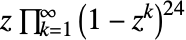 .
.- RamanujanTau automatically threads over lists.
Examples
open all close allBasic Examples (2)
The first 10 values of RamanujanTau:
Table[RamanujanTau[n], {n, 10}]Plot over a subset of the reals:
ListLinePlot[RamanujanTau[Range[20]], PlotRange -> All]Scope (12)
Numerical Evaluation (3)
RamanujanTau[5]RamanujanTau[485]Evaluate efficiently for large values of the argument:
RamanujanTau[72675]//TimingRamanujanTau[586586575];//TimingCompute the elementwise values of an array:
RamanujanTau[{{1, 0}, {-1, 2}}]Or compute the matrix RamanujanTau function using MatrixFunction:
MatrixFunction[RamanujanTau, {{1, 0}, {-1, 2}}]//FullSimplifySpecific Values (2)
Visualization (3)
Plot the RamanujanTau function:
ListLinePlot[RamanujanTau[Range[20]], PlotRange -> All]Plot the contours of the RamanujanTau function:
ListContourPlot[Table[RamanujanTau[x + y], {x, 0, 20, 1}, {y, 0, 20, 1}]]Plot the RamanujanTau function in three dimensions:
ListPlot3D[Table[RamanujanTau[x + y], {x, 0, 20, 1}, {y, 0, 20, 1}], ColorFunction -> "BlueGreenYellow"]Function Properties (4)
RamanujanTau is only defined for integer inputs:
FunctionDomain[RamanujanTau[x], x]FunctionDomain[RamanujanTau[z], z, Complexes]RamanujanTau threads over lists:
RamanujanTau[{2, 3, 5, 7, 11}]RamanujanTauL is everywhere singular:
FunctionSingularities[RamanujanTau[x], x]FunctionDiscontinuities[RamanujanTau[x], x]RamanujanTau[n] // TraditionalFormApplications (7)
Logarithmic plot of RamanujanTau:
ListLinePlot[Log[Abs[RamanujanTau[Range[2000]]]]]The first prime value of RamanujanTau:
RamanujanTau[63001]PrimeQ[%]The first 20,000 values are nonzero, satisfying Lehmer's conjecture [more info]:
And@@Table[RamanujanTau[n] != 0, {n, 20000}]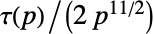

ListLinePlot[RamanujanTau[#] / (2 # ^ (11 / 2)) & /@ Prime[Range[50]], Mesh -> All]m[q_] := (2Pi) ^ 12 NSum[RamanujanTau[n] E ^ (2Pi I n q), {n, 1, Infinity}]Relation with DedekindEta:
m[I] == (2 Pi) ^ 12 DedekindEta[I] ^ 24The summatory  -function [more info]:
Plot[Sum[RamanujanTau[n], {n, 1, x - 1}] + Piecewise[{{RamanujanTau[x] / 2, Element[x, Integers]}}, RamanujanTau[Floor[x]]], {x, 0, 30}, PlotRange -> All, Filling -> Axis]m[τ_] := (2Pi) ^ 12 NSum[RamanujanTau[n] (E^2π I τ)^n, {n, 1, Infinity}]Relation with DedekindEta:
DedekindEta[2I]^24 == m[2I] / (2 Pi) ^ 12Properties & Relations (7)
The first 10 values of RamanujanTau using Product:
CoefficientList[QPochhammer[x] ^ 24 + O[x] ^ 10, x]RamanujanTau[Range[10]]RamanujanTau is multiplicative for coprime integers:
RamanujanTau[7 5]RamanujanTau[7] RamanujanTau[5]
With[{p = 3, n = 6}, RamanujanTau[p ^ (n + 1)] == RamanujanTau[p]RamanujanTau[p ^ n] - p ^ 11 RamanujanTau[p ^ (n - 1)]]And @@ Table[Mod[RamanujanTau[5 n], 5] == 0, {n , 200}]And@@Table[Mod[RamanujanTau[4n] - RamanujanTau[n], 3] == 0, {n, 200}]And @@ Table[Mod[RamanujanTau[n] - DivisorSigma[11, n], 691] == 0, {n, 200}]Representation of an integer as the sum of 24 squares:
r[n_] := 16 / 691 Sum[(-1) ^ (n + d) d ^ 11, {d, Divisors[n]}] + 128 / 691(259(-1) ^ (n - 1)RamanujanTau[n] - 512 RamanujanTau[n / 2])r[8]SquaresR[24, 8]RamanujanTauL is the Dirichlet  -function associated with RamanujanTau:
NSum[RamanujanTau[n] / n ^ (20 + I), {n, 1, Infinity}]N[RamanujanTauL[20 + I]]FindSequenceFunction can recognize the RamanujanTau sequence:
Table[RamanujanTau[n], {n, 10}]FindSequenceFunction[%, n]Possible Issues (1)
Neat Examples (3)
Successive differences of RamanujanTau modulo 3:
ArrayPlot[Mod[NestList[Differences, RamanujanTau[Range[100]], 100], 3]]A representation of zero in terms of RamanujanTau:
RamanujanTau[6] + RamanujanTau[14] + RamanujanTau[29] + RamanujanTau[41] + RamanujanTau[42] + RamanujanTau[44] + RamanujanTau[48]Find digit counts for RamanujanTau[10^12]:
DigitCount[RamanujanTau[10 ^ 12]]Text
Wolfram Research (2007), RamanujanTau, Wolfram Language function, https://reference.wolfram.com/language/ref/RamanujanTau.html.
CMS
Wolfram Language. 2007. "RamanujanTau." Wolfram Language & System Documentation Center. Wolfram Research. https://reference.wolfram.com/language/ref/RamanujanTau.html.
APA
Wolfram Language. (2007). RamanujanTau. Wolfram Language & System Documentation Center. Retrieved from https://reference.wolfram.com/language/ref/RamanujanTau.html