ReactionPDETerm[vars,a]
represents a reaction term  with reaction coefficient
  and with model variables vars.


ReactionPDETerm
ReactionPDETerm[vars,a]
represents a reaction term  with reaction coefficient
  and with model variables vars.
ReactionPDETerm[{u,{x1,…,xn}},a,pars]
uses model parameters pars.
Details
- Reaction terms are used to model absorption or emission in a number of domains, such as biology, chemistry and physics.
- Reaction with a reaction coefficient
 is the process of absorbing of the dependent variable
  :
: - ReactionPDETerm returns differential operators term to be used as a part of partial differential equations:
- ReactionPDETerm can be used to model reaction equations with dependent variable
 , independent variables
  and time variable
  .
. - Stationary model variables vars are vars={u[x1,…,xn],{x1,…,xn}}.
- Time-dependent model variables vars are vars={u[t,x1,…,xn],{x1,…,xn}} or vars={u[t,x1,…,xn],t,{x1,…,xn}}.
- The reaction term
 in context with other PDE terms is given by:
 - The reaction coefficient
 has the following form:
 -


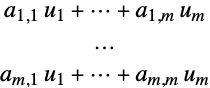
scalar a - For a system of PDEs with dependent variables {u1,…,um}, the reaction represents:
- The reaction term in context systems of PDE terms:
- The reaction coefficient
 is a tensor of rank 2 of the form
  where each submatrix
  is a scalar that can specified in the same way as for a single dependent variable.
 - The reaction coefficient
 can depend on time, space, parameters and the dependent variables.
 - The coefficient
 does not affect the meaning of NeumannValue.
 - All quantities that do not explicitly depend on the independent variables given are taken to have zero partial derivative.




Examples
open all close allBasic Examples (4)
Define a stationary reaction term:
ReactionPDETerm[{u[x], {x}}, a]Define a stationary reaction term with a parameter:
ReactionPDETerm[{u[x], {x}}, a, <|a -> 2|>]Solve a reaction diffusion equation build with basic terms:
vars = {u[x, y], {x, y}};
NDSolveValue[{DiffusionPDETerm[vars, 1] + ReactionPDETerm[vars, 10] == SourcePDETerm[vars, -1], DirichletCondition[u[x, y] == 0, True]}, u[x, y], {x, y}∈Rectangle[]]Plot3D[%, {x, y}∈Rectangle[]]Solve for the eigenvalues of a reaction diffusion equation:
vars = {u[x, y], {x, y}};
NDEigenvalues[{ReactionPDETerm[vars, 4] + DiffusionPDETerm[vars, 1]}, u, {x, y}∈Disk[], 5]
Scope (7)
Define a time-dependent reaction term:
ReactionPDETerm[{u[t, x], t, {x}}, 1 + t]Define a symbolic reaction term:
ReactionPDETerm[{u[t, x], t, {x}}, a]Define a 3D axisymmetric time-independent reaction term:
ReactionPDETerm[{u[r, θ, z], {r, θ, z}}, 1, <|"RegionSymmetry" -> "Axisymmetric"|>]Define a 2D stationary reaction term:
ReactionPDETerm[{u[x, y], {x, y}}, a]Define a reaction term with multiple dependent variables:
ReactionPDETerm[{{u[x], v[x]}, {x}}, {{Subscript[a, 11], Subscript[a, 12]}, {Subscript[a, 21], Subscript[a, 22]}}]helmholtzModel[vars_, k_] := DiffusionPDETerm[vars, 1] + ReactionPDETerm[vars, k]Solve for the eigenvalues of the Helmholtz equation:
NDEigenvalues[{helmholtzModel[{u[x, y], {x, y}}, 4]}, u, {x, y}∈Disk[], 5]Solve the Helmholtz equation with a source term:
vars = {u[x, y], {x, y}};
NDSolveValue[{helmholtzModel[vars, 4] == SourcePDETerm[vars, 1], DirichletCondition[u[x, y] == 0, True]}, u[x, y], {x, y}∈Disk[]]Plot3D[%, {x, y}∈Disk[]]Solve a nonlinear reaction diffusion equation build with basic terms:
vars = {u[x, y], {x, y}};
NDSolveValue[{DiffusionPDETerm[vars, 1] + ReactionPDETerm[vars, u[x, y] ^ 2] == SourcePDETerm[vars, -1], DirichletCondition[u[x, y] == 0, True]}, u[x, y], {x, y}∈Rectangle[]]Plot3D[%, {x, y}∈Rectangle[]]Text
Wolfram Research (2020), ReactionPDETerm, Wolfram Language function, https://reference.wolfram.com/language/ref/ReactionPDETerm.html.
CMS
Wolfram Language. 2020. "ReactionPDETerm." Wolfram Language & System Documentation Center. Wolfram Research. https://reference.wolfram.com/language/ref/ReactionPDETerm.html.
APA
Wolfram Language. (2020). ReactionPDETerm. Wolfram Language & System Documentation Center. Retrieved from https://reference.wolfram.com/language/ref/ReactionPDETerm.html