DiffusionPDETerm[vars]
represents a diffusion term  with model variables vars.
DiffusionPDETerm[vars,c]
represents a diffusion term  with diffusion coefficient
  .
.




DiffusionPDETerm
DiffusionPDETerm[vars]
represents a diffusion term  with model variables vars.
DiffusionPDETerm[vars,c]
represents a diffusion term  with diffusion coefficient
  .
.
DiffusionPDETerm[vars,c,pars]
uses model parameters pars.
Details
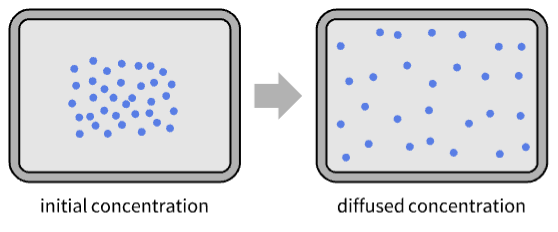
- Diffusion is a central concept of physics that is used in a number of domains, such as thermodynamics, acoustics, structural mechanics and fluid dynamics.
- Diffusion is also known as conduction.
- Diffusion with a diffusion coefficient
 is the process of equilibration solely driven by a gradient of the dependent variable
  :
: - DiffusionPDETerm returns a differential operators term to be used as a part of partial differential equations:
- DiffusionPDETerm can be used to model diffusion equations with dependent variable
 , independent variables
  and time variable
  .
. - Stationary model variables vars are vars={u[x1,…,xn],{x1,…,xn}}.
- Time-dependent model variables vars are vars={u[t,x1,…,xn],{x1,…,xn}} or vars={u[t,x1,…,xn],t,{x1,…,xn}}.
- The diffusion term
 in context with other PDE terms is given by:
 - During diffusion, the medium in which the diffusion happens remains stationary, in contrast to convection where the medium is the transport mechanism.
- The diffusion coefficient
 can have the following forms:
 -


scalar  , isotropic diffusion
{c1,…,cn} 
vector  , orthotropic diffusion
{{c11,…,c1n},…,{cn1,…,cnn}} 
matrix  , anistropic diffusion
 - For a system of PDEs with dependent variables {u1,…,um}, the diffusion represents:
- The diffusion term in context systems of PDE terms:
- The diffusion coefficient
 is a tensor of rank 4 of the form
  where each submatrix
  is an
is an  matrix that can be specified in the same way as for a single dependent variable.
 - A symbolic diffusion coefficient can be specified through a MatrixSymbol. »
- The diffusion coefficient
 can depend on time, space, parameters and the dependent variables.
 - The following parameters pars can be given:
-
parameter default symbol "CoordinateChart" "Cartesian" 
"RegionSymmetry" None 
- A possible choice for the parameter "RegionSymmetry" is "Axisymmetric".
- "Axisymmetric" region symmetry represents a truncated cylindrical coordinate system where the cylindrical coordinates are reduced by removing the angle variable as follows:
-
dimension reduction equation 1D 

2D 

- The coefficient
 affects the meaning of NeumannValue.
 - All quantities that do not explicitly depend on the independent variables given are taken to have zero partial derivative.





Examples
open all close allBasic Examples (6)
Define a stationary diffusion term:
DiffusionPDETerm[{u[x], {x}}, 1]Activate[%]Define a stationary diffusion term with a parametric diffusion coefficient replaced:
DiffusionPDETerm[{u[x], {x}}, κ, <|κ -> 1|>]Activate[%]Define a symbolic diffusion term:
DiffusionPDETerm[{u[x], {x}}, {{κ[x]}}]Activate[%]Find the eigenvalues of a diffusion term:
NDEigenvalues[DiffusionPDETerm[{u[x], {x}}], u, {x}∈Line[{{0}, {1}}], 3]Construct a Poisson equation from basic terms and solve it symbolically:
vars = {u[x, y], {x, y}};
DSolveValue[Activate[DiffusionPDETerm[vars] == SourcePDETerm[vars, 1]], u[x, y], {x, y}]
Solve a time-dependent diffusion equation with a Gaussian initial condition:
ufun = NDSolveValue[{D[u[t, x], t] + DiffusionPDETerm[{u[t, x], {x}}, 1] == 0, u[0, x] == Exp[-x ^ 2]}, u, {t, 0, 1}, {x, -π, π}]Visualize the smoothing of the initial condition through time:
Plot[Evaluate[Table[ufun[t, x], {t, 0, 1, 0.25}]], {x, -π, π}, Rule[...]]Check that the area under the curves remains constant:
NIntegrate[ufun[0, x], {x, -π, π}] - NIntegrate[ufun[1, x], {x, -π, π}]Scope (36)
1D (6)
Define a symbolic matrix diffusion term:
DiffusionPDETerm[{u[t, x], {x}}, MatrixSymbol["c", {1, 1}]]Activate[%]Not specifying a diffusion coefficient will result in an identity matrix coefficient:
DiffusionPDETerm[{u[x], {x}}]Define a time-dependent diffusion term:
DiffusionPDETerm[{u[t, x], {x}}, {{1 + t}}]Activate[%]Define a stationary diffusion term with a parametric diffusion coefficient replaced:
κ = MatrixSymbol["c", {1, 1}];
DiffusionPDETerm[{u[x], {x}}, κ, <|{κ -> {{1}}}|>]Activate[%]Use DiffusionPDETerm for modeling an eigenvalue problem:
NDEigensystem[DiffusionPDETerm[{u[x], {x}}, 1], u, {x, 0, 1}, 3]Use DiffusionPDETerm to set up a 1D Poisson equation:
NDSolveValue[{DiffusionPDETerm[{u[x], {x}}, 1] == 1, DirichletCondition[u[x] == 0, True]}, u, {x, 0, 1}]Plot[%[x], {x, 0, 1}]1D Axisymmetric (1)
Set up a 1D axisymmetric diffusion equation:
DiffusionPDETerm[{u[r], {r}}, 1, <|"RegionSymmetry" -> "Axisymmetric"|>]Apply Activate to the term:
Activate[%]Verify that the axisymmetric case is a consequence of using a truncated cylindrical coordinate system using the operators that compose the diffusion equation:
Div[-1 * Grad[u[r], {r, θ, z}, "Cylindrical"], {r, θ, z}, "Cylindrical"]2D (13)
Define a 2D stationary diffusion term:
DiffusionPDETerm[{u[x, y], {x, y}}, 1]Activate[%]Not specifying a diffusion coefficient will result in an identity matrix coefficient:
DiffusionPDETerm[{u[x, y], {x, y}}]Set up a 2D stationary diffusion equation:
DiffusionPDETerm[{u[x, y], {x, y}}, 1] == 0Activate[%]Define a symbolic matrix diffusion term:
DiffusionPDETerm[{u[x, y], {x, y}}, MatrixSymbol["c", {2, 2}]]Activate[%]Set up a 2D time-dependent diffusion equation:
D[u[t, x, y]] + DiffusionPDETerm[{u[t, x, y], {x, y}}, 1] == 0Activate[%]Define a 2D orthotropic stationary diffusion term with a vector diffusion coefficient:
DiffusionPDETerm[{u[x, y], {x, y}}, {10, 20}]Define a 2D stationary diffusion term with an anisotropic diffusion matrix:
DiffusionPDETerm[{u[x, y], {x, y}}, {{2, 1}, {0, 1}}]Define a 2D diffusion term with an anisotropic diffusion matrix:
DiffusionPDETerm[{u[t, x, y], t, {x, y}}, {{2, 1}, {0, 1}}]Use DiffusionPDETerm to set up a 2D Poisson equation:
NDSolveValue[{DiffusionPDETerm[{u[x, y], {x, y}}, 1] == 1, DirichletCondition[u[x, y] == 0, True]}, u, {x, y}∈Rectangle[]]ContourPlot[%[x, y], {x, y}∈Rectangle[]]Construct a Poisson equation from basic PDE terms and solve it numerically:
vars = {u[x, y], {x, y}};
NDSolveValue[{DiffusionPDETerm[vars] == SourcePDETerm[vars, 1], DirichletCondition[u[x, y] == 0, True]}, u[x, y], {x, y}∈Disk[]]Plot3D[%, {x, y}∈Disk[]]Use a vector-valued diffusion coefficient that has a larger diffusion constant in the  direction than the
  direction:
NDSolveValue[{DiffusionPDETerm[{u[x, y], {x, y}}, {10, 1}] == 1, DirichletCondition[u[x, y] == 0, True]}, u, {x, y}∈Rectangle[]]ContourPlot[%[x, y], {x, y}∈Rectangle[]]Use a vector-valued diffusion coefficient that has a larger diffusion constant in the  direction than the
  direction:
NDSolveValue[{DiffusionPDETerm[{u[x, y], {x, y}}, {1, 10}] == 1, DirichletCondition[u[x, y] == 0, True]}, u, {x, y}∈Rectangle[]]ContourPlot[%[x, y], {x, y}∈Rectangle[]]Use an anisotropic diffusion coefficient:
NDSolveValue[{DiffusionPDETerm[{u[x, y], {x, y}}, {{1, 1 / 2}, {1 / 2, 1}}] == 1, DirichletCondition[u[x, y] == 0, True]}, u, {x, y}∈Rectangle[]]ContourPlot[%[x, y], {x, y}∈Rectangle[]]2D Axisymmetric (3)
Set up a 2D axisymmetric diffusion equation:
DiffusionPDETerm[{u[r, z], {r, z}}, 1, <|"RegionSymmetry" -> "Axisymmetric"|>] == 0Apply Activate to the term:
Activate[%]Verify that the axisymmetric case is a consequence of using a truncated cylindrical coordinate system using the operators that compose the diffusion equation:
Div[{{-1, 0, 0}, {0, -1, 0}, {0, 0, -1}}. Grad[u[r, z], {r, θ, z}, "Cylindrical"], {r, θ, z}, "Cylindrical"]Set up a 2D axisymmetric diffusion equation:
DiffusionPDETerm[{u[r, z], {r, θ, z}}, 1, <|"RegionSymmetry" -> "Axisymmetric"|>]Apply Activate to the term:
Activate[%]Set up a 2D axisymmetric time-dependent diffusion equation:
D[u[t, r, z]] + DiffusionPDETerm[{u[t, r, z], {r, z}}, 1, <|"RegionSymmetry" -> "Axisymmetric"|>] == 0Apply Activate to the term:
Activate[%]3D (1)
Use DiffusionPDETerm to set up a 3D Poisson equation:
usol  = NDSolveValue[
	{DiffusionPDETerm[{u[x, y, z], {x, y, z}}, -1] == 1,
DirichletCondition[u[x, y, z] == x y z, True]}, u, {x, y, z}∈ Ball[]]DensityPlot3D[usol[x, y, z], {x, y, z}∈Ball[], PlotLegends -> Automatic, AxesLabel -> Automatic]Coordinate Chart (3)
Define a diffusion term with a coordinate chart:
DiffusionPDETerm[{u[r, z], {r, z}}, 1, <|"CoordinateChart" -> "Polar"|>]Activate[%]Compare with a Laplacian:
Laplacian[u[r, z], {r, z}, "Polar"]Find eigenvalues and vectors of a diffusion term in polar coordinates:
{vals, funs} = NDEigensystem[{DiffusionPDETerm[{u[r, θ], {r, θ}}, 1, <|"CoordinateChart" -> "Polar"|>], DirichletCondition[u[r, θ] == 0, r == π], PeriodicBoundaryCondition[u[r, θ], θ == -π && r < π, Function[X, X + {0, 2π}]]}, u, {r, θ}∈Rectangle[{0, -π}, {π, π}], 4]Visualize eigenvectors of a Laplacian term in polar coordinates:
RevolutionPlot3D[#[r, θ], {r, 0, π}, {θ, -π, π}, PlotRange -> All]& /@ funsSolve a PDE in polar coordinates:
ifun = NDSolveValue[{DiffusionPDETerm[{u[r, θ], {r, θ}}, 1, <|"CoordinateChart" -> "Polar"|>] == 0, DirichletCondition[u[r, θ] == Sin[4 θ], r == π], DirichletCondition[u[r, θ] == 0, θ == -π || θ == π]}, u, {r, θ}∈Rectangle[{0, -π}, {π, π}]]Plot the solution in Cartesian coordinates:
Plot3D[Evaluate[ifun[r, θ] /. {r -> Sqrt[x ^ 2 + y ^ 2], θ -> ArcTan[x, y]}], {x, y}∈Disk[{0, 0}, π]]Coupled (6)
Define a diffusion term with multiple dependent variables:
DiffusionPDETerm[{{u[x], v[x]}, {x}}]Define a diffusion term with multiple dependent variables:
DiffusionPDETerm[{{u[x], v[x]}, {x}}, 1]Define a diffusion term with multiple dependent variables and multiple diffusion coefficients:
DiffusionPDETerm[{{u[x], v[x]}, {x}}, {{Subscript[c, 11], Subscript[c, 12]}, {Subscript[c, 21], Subscript[c, 22]}}]Define a diffusion term with multiple dependent variables and anisotropic diffusion coefficients:
DiffusionPDETerm[{{u[x, y], v[x, y]}, {x, y}}, {{Subscript[c, 11], {Subscript[c, 1211], Subscript[c, 1222]}}, {0, {{Subscript[c, 2211], Subscript[c, 2212]}, {Subscript[c, 2221], Subscript[c, 2222]}}}}]Define a diffusion term with multiple dependent variables and all coefficients specified:
cIn = Array[Subscript[c, ##]&, {2, 2, 2, 2}]DiffusionPDETerm[{{u[x, y], v[x, y]}, {x, y}}, cIn]Off-diagonal diffusion coefficients are possible in coupled PDEs:
MatrixForm[coefficients = {{{{1, 0}, {0, 1}}, {{0, 2}, {2, 0}}}, {{{0, 0}, {0, 0}}, {{1, 0}, {0, 1}}}}]{uif, vif} = NDSolveValue[{DiffusionPDETerm[{{u[x, y], v[x, y]}, {x, y}}, coefficients] == {1, 1}, DirichletCondition[{u[x, y] == 0, v[x, y] == 0}, True]}, {u, v}, {x, y}∈Rectangle[]];GraphicsRow[{ContourPlot[uif[x, y], {x, y}∈Rectangle[]], ContourPlot[vif[x, y], {x, y}∈Rectangle[]]}]Coupled Axisymmetric (3)
Use DiffusionPDETerm to set up a 1D axisymmetric equation with multiple dependent variables:
eqn = DiffusionPDETerm[{{u[r], v[r]}, {r}}, {{2.4, 3}, {3, 3}}, <|"RegionSymmetry" -> "Axisymmetric"|>] == {1, 1}bcs = {u[0.1] == 200, v[0.1] == 200, u[0.5] == 50, v[0.5] == 5};Solve the equations numerically:
{uif, vif} = NDSolveValue[{eqn, bcs}, {u, v}, {r, 0.1, 0.5}]Solve the same equation symbolically:
{fufun, fvfun} = DSolveValue[{eqn, bcs}, {u, v}, {r}]Visualize the difference between the results:
Plot[{fufun[r] - uif[r], fvfun[r] - vif[r]}, {r, 0.1, 0.5}, PlotLegends -> "Expressions", PlotRange -> All]Define an axisymmetric diffusion term with multiple dependent variables:
DiffusionPDETerm[{{u[r, z], v[r, z]}, {r, z}}, 1, <|"RegionSymmetry" -> "Axisymmetric"|>]Apply Activate to the term:
Activate[%]Define a 2D diffusion axisymmetric term with multiple dependent variables and multiple diffusion coefficients:
MatrixForm[
coefficients = {{{{25, 0}, {0, 25}}, {{0, 10}, {5, 0}}}, {{{0, 15}, {20, 0}}, {{50, 0}, {0, 25}}}}]coupledPDEs = DiffusionPDETerm[{{u[r, z], v[r, z]}, {r, z}}, coefficients, <|"RegionSymmetry" -> "Axisymmetric"|>];{uif, vif} = NDSolveValue[{coupledPDEs == {1, 1}, DirichletCondition[{u[r, z] == 0, v[r, z] == 0}, z == 0]}, {u, v}, {r, z}∈Rectangle[]];GraphicsRow[{ContourPlot[uif[r, z], {r, z}∈Rectangle[]], ContourPlot[vif[r, z], {r, z}∈Rectangle[]]}]Applications (9)
Use DiffusionPDETerm with a variable diffusion coefficient:
model = DiffusionPDETerm[{u[x], {x}}, {{If[x ≤ 3 / 4, 1, 2]}}]solution = NDSolveValue[{model == 0, DirichletCondition[u[x] == 1, x == 0], DirichletCondition[u[x] == 0, x == 1]}, u, {x, 0, 1}]flux = model /. Inactive[Div][flux_, _] :> Activate[flux]Plot[Evaluate[{solution[x], flux /. u -> solution}], {x, 0, 1}, ...]Use DiffusionPDETerm to model conductive heat transfer using an axisymmetric geometry.
The region of analysis is a 2D region. Instead of defining the full 2D region in Cartesian coordinates  , you can define a region with truncated cylindrical coordinates in 1D
  . The cylindrical coordinate variables
  and
and  vanish because the system is rotationally symmetric around the
  axis.
axis.
eqn = DiffusionPDETerm[{u[r], {r}}, 2.4, <|"RegionSymmetry" -> "Axisymmetric"|>] == 0bcs = {u[1 / 10] == 200, u[1 / 2] == 50};numericSolution = NDSolveValue[{eqn, bcs}, u, {r, 0.1, 0.5}]Or solve it symbolically with DSolveValue:
analytocalSolution = DSolveValue[{eqn, bcs}, u, r]Visualize the difference between the results:
Plot[analytocalSolution[r] - numericSolution[r], {r, 0.1, 0.5}, PlotRange -> All]Use DiffusionPDETerm to model species diffusion under a dam. Set up the region:
Subscript[Ω, dam] = Rectangle[{6, 3}, {12, 18}];
Subscript[Ω, sediment] = RegionDifference[Rectangle[{0, 0}, {18, 6}], Subscript[Ω, dam]];model = DiffusionPDETerm[{u[x, y], {x, y}}, 10 ^ -4]solution = NDSolveValue[{model == 0, DirichletCondition[u[x, y] == 16, x ≤ 6 && y == 6], DirichletCondition[u[x, y] == 8, x ≥ 12 && y == 6]}, u, {x, y}∈Subscript[Ω, sediment]]flux = model /. Inactive[Div][flux_, _] :> Activate[flux]Show[
...,
VectorPlot[Evaluate[flux /. u -> solution], {x, y}∈Subscript[Ω, sediment], Rule[...]]]Find the concentration of species under the dam. Construct the model:
op = DiffusionPDETerm[{c[x, y], {x, y}}, 1] + ConvectionPDETerm[{c[x, y], {x, y}}, flux /. u -> solution] + 2 * 10 ^ -5c[x, y];concentration = NDSolveValue[{op == 0,
DirichletCondition[c[x, y] == 100, x ≤ 6 && y == 6], DirichletCondition[c[x, y] == 50, x ≥ 12 && y == 6]
}, c, {x, y}∈Subscript[Ω, sediment]]Visualize the species concentration:
Show[
	...,
	ContourPlot[concentration[x, y], {x, y}∈Subscript[Ω, sediment], ...],
	VectorPlot[Evaluate[flux /. u -> solution], {x, y}∈Subscript[Ω, sediment], Rule[...]]
]helmholtzModel[vars_, k_] := DiffusionPDETerm[vars, 1] + ReactionPDETerm[vars, k]Solve for the eigenvalues of the Helmholtz equation:
NDEigenvalues[{helmholtzModel[{u[x, y], {x, y}}, 4]}, u, {x, y}∈Disk[], 5]Solve the Helmholtz equation with a source term:
vars = {u[x, y], {x, y}};
NDSolveValue[{helmholtzModel[vars, 4] == SourcePDETerm[vars, 1], DirichletCondition[u[x, y] == 0, True]}, u[x, y], {x, y}∈Disk[]]Plot3D[%, {x, y}∈Disk[]]Use DiffusionPDETerm to model conductive heat transfer using an axisymmetric geometry. The region of analysis is a 3D hollow cylinder. Instead of defining the full 3D region in Cartesian coordinates  , you can define a region with truncated cylindrical coordinates in 2D
  . The cylindrical coordinate variable
  vanishes because the system is rotationally symmetric around the
  axis.
axis.
Ω = Rectangle[{0.02, 0}, {0.1, 0.14}];model = DiffusionPDETerm[{u[r, z], {r, z}}, 52, <|"RegionSymmetry" -> "Axisymmetric"|>]Solve the axisymmetric equation:
solution = NDSolveValue[{model == NeumannValue[5 * 10 ^ 5, r == 0.02 && (0.04 <= z <= 0.1)], DirichletCondition[u[r, z] == 273.15, z == 0 || r == 0.1 || z == 0.14]}, u, {r, z}∈Ω]ContourPlot[solution[r, z], {r, z}∈Ω, ...]Visualize the result in 3D space for part of the cylinder:
Legended[RegionPlot3D[0.02^2 ≤ x^2 + y^2 ≤ 0.1^2 && 0 ≤ PlanarAngle[{0, 0} -> {{0.02, 0}, {x, y}}] ≤ (4 π/3), {x, -0.1, 0.1}, {y, -0.1, 0.1}, {z, 0, 0.14}, ...], BarLegend[...]]Use DiffusionPDETerm to model a nonlinear conductive heat transfer using an axisymmetric geometry.
radius = 3;
height = 8;
Ω2D = Rectangle[{0, 0}, {radius, height}];
Find the thermal conductivity for air:
Subscript[k, air] = QuantityMagnitude[ThermodynamicData["Air", "ThermalConductivity"]];flux = 10;
temperature = 10;
model2D = {DiffusionPDETerm[{u[r, z], {r, z}}, (Subscript[k, air] + 10^-3u[r, z]) * IdentityMatrix[2], <|"RegionSymmetry" -> "Axisymmetric"|>] == NeumannValue[flux, r == radius], DirichletCondition[u[r, z] == temperature, z == 0]};Solve the equation and measure the time and memory needed to do so:
measure2D  =
	AbsoluteTiming[
	MaxMemoryUsed[
	solution2D = NDSolveValue[model2D, u, {r, z}∈Ω2D]]];
Visualize the axisymmetric result:
ContourPlot[solution2D[r, z], {r, z}∈Ω2D, ...]Print the total time to do the computation and number of megabytes used during the evaluation:
Print["Time -> ", measure2D[[1]], " s", "
Memory -> ", measure2D[[2]] / (1024. ^ 2), " MB"]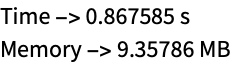
Use DiffusionPDETerm to set up a plane stress operator. Set up the coupled coefficients:
MatrixForm[coefficients = {{{{(Y/1 - ν^2), 0}, {0, (Y (1 - ν)/2 (1 - ν^2))}}, {{0, (Y ν/1 - ν^2)}, {(Y (1 - ν)/2 (1 - ν^2)), 0}}}, {{{0, (Y (1 - ν)/2 (1 - ν^2))}, {(Y ν/1 - ν^2), 0}}, {{(Y (1 - ν)/2 (1 - ν^2)), 0}, {0, (Y/1 - ν^2)}}}}]model = DiffusionPDETerm[{{u[x, y], v[x, y]}, {x, y}}, coefficients, <|ν -> 1 / 3, Y -> 10 ^ 3|>]Ω = Rectangle[{0, 0}, {5, 1}]{uif, vif} = NDSolveValue[{model == {0, NeumannValue[-1, x == 5]}, DirichletCondition[{u[x, y] == 0., v[x, y] == 0.}, x == 0]}, {u, v}, {x, y}∈Ω]ContourPlot[uif[x, y], {x, y}∈Ω, ...]ContourPlot[vif[x, y], {x, y}∈Ω, ...]flux = model /. Inactive[Div][flux_, _] :> Activate[flux]stokesModel[vars_, μ_] := DiffusionPDETerm[vars, {{μ, 0, 0}, {0, μ, 0}, {0, 0, 0}}] + ConvectionPDETerm[vars, {{0, 0, {1, 0}}, {0, 0, {0, 1}}, {{1, 0}, {0, 1}, 0}}]eqn = stokesModel[{{u[x, y], v[x, y], p[x, y]}, {x, y}}, 1] == {0, 0, 0}Ω = RegionUnion[Rectangle[{0, 0}, {1, 1 / 2}], Rectangle[{1, 1 / 10}, {2, 2 / 5}]];bcs = {DirichletCondition[
{u[x, y] == 4 * 0.3 * y * (0.5 - y) / (0.41) ^ 2, v[x, y] == 0.}, x == 0.], DirichletCondition[{u[x, y] == 0., v[x, y] == 0.}, 0 < x < 2],
DirichletCondition[p[x, y] == 0., x == 2]};{xVel, yVel, pressure} = NDSolveValue[{eqn, bcs}, {u, v, p}, {x, y}∈Ω, Method -> {"FiniteElement", "InterpolationOrder" -> {u -> 2, v -> 2, p -> 1}, "MeshOptions" -> {"MaxCellMeasure" -> 0.0005}}];VectorPlot[{xVel[x, y], yVel[x, y]}, {x, y}∈Ω, AspectRatio -> Automatic, StreamPoints -> 6, StreamColorFunction -> "TemperatureMap", StreamColorFunctionScaling -> False]//QuietExtend a Stokes-flow model to a Navier–Stokes-flow model. Define a Stokes-flow model:
stokesModel[vars_, μ_] := DiffusionPDETerm[vars, {{μ, 0, 0}, {0, μ, 0}, {0, 0, 0}}] + ConvectionPDETerm[vars, {{0, 0, {1, 0}}, {0, 0, {0, 1}}, {{1, 0}, {0, 1}, 0}}]Define a Navier–Stokes-flow model:
navierStokesModel[vars_, μ_, ρ_] := stokesModel[vars, μ] + ConvectionPDETerm[vars, {{ρ vars[[1, {1, 2}]], 0, 0}, {0, ρ vars[[1, {1, 2}]], 0}, {0, 0, 0}}]eqn = navierStokesModel[{{u[x, y], v[x, y], p[x, y]}, {x, y}}, 1, 10 ^ -3] == {0, 0, 0}Ω = Rectangle[{0, 0}, {1, 1}];bcs = {DirichletCondition[
{u[x, y] == 1, v[x, y] == 0}, y == 1], DirichletCondition[{u[x, y] == 0, v[x, y] == 0}, y < 1],
DirichletCondition[p[x, y] == 0, x == 0 && y == 1]};{xVel, yVel, pressure} = NDSolveValue[{eqn, bcs}, {u, v, p}, {x, y}∈Ω, Method -> {"FiniteElement", "InterpolationOrder" -> {u -> 2, v -> 2, p -> 1}, "MeshOptions" -> {"MaxCellMeasure" -> 0.0005}}];VectorPlot[{xVel[x, y], yVel[x, y]}, {x, y}∈Ω, AspectRatio -> Automatic, StreamPoints -> 6, StreamColorFunction -> "TemperatureMap", StreamColorFunctionScaling -> False]//QuietProperties & Relations (3)
Verify that anisotropic diffusion  is the same as
  :
:
sol1 = NDSolveValue[{DiffusionPDETerm[{u[x, y], {x, y}}, {{1, 1 / 2}, {0, 1}}] == 1, DirichletCondition[u[x, y] == 0, True]}, u, {x, y}∈Rectangle[]]sol2 = NDSolveValue[{DiffusionPDETerm[{u[x, y], {x, y}}, {{1, 1 / 4}, {1 / 4, 1}}] == 1, DirichletCondition[u[x, y] == 0, True]}, u, {x, y}∈Rectangle[]]Visualize that there is no difference in the two solutions:
Plot3D[Chop[sol1[x, y] - sol2[x, y]], {x, y}∈Rectangle[]]Solve a time-dependent diffusion equation with a Gaussian initial condition:
nfun = NDSolveValue[{D[u[t, x], t] + DiffusionPDETerm[{u[t, x], {x}}, 1] == 0, DirichletCondition[u[t, x] == 0, True], u[0, x] == Exp[-x ^ 2]}, u[t, x], {t, 0, 1}, {x, -π, π}]The analytical solution is an infinite series:
afun = DSolveValue[{Activate[D[u[t, x], t] + DiffusionPDETerm[{u[t, x], {x}}, 1] == 0], u[t, -π] == 0, u[t, π] == 0, u[0, x] == Exp[-x ^ 2]}, u, {t, 0, 1}, {x, -π, π}]Extract a few terms from the Inactive sum:
asol = afun[t, x] /. {∞ -> 15}//Activate;Visualize the difference between the numerical and the analytical solutions:
Plot3D[asol - nfun, {x, -π, π}, {t, 0, 1}, AxesLabel -> {"x", "t"}, PlotRange -> All]The equilibration property of the diffusion term manifests itself in the smoothing of a discontinuous initial condition:
ufun = NDSolveValue[{D[u[t, x], t] + DiffusionPDETerm[{u[t, x], {x}}, 1] == 0, DirichletCondition[u[t, x] == 0, True], u[0, x] == 1 / 2 - Abs[x - 1 / 2]}, u, {t, 0, 0.001}, x∈Line[{{0}, {1}}]]Visualize the discontinuous initial condition and the smoothed evolution of the initial condition:
Plot[{(1 / 2 - Abs[x - 1 / 2]), ufun[0.001, x]}, {x, 0, 1}, PlotRange -> {{0.35, 0.65}, {0.4, 0.51}}]Possible Issues (3)
The negative sign in the operator  does not need to be given:
DiffusionPDETerm[{u[x], {x}}, c]A symbolic diffusion coefficient is interpreted as a scalar coefficient in the following input:
DiffusionPDETerm[{u[x], {x}}, c]A subsequent substitution must account for that:
DiffusionPDETerm[{u[x], {x}}, c, <|c -> 1|>]DiffusionPDETerm[{u[x], {x}}, c]//ActivateA numeric diffusion coefficient will automatically be multiplied with an IdentityMatrix of proper dimensions:
DiffusionPDETerm[{u[x], {x}}, 1]A way to specify a symbolic matrix diffusion coefficient is through a MatrixSymbol:
cs = MatrixSymbol["c", {1, 1}];
DiffusionPDETerm[{u[x], {x}}, cs, <|cs -> {{1}}|>]
Using a MatrixSymbol allows for activation of the operator:
DiffusionPDETerm[{u[x], {x}}, cs]//ActivateDiffusionPDETerm models  , not
, not  :
:
c = 1 / (x + 1);
model = DiffusionPDETerm[{u[x], {x}}, {{c}}];
solution1 = NDSolveValue[{model == 1, DirichletCondition[u[x] == 1, x == 0], DirichletCondition[u[x] == 0, x == 1]}, u, {x, 0, 1}];solution2 = NDSolveValue[{-c Laplacian[u[x], {x}] == 0, DirichletCondition[u[x] == 1, x == 0], DirichletCondition[u[x] == 0, x == 1]}, u, {x, 0, 1}];Visualize the difference in the solutions:
Plot[{solution1[x], solution2[x]}, {x, 0, 1}, PlotLegends -> {"solution1", "solution2"}]Text
Wolfram Research (2020), DiffusionPDETerm, Wolfram Language function, https://reference.wolfram.com/language/ref/DiffusionPDETerm.html (updated 2026).
CMS
Wolfram Language. 2020. "DiffusionPDETerm." Wolfram Language & System Documentation Center. Wolfram Research. Last Modified 2026. https://reference.wolfram.com/language/ref/DiffusionPDETerm.html.
APA
Wolfram Language. (2020). DiffusionPDETerm. Wolfram Language & System Documentation Center. Retrieved from https://reference.wolfram.com/language/ref/DiffusionPDETerm.html