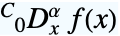



CaputoD
CaputoD[f,{x,α}]
gives the Caputo fractional differintegral 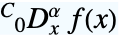 of the function
  .
.
Details and Options
- CaputoD is also known as the Caputo differintegral of f.
- CaputoD generalizes D to fractional order and unifies the notions of derivatives and integrals from calculus.
- CaputoD has found wide applications for modeling systems using initial value problems for fractional differential equations.
- The Caputo fractional derivative of order
 of
of  is defined as
  , where
 ![n=max(0,TemplateBox[{alpha}, Ceiling])](Files/CaputoD.en/1.png "n=max(0,TemplateBox[{alpha}, Ceiling])") .
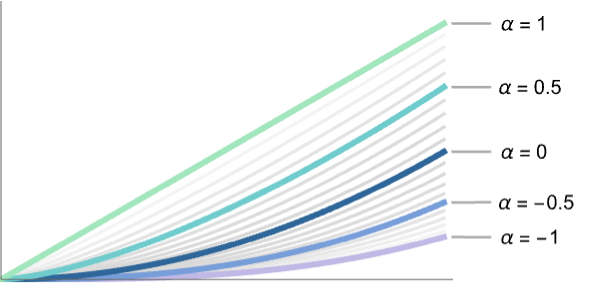
. - The derivatives of fractional order "interpolate" between the derivatives of integer orders, as shown below for the function
 and its fractional derivatives of order
  given by
 ![2/TemplateBox[{{3, -, alpha}}, Gamma] x^(2-alpha)](Files/CaputoD.en/2.png "2/TemplateBox[{{3, -, alpha}}, Gamma] x^(2-alpha)") for
for  :
: - The Caputo fractional derivative is connected with the FractionalD (Riemann–Liouville fractional derivative) via the formula
 .
. - The order α of a fractional derivative can be symbolic or an arbitrary real number.
- CaputoD[{array},{x,α}] threads CaputoD over each element of array.
- CaputoD takes different Assumptions on the parameters of input functions.
- All expressions that do not explicitly depend on the given variable
 are interpreted as constants.
Examples
open all close allBasic Examples (4)
Calculate the half-order Caputo fractional derivative of a quadratic function with respect to x:
CaputoD[x^2, {x, 1 / 2}]Arbitrary-order Caputo fractional derivative of a quadratic function with respect to x:
CaputoD[x^2, {x, α}]Plot these fractional derivatives for different  's:
's:
Plot[Evaluate[% /. α -> {0, 1 / 2, 9 / 10, 1}], {x, 0, 1}, Rule[...]]The Caputo fractional derivative of a constant with respect to x for positive values of  is 0:
is 0:
CaputoD[c, {x, 2 / 3}]Caputo fractional derivative of MittagLefflerE:
CaputoD[MittagLefflerE[a, x], {x, 1 / 2}]Scope (4)
Caputo fractional derivative of the Exp function with respect to x:
CaputoD[Exp[x], {x, 1 / 2}]Caputo fractional derivative of the Sin function with respect to x:
CaputoD[Sin[x], {x, 5 / 2}]This expression can be further simplified:
%//FunctionExpand//FullSimplifyCaputo fractional derivative of some BesselJ function:
CaputoD[BesselJ[1 / 3, x], {x, 1 / 2}]Laplace transform of the CaputoD function in general form:
LaplaceTransform[CaputoD[f[t], {t, 3 / 2}], t, s]Apply the formula to Sin:
% /. {f[t_] -> Sin[t], f'[t_] -> Cos[t]}//SimplifyGet the same result applying LaplaceTransform to the CaputoD of Sin:
LaplaceTransform[CaputoD[Sin[t], {t, 3 / 2}], t, s]//FullSimplifyOptions (1)
Assumptions (1)
CaputoD may return a ConditionalExpression:
CaputoD[MittagLefflerE[a, x], {x, 1 / 2}]Restricting parameters using Assumptions will simplify the output:
CaputoD[MittagLefflerE[a, x], {x, 1 / 2}, Assumptions -> {a > 0}]Applications (8)
Calculate the half-order Caputo fractional derivative of the cubic function:
CaputoD[x ^ 3, {x, 1 / 2}]Get the ordinary derivative of the cubic function repeating the half-order Caputo fractional differentiation:
CaputoD[%, {x, 1 / 2}]Recover the initial function using the Caputo fractional integration operation:
CaputoD[CaputoD[CaputoD[%, {x, -1 / 3}], {x, -1 / 3}], {x, -1 / 3}]Solve a fractional DE containing a half-order Caputo derivative:
sol = DSolve[CaputoD[y[x], {x, 1 / 2}] - y[x] == 0, y[x], x]sol = DSolve[{CaputoD[y[x], {x, 1 / 2}] - y[x] == 0, y[0] == 1 / 2}, y[x], x]Plot[Evaluate[y[x] /. sol[[1]]], {x, 0, 1}]sol = DSolve[{CaputoD[y[x], {x, 21 / 10}] + 10y[x] == 0, y[0] == 1, y'[0] == 0, y''[0] == 0}, y[x], x]Plot[y[x] /. %, {x, 0, 10}]Solve a mixed fractional differential-integral equation:
DSolve[{CaputoD[y[x], {x, 1 / 2}] - CaputoD[y[x], {x, -1 / 2}] == 1, y[0] == 0}, y[x], x]Solve some fractional DE containing two different order Caputo derivatives:
sol = DSolve[{CaputoD[y[x], {x, 3 / 4}] == -2CaputoD[y[x], {x, 1 / 2}] + y[x], y[0] == 1}, y[x], x]//FullSimplifySolve a system of two fractional DEs including CaputoD fractional derivatives of functions:
eqns = {CaputoD[x1[t], {t, 0.95}] == 2x1[t] - x2[t], CaputoD[x2[t], {t, 0.95}] == 4x1[t] - 3x2[t], x1[0] == 1.2, x2[0] == 4.2};

sol = DSolve[eqns, {x1, x2}, t]eqns /. sol//SimplifyParametric plot of this solution:
ParametricPlot[Evaluate[{x1[t], x2[t]} /. sol], {t, 0, 2}]Solve a system of two fractional DEs in vector form:
B = {{0, 1}, {-1, 0}};
a = 16 / 17;
v = {-3, 5};
sol = DSolve[{CaputoD[x[t], {t, a}] == B. x[t], x[0] == v}, Element[x[t], Vectors[2]], t]Plot[Evaluate[x[t] /. sol[[1]]], {t, 0, 10}]Parametrically plot the solution:
ParametricPlot[Evaluate[x[t] /. sol[[1]]], {t, 0, 20}]Solve a system of three fractional DEs in vector form:
B = {{-1, 0, 0}, {2, 1, -9}, {3, 6, 1}};
a = 0.95;
v = {-3, 5, 0};

sol = DSolve[{CaputoD[x[t], {t, a}] == B. x[t], x[0] == v}, Element[x[t], Vectors[3]], t]Plot[Evaluate[x[t] /. sol[[1]]], {t, 0, 1}]Parametrically plot the solution:
ParametricPlot3D[Evaluate[x[t] /. sol[[1]]], {t, 0, 1}]Properties & Relations (7)
CaputoD is defined for all real  :
:
CaputoD[x ^ 2, {x, 4 / 5}]CaputoD[x ^ 2, {x, -4 / 5}]0-order Caputo fractional derivative is the function itself:
CaputoD[x ^ 2, {x, 0}]CaputoD is not defined for complex order  :
:
CaputoD[x ^ 2, {x, -4 / 5 + I}]
The Caputo fractional derivative of a constant is 0 for positive fractional orders:
CaputoD[c, {x, 1 / 2}]CaputoD[c, {x, α}]CaputoD coincides with FractionalD for all negative orders  :
:
CaputoD[Sin[a x], {x, -1 / 2}]Compare with the output of FractionalD:
FractionalD[Sin[a x], {x, -1 / 2}]Restricting the order  to negative values, CaputoD will automatically generate the FractionalD output:
CaputoD[Sin[a x], {x, α}, Assumptions -> {α < 0}]% /. α -> -1 / 2Calculate the Caputo fractional derivative of a function at some point:
N[CaputoD[Sin[x]Cos[x - 1], {x, 1 / 2}] /. x -> 1 / 3]//AbsoluteTimingUse the NCaputoD function for faster numerical calculations:
NCaputoD[Sin[x]Cos[x - 1], {x, 1 / 2}, 1 / 3]//AbsoluteTimingPossible Issues (1)
CaputoD fractional derivative might not be defined for some fractional orders:
CaputoD[x^1 / 3, {x, 5 / 3}]
While for others it is defined:
CaputoD[x^1 / 3, {x, 2 / 3}]Neat Examples (1)
Create a table of half-order Caputo fractional derivatives for some special functions:
flist = {E ^ (x), x ^ 2, Sin[x], ArcTan[x], BesselJ[0, x], Hypergeometric1F1[a, b, x]};Grid[Join[{{f[x], Subsuperscript[D, x, α][f[x]]}}, Transpose[{flist, Map[CaputoD[#, {x, 1 / 2}]&, flist]}]], IconizedObject[«Grid options»]]//TraditionalForm//FullSimplifyText
Wolfram Research (2022), CaputoD, Wolfram Language function, https://reference.wolfram.com/language/ref/CaputoD.html.
CMS
Wolfram Language. 2022. "CaputoD." Wolfram Language & System Documentation Center. Wolfram Research. https://reference.wolfram.com/language/ref/CaputoD.html.
APA
Wolfram Language. (2022). CaputoD. Wolfram Language & System Documentation Center. Retrieved from https://reference.wolfram.com/language/ref/CaputoD.html