



Exp
Exp[z]
gives the exponential of z.
Details
- Mathematical function, suitable for both symbolic and numerical manipulation.
- For certain special arguments, Exp automatically evaluates to exact values.
- Exp can be evaluated to arbitrary numerical precision.
- Exp automatically threads over lists.
- Exp[z] is converted to E^z.
- Exp can be used with Interval and CenteredInterval objects. »
Examples
open all close allBasic Examples (6)
Exp[3.4]Evaluate numerically to any precision:
Exp[I Pi / 5]N[%, 30]Plot over a subset of the reals:
Plot[Exp[x], {x, -1, 1}]Plot over a subset of the complexes:
ComplexPlot3D[Exp[z], {z, -2 - 2I, 2 + 2I}, PlotLegends -> Automatic]Series expansion at the origin:
Series[Exp[x], {x, 0, 10}]Exponential functions can be entered as  ee
ee
 x:
x:
E^xScope (55)
Numerical Evaluation (6)
Exp[1.5]N[Exp[16 / 10], 50]The precision of the output tracks the precision of the input:
Exp[1.60000000000000000000000]Exp can take complex number inputs:
Exp[2.5 + I]Evaluate Exp efficiently at high precision:
Exp[1.6`500]//TimingExp[1.6`100000];//TimingCompute worst-case guaranteed intervals using Interval and CenteredInterval objects:
Exp[Interval[{-1, Log[2]}]]Exp[CenteredInterval[2, 1 / 100]]Exp[CenteredInterval[2 + 3I, (1 + I) / 100]]Or compute average-case statistical intervals using Around:
Exp[ Around[2, 0.01]]Compute the elementwise values of an array:
Exp[{{1, I π / 2}, {0, 1}}]Or compute the matrix Exp function using MatrixFunction:
MatrixFunction[Exp, {{1, I π / 2}, {0, 1}}]Specific Values (6)
Exp[0]Values of Exp at fixed points:
Table[Exp[I n (π/2)], {n, 0, 4}]Exp[Infinity]Exp[-Infinity]Simple exact values are generated automatically:
Exp[9 / 2 I Pi]Some more complicated values can be expanded using ExpToTrig:
ExpToTrig[Exp[I Pi / 5]]Local extrema of Exp along the imaginary axis:
Assuming[n∈Integers, Refine@Exp[2π I n]]Assuming[n∈Integers, Refine@Exp[2 π I(n + (1/2))]]Find a value of  for which the
  using Solve:
f[x_] := Exp[x] - 1.7Solve[f[x] == 0, x, Reals]//Quietxval = x /. First[%]Plot[f[x], {x, -2, 2}, Epilog -> Style[Point[{xval, f[xval]}], PointSize[Large], Red]]Visualization (4)
Plot the Exp function:
Plot[Exp[x], {x, -2, 2}]Plot the real and imaginary parts of Exp[I x]:
ReImPlot[Exp[I x], {x, -2π, 2π}, PlotLegends -> Automatic]
ComplexContourPlot[Re[Exp[z]], {z, -2 - 4 I, 2 + 4 I}, Contours -> 20]
ComplexContourPlot[Im[Exp[z]], {z, -2 - 4 I, 2 + 4 I}, Contours -> 20]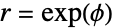
PolarPlot[Exp[ϕ], {ϕ, 0, 2π}, Frame -> True]Function Properties (12)
Exp is defined for all real and complex values:
FunctionDomain[Exp[x], x]FunctionDomain[Exp[z], z, Complexes]Exp achieves all positive values on the reals:
FunctionRange[Exp[x], x, y]The range for complex values is the entire plane except for 0:
FunctionRange[Exp[z], z, y, Complexes]Exp is a periodic function with period  :
:
FullSimplify[Exp[z + 2π I n] == Exp[z], n∈Integers]Exp has the mirror property ![exp(TemplateBox[{z}, Conjugate])=TemplateBox[{{exp, (, z, )}}, Conjugate]](Files/Exp.en/16.png "exp(TemplateBox[{z}, Conjugate])=TemplateBox[{{exp, (, z, )}}, Conjugate]") :
:
FullSimplify[Exp[Conjugate[z]] == Conjugate[Exp[z]]]Exp is an analytic function of x:
FunctionAnalytic[Exp[x], x]Exp is non-decreasing:
FunctionMonotonicity[Exp[x], x]Exp is injective:
FunctionInjective[Exp[x], x]Plot[{Exp[x], 2}, {x, -3, 3}]Exp is not surjective:
FunctionSurjective[Exp[x], x]Plot[{Exp[x], -1}, {x, -2π, 2π}]Exp is non-negative:
FunctionSign[Exp[x], x]Has no singularities or discontinuities:
FunctionSingularities[Exp[x], x]FunctionDiscontinuities[Exp[x], x]Exp is convex:
FunctionConvexity[Exp[x], x]TraditionalForm formatting:
Exp[x]//TraditionalFormDifferentiation (3)

 derivative:
Integration (5)
Indefinite integral of Exp:
Integrate[Exp[x], x]Definite integral of Exp:
Integrate[Exp[x], {x, -Infinity, 0}]Integrate[Exp[-x^2], {x, -Infinity, Infinity}]Plot[Exp[-x^2], {x, -3, 3}, Axes -> False, Frame -> True, Filling -> Bottom]Integrate[t^z - 1Exp[-t], {t, 0, Infinity}, Assumptions -> Re[z] > 0]Integrate[z^αExp[z^β], z]Integrate[t^k / (Exp[t] + 1), {t, 0, Infinity}, Assumptions -> k > -1]Integrate[Exp[-a t^2 - (b/t^2)], {t, 0, Infinity}, Assumptions -> a > 0 && b > 0]Integrate[Exp[Exp[I t]], {t, 0, 2Pi}]Series Expansions (5)
Taylor expansion for Exp:
Series[Exp[x], {x, 0, 7}]Plot the first three approximations for Exp around  :
:
terms = Normal@Table[Series[Exp[x], {x, 0, m}], {m, 1, 3}];
Plot[{Exp[x], terms}, {x, -2, 3}]
General term in the series expansion of Exp:
SeriesCoefficient[Exp[x], {x, 0, n}]Series expansion of the exponential function  at infinity:
Series[Exp[1 / x], {x, Infinity, 3}]The first-order Fourier series:
FourierSeries[Exp[z], z, 1]//FullSimplifyExp can be applied to power series:
Exp[x - (x^2/2) + (x^3/9) + O[x]^4]Integral Transforms (3)
Compute the Fourier transforms using FourierTransform:
FourierTransform[Exp[-Abs[t]], t, ω]FourierTransform[Exp[-t ^ 2], t, ω]LaplaceTransform[Exp[t], t, s ]MellinTransform[Exp[-x], x, s ]Function Identities and Simplifications (6)
Exp[z] == Power[E, z]ExpToTrig[Exp[I x]]Convert from exponential to hyperbolic functions:
ExpToTrig[Exp[x]]Convert trigonometric and hyperbolic functions into exponentials:
TrigToExp[{Sin[z], Cosh[z]}]Products are automatically combined:
Exp[x]Exp[y]Exp[1 / z]Expand assuming real variables x and y:
ComplexExpand[Exp[x + I y]]Function Representations (5)
Exp arises from the power function in a limit:
Limit[(1 + (x/n))^n, n -> Infinity]Sum[(z^k/k!), {k, 0, Infinity}]Representation in terms of Bessel functions:
Sqrt[(π I z/2)] BesselJ[-(1/2), I z] + I Sqrt[-(π I z/2)] BesselJ[(1/2), -I z]//FullSimplifySqrt[(z π/2)] (BesselI[(1/2), z] + BesselI[-(1/2), z])//FullSimplifyExp can be represented in terms of MeijerG:
MeijerGReduce[Exp[x], x]Activate[%]Exp can be represented as a DifferentialRoot:
DifferentialRootReduce[Exp[x], x]Applications (15)
Differential Equations (7)
DSolve[{n'[t] == -λ n[t], n[0] == n0}, n[t], t]DSolve[{x''[t] + 3x'[t] + 5 / 4x[t] == 0, x[0] == 1, x'[0] == 0}, x[t], t] //ExpandAllPlot[Evaluate[x[t] /. %], {t, 0, 10}]Solution of a boundary‐layer problem using Exp:
DSolve[{ϵ y''[x] + (1 + ϵ)y'[x] + y[x] == 0, y[0] == 0, y[1] == 1}, y[x], x]//SimplifyPlot[Evaluate[Table[y[x] /. % /. ϵ -> 10 ^ k, {k, -2, 2, 4 / 15}]], {x, 0, 1}]Calculate the dispersion relation for the telegrapher's equation using a plane wave ansatz:
Subscript[∂, x, x]V[x, t] - L C Subscript[∂, t, t]V[x, t] - R C Subscript[∂, t]V[x, t] == 0 /. V -> Function[{x, t}, E^I (k x - ω t)]Solve[%, ω]Solve the Schrödinger equation for the exponential Liouville potential:
DSolve[-ψ''[x] + Exp[x]ψ[x] == ε ψ[x], ψ[x], x]Transmission and reflection coefficient of the Schrödinger equation for a step potential:
ψL[ℰ_, x_] := Exp[I Sqrt[ℰ]x] + ℛ[ℰ]Exp[-ISqrt[ℰ]x]
ψR[ℰ_, x_] := 𝒯[ℰ]Exp[I Sqrt[ℰ - Subscript[𝒱, 0]]x]Solve[{ψL[ℰ, 0] == ψR[ℰ, 0], D[ψL[ℰ, x], x] == D[ψR[ℰ, x], x] /. x -> 0}, {ℛ[ℰ], 𝒯[ℰ]}]Propagator for the free‐particle Schrödinger equation:
𝒢[x_, t_] := Sqrt[(m/2 π t I ℏ)]Exp[(I m x^2/2 t ℏ)]Calculate spreading of a Gaussian wave packet:
ψ[x_, t_] = Integrate[𝒢[x - y, t]Exp[-y^2]Exp[I k y], {y, -∞, ∞}, Assumptions -> m > 0 && ℏ > 0 && t > 0]ContourPlot[Evaluate[Abs[ψ[x, t] /. {ℏ -> 1, m -> 1, k -> 1}] ^ 2], {x, -4, 4}, {t, 0, 4}, PlotRange -> All]Probability, Statistics and Statistical Mechanics (4)
PDF[NormalDistribution[μ, σ]][x]Plot[% /. {μ -> 0, σ -> 1}, {x, -3, 3}]Assuming[μ∈Reals∧σ > 0,
Table[Integrate[x^kPDF[NormalDistribution[μ, σ]][x], {x, -∞, ∞}], {k, 0, 4}]]Define the CDF of the Gumbel distribution through nested exponential functions:
GumbelG[x_, {a_, b_}] := Exp[-Exp[-(x - b) / a]]Plot[GumbelG[x, {2, 2}], {x, -4, 12}]Plot[Evaluate[D[GumbelG[x, {2, 2}], x]], {x, -4, 12}]Calculate the first moment symbolically:
Integrate[x D[GumbelG[x, {1, 0}], x], {x, -∞, ∞}]Define a Fermi–Dirac, a Bose–Einstein and a Maxwell–Boltzmann distribution function:
fd[ℰ_, μ_, kBT_] := (1/E^(ℰ - μ/kBT) + 1)be[ℰ_, μ_, kBT_] := UnitStep[ℰ - μ](1/E^(ℰ - μ/kBT) - 1)mb[ℰ_, μ_, kBT_] := E^-(ℰ - μ/kBT)Plot[{fd[ℰ, 1, 1 / 10], be[ℰ, 1, 1 / 10], mb[ℰ, 1, 1 / 10]}, {ℰ, 0, 3}]Calculate the moments of the binomial distribution from the exponential generating function:
egf[n_, p_][t_] := (p Exp[t] + (1 - p)) ^ nTable[Derivative[k][egf[n, p]][0], {k, 0, 4}]//FactorGaussian Functions (2)
Multivariate Gaussian integrals:
Assuming[λ > 0 && {a, b}∈Reals, Subsuperscript[∫, -∞, ∞]Subsuperscript[∫, -∞, ∞]Subsuperscript[∫, -∞, ∞]E^-λ((Subscript[x, 1] - a)^2 + (Subscript[x, 2] - Subscript[x, 1])^2 + (b - Subscript[x, 3])^2)ⅆSubscript[x, 1]ⅆSubscript[x, 2]ⅆSubscript[x, 3]]Subsuperscript[∫, -∞, ∞]Subsuperscript[∫, -∞, ∞]E^ I(Subsuperscript[x, 1, 2] + Subsuperscript[x, 2, 2])ⅆSubscript[x, 1]ⅆSubscript[x, 2]f1 = Exp[-x^2 + 1]UnitStep[x];
f2 = Exp[-x^2 + 1](UnitStep[x + 2] - UnitStep[x - 3]);
ft1 = FourierTransform[f1, x, k];
ft2 = FourierTransform[f2, x, k];AbsArgPlot[{ft1, ft2}, {k, -20, 20}, PlotRange -> All, ScalingFunctions -> "Log", PlotLabels -> {ℱ[f1], ℱ[f2]}]Limits and Expansions (2)
Take this multivariate function:
f = Sin[x + y + u + v] - u x + v y;
g = Exp[x - u] + Exp[y - v] - 2 Cos[x - v] + y - u;
Find series solution up to order three for the following system of equations:
AsymptoticSolve[f == 0 && g == 0, {{x, y}, {0, 0}}, {{u, v}, {0, 0}, 3}]The result satisfies the equations:
Series[{f, g} /. %[[1]] /. {u -> t u, v -> t v}, {t, 0, 3}]Construct a fast growing function using Exp and compute its limit:
Assuming[a∈Reals, # == Activate@#&[Inactive[Limit][Exp[Exp[Exp[a Exp - Exp[Exp[x]] - Exp[x]] + x] - Exp[Exp[Exp[x]]]], x -> ∞]]]Properties & Relations (19)
Together[Exp[I Pi / 5]]Convert from exponential to trigonometric and hyperbolic functions:
ExpToTrig[Exp[x]]ExpToTrig[Exp[I x]]ExpToTrig[Exp[I Pi / 5]]Convert trigonometric and hyperbolic functions into exponentials:
TrigToExp[{Sin[z], Cosh[z]}]Calculate special values as radicals:
Exp[I Pi / 32]FunctionExpand[ExpToTrig[%]]Extract numerators and denominators:
Numerator[{E^x, E^-x, E^x - 1 / y}]Denominator[{E^x, E^-x, E^x - 1 / y}]Reciprocals of the exponential function evaluate to exponential functions:
1 / Exp[x]Exp arises from the power function in a limit:
Limit[(1 + (x/n))^n, n -> Infinity]Compose with inverse functions:
{Exp[Log[z]], Log[Exp[z]]}PowerExpand disregards multivaluedness of Log:
PowerExpand[%]Obtain a form correct for all complex  ‐values:
PowerExpand[%%, Assumptions -> {}]Compose with inverse trigonometric and hyperbolic functions:
{Exp[I ArcSin[x]], Exp[I ArcTanh[x]]}//TrigToExp//TogetherSolve transcendental equations involving Exp:
Reduce[Exp[x] + x == 0, x]FindRoot[Exp[x] + x == 0, {x, 0}]FindRoot[Exp[x] - x == 0, {x, 2I}]Reduce an exponential equation:
Reduce[Exp[α x + β] == 1, x]∫z^αExp[z^β]ⅆzSubsuperscript[∫, 0, ∞](t^k/E^t + 1)ⅆtSubsuperscript[∫, 0, ∞]E^-a t^2 - (b/t^2)ⅆtSubsuperscript[∫, 0, 2 π]E^E^I tⅆtInverseFourierCosTransform[Exp[-μ Abs[k] ^ 3 t], k, x, Assumptions -> μ > 0]Underoverscript[∑, k = 1, ∞](E^k z/k)Underoverscript[∑, k = 1, ∞]((-1)^k - 1 E^k w/k^2)The coefficients of the series of nested exponential functions are multiples of Bell numbers:
CoefficientList[Series[Exp[Exp[t] - 1], {t, 0, 12}], t]Table[BellB[n] / n!, {n, 0, 12}]Exp is a numeric function:
Attributes[Exp]NumericQ[Exp[2 + GoldenRatio]]The generating function for Exp:
GeneratingFunction[Exp[n], n, x]Series[%, {x, 0, 10}]FindSequenceFunction can recognize the Exp sequence:
Table[Exp[n], {n, 10}]FindSequenceFunction[%, n]The exponential generating function for Exp:
ExponentialGeneratingFunction[Exp[n], n, x]Possible Issues (7)
Exponentials can be very large:
N[Exp[10 ^ 6]]And can become too large for computer representation of a number:
Exp[%]
Literal matchings may fail because exponential functions evaluate to powers with base E:
MatchQ[Exp[x + y], HoldPattern[Exp[_ + _]]]Exp[x]//FullFormUse Unevaluated or Hold to avoid evaluation:
Hold[Exp[x]]//FullFormMatchQ[Unevaluated[Exp[x + y]], HoldPattern[Exp[_ + _]]]Logarithms in exponents are not always automatically resolved:
{Exp[-Pi Log[2]], Exp[1 - Pi Log[2]]}Use Together to remove logarithms in exponents:
Together[%]Machine-precision input is insufficient to give a correct answer:
Exp[20 + 10. ^ 30 I]With exact input, the answer is correct:
N[Exp[20 + 10 ^ 30 I], 20]No power series exists at infinity, where Exp has an essential singularity:
Series[Exp[x], {x, Infinity, 2}]Exp is applied elementwise to matrices; MatrixExp finds matrix exponentials:
Exp[{{0, 1}, {1, 0}}]MatrixExp[{{0, 1}, {1, 0}}]In TraditionalForm input, parentheses are needed around the argument:
exp xexp(x)Neat Examples (5)
Find correction terms to a classic limit:
Series[(1 + (z/n))^n, {n, ∞, 2}]Closed-form expression for the partial sum of the power series of Exp:
Sum[z ^ k / k!, {k, 0, n}]Leading correction for the difference to Exp[z] for large  :
:
Simplify[Normal[Series[Exp[z] - %, {n, ∞, 2}]]]Nested exponential functions over the complex plane:
DensityPlot[Arg[Nest[Exp, x + I y, 3]], {x, 0, 3}, {y, -2, 2}]Fractal from iterating Exp:
DensityPlot[Length @FixedPointList[If[TrueQ[Abs[#] > 10. ^ 5], Indeterminate, Exp[# / (x + I y)]]&, x + I y, 10], {x, -1 / 2, 3}, {y, -1, 1}, MaxRecursion -> 4]The almost nowhere differentiable Riemann–Weierstrass function:
ParametricPlot[{Re[#], Im[#]}&@Underoverscript[∑, j = 1, 200](E^I j^3 φ/j^2), {φ, 0, 2π}]
 MathWorld
 The Wolfram Functions Site
 An Elementary Introduction to the Wolfram Language
 NKS|Online
Text
Wolfram Research (1988), Exp, Wolfram Language function, https://reference.wolfram.com/language/ref/Exp.html (updated 2021).
CMS
Wolfram Language. 1988. "Exp." Wolfram Language & System Documentation Center. Wolfram Research. Last Modified 2021. https://reference.wolfram.com/language/ref/Exp.html.
APA
Wolfram Language. (1988). Exp. Wolfram Language & System Documentation Center. Retrieved from https://reference.wolfram.com/language/ref/Exp.html