

CoplanarPoints
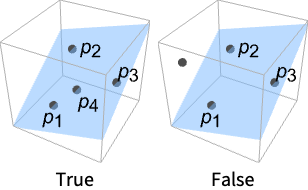
CoplanarPoints[{p1,p2,p3,p4,…,pn}]
tests whether the points p1,p2,p3,p4,…,pn are coplanar.
Details
- CoplanarPoints is also known as linearly dependent.
- Typically used to test whether a set of points lie on the same plane.
- CoplanarPoints[{p1,p2,p3,p4,…,pn}] gives True if the points p4,…,pn are on the plane passing through the points p1, p2 and p3.
- For coplanar points p1, p2, p3 and p4, the rank of the matrix {p2-p1,p3-p1,p4-p1} is less than or equal to 2.
Examples
open all close allBasic Examples (2)
The points {0,0,0}, {1,1,-2}, {-1,2,-1}, {3,-4,1} are coplanar:
pts = {{0, 0, 0}, {1, 1, -2}, {-1, 2, -1}, {3, -4, 1}};CoplanarPoints[pts]Graphics3D[{InfinitePlane[pts[[1 ;; 3]]], Red, Point[pts]}]Find the equation of the plane containing the points {0,0,0}, {1,1,-2} and {-1,2,-1}:
CoplanarPoints[{{0, 0, 0}, {1, 1, -2}, {-1, 2, -1}, {x, y, z}}]Scope (4)
CoplanarPoints works with two-dimensional points:
CoplanarPoints[{{1, 2}, {3, 4}, {5, 6}}]CoplanarPoints[{{1, 2, 1}, {3, 4, 1}, {5, 6, 1}, {7, 8, 1}}]CoplanarPoints[{{0, 0, 1, 1}, {1, 0, 1, 0}, {0, 1, 0, 1}, {0, 1, 1, 1}, {0, 0, 0, 1}}]CoplanarPoints works with numerical coordinates:
CoplanarPoints[{{1, 2}, {3, 4}, {5, 6}}]CoplanarPoints[{{1, a, 1}, {a, 2, 1}, {1, 2, 1}, {a, b, c}}]CoplanarPoints over a set of coordinates:
CoplanarPoints[{{1, 2, 1}, {3, 4, 1}, {5, 6, 1}, {7, 8, 1}}]CoplanarPoints[{Point[{b, 0, 1}], Point[{a, 1, 1}], Point[{a, 3, 1}], Point[{a, b, c}]}]CoplanarPoints[Point[{{b, 0, 1}, {a, 1, 1}, {a, 3, 1}, {a, b, c}}]]CoplanarPoints works for large sets:
pts = RandomPoint[Polygon[{{0, 0, 0}, {1, 0, 0}, {1, 1, 0}}], 10 ^ 6];CoplanarPoints[pts]//AbsoluteTimingApplications (5)
Basic Applications (4)
Find conditions for which two points lie on a plane passing through the origin:
CoplanarPoints[{{0, 0, 0}, {0, 1, 0}, {a, 2, b}, {c, 3, d}}]{{a, 2, b}, {c, 3, d}} /. FindInstance[% && a ≠ 0, {a, b, c, d}, Reals, 3]2D points lie on the same plane:
CoplanarPoints[{{1, 2}, {3, 4}, {5, 6}}]CoplanarPoints[RandomPoint[Disk[], 5000]]CoplanarPoints[RandomReal[1, {5000, 2}]]Find the equation of a plane containing a set of points:
pts = {{0, 0, 0}, {1, 1, -2}, {-1, 2, -1}};CoplanarPoints[Append[pts, {x, y, z}]]pts = {{0, 0, 0}, {1, 0, 0}, {1, 1, 1}};CoplanarPoints[pts]Graphics3D[{InfinitePlane[pts], Red, PointSize[Large], Point[pts]}]Geometry (1)
A face of a polyhedron lies on a plane:
poly = OuterPolyhedron[Polyhedron[{{-1/2, -1/2, -1/2}, {-1/2, -1/2, 1/2}, {-1/2, 1/2, -1/2}, {-1/2, 1/2, 1/2},
  {1/2, -1/2, -1/2}, {1/2, -1/2, 1/2}, {1/2, 1/2, -1/2}, {1/2, 1/2, 1/2}},
{{8, 4, 2, 6}, {8, 6, 5, 7}, {8, 7, 3, 4}, {4, 3, 1, 2}, {1, 3, 7, 5}, {2, 1, 5, 6}}]];faces = poly[[2]]CoplanarPoints[PolyhedronCoordinates[poly][[#]]]& /@ facesProperties & Relations (5)
PositivelyOrientedPoints returns False for coplanar points:
pts = {{0, 0, 0}, {1, 1, -2}, {-1, 2, -1}, {3, -4, 1}};{CoplanarPoints[pts], PositivelyOrientedPoints[pts]}NegativelyOrientedPoints returns False for coplanar points:
pts = {{0, 0, 0}, {1, 1, -2}, {-1, 2, -1}, {3, -4, 1}};{CoplanarPoints[pts], NegativelyOrientedPoints[pts]}Collinear points are coplanar:
pts = RandomPoint[Line[{{0, 0, 0}, {1, 1, 1}}], 5];{CollinearPoints[pts], CoplanarPoints[pts]}Use RegionMember to test whether points are coplanar:
RegionMember[Line[{{0, 0, 1}, {1, 1, 1}}], {2, 2, 1}]CoplanarPoints[{{0, 0, 1}, {1, 1, 1}, {2, 2, 1}}]Use InfinitePlane to draw a graphics image:
pts = {{0, 0, 0}, {1, 0, 0}, {1, 1, 1}};Graphics3D[{InfinitePlane[pts], Red, PointSize[Large], Point[pts]}]Text
Wolfram Research (2020), CoplanarPoints, Wolfram Language function, https://reference.wolfram.com/language/ref/CoplanarPoints.html.
CMS
Wolfram Language. 2020. "CoplanarPoints." Wolfram Language & System Documentation Center. Wolfram Research. https://reference.wolfram.com/language/ref/CoplanarPoints.html.
APA
Wolfram Language. (2020). CoplanarPoints. Wolfram Language & System Documentation Center. Retrieved from https://reference.wolfram.com/language/ref/CoplanarPoints.html