

PositivelyOrientedPoints
PositivelyOrientedPoints[{p1,p2,p3,…,pd+1}]
tests whether the sequence of points p1,p2,p3,…,pd+1 is positively oriented.
Details
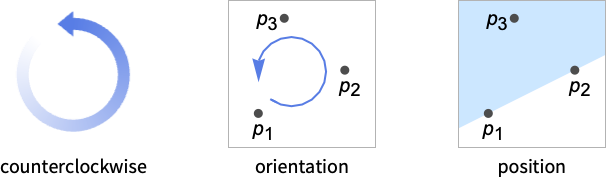
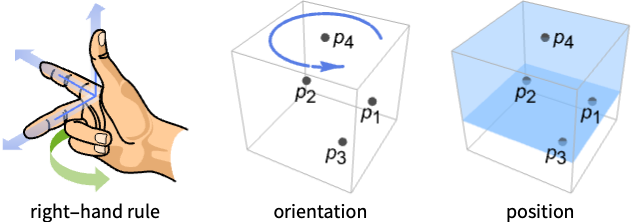
- PositivelyOrientedPoints is also known as counterclockwise or anticlockwise in 2D and right‐hand rule in 3D.
- Typically used to determine the orientation of a rotational motion with respect to a set of points.
- A counterclockwise motion is one that proceeds in the opposite direction to the way in which the hands of a clock move around.
- In two dimensions, the sequence of points p1, p2 and p3 is positively oriented if the orientation of the points is counterclockwise.
- PositivelyOrientedPoints[{p1,p2,p3}] gives True if the point p3 is in the half-plane bounded by the line through p1 and p2 and extended in the direction of {-1,0}.
- For positively oriented points p1, p2 and p3, the determinant of the matrix {p2-p1,p3-p1} is positive.
- In three dimensions, PositivelyOrientedPoints[{p1,p2,p3,p4}] gives True if the point p4 is in the half-space bounded by the plane through the point p1 with normal direction (p2-p1)(p3-p1).
- For positively oriented points p1, p2, p3 and p4, the dot product of p4-p1 and (p2-p1)(p3-p1) is positive.
- In d dimensions, d+1 points p1,p2,…,pd+1 are positively oriented if the determinant of the matrix {p2-p1,…,pd+1-p1} is positive.
Examples
open all close allBasic Examples (2)
The points {0,0},{.5,-1},{1,1} are positively oriented:
pts = {{0, 0}, {0.5, -1}, {1, 1}};PositivelyOrientedPoints[pts]Graphics[{Arrowheads[Small], Arrow /@ Partition[pts, 2, 1, 1], Red, Point[pts]}]Find the condition for which a point is above a plane:
PositivelyOrientedPoints[{{0, 0, 0}, {1, 1, -2}, {-1, 2, -1}, {x, y, z}}]Scope (3)
PositivelyOrientedPoints works with two-dimensional points:
PositivelyOrientedPoints[{{1, 2}, {3, 4}, {5, 6}}]PositivelyOrientedPoints[{{1, 2, 1}, {3, 4, 1}, {5, 6, 1}, {7, 8, 1}}]
PositivelyOrientedPoints[{{0, 0, 1, 1}, {1, 0, 1, 0}, {0, 1, 0, 1}, {0, 1, 1, 1}, {0, 0, 0, 1}}]PositivelyOrientedPoints works with numerical coordinates:
PositivelyOrientedPoints[{{1, 2}, {3, 4}, {5, 6}}]PositivelyOrientedPoints[{{0, 0}, {a, b}, {c, d}}]PositivelyOrientedPoints over a set of coordinates:
PositivelyOrientedPoints[{{0, 0}, {a, b}, {c, d}}]PositivelyOrientedPoints[{Point[{0, 0}], Point[{a, b}], Point[{c, d}]}]PositivelyOrientedPoints[Point[{{0, 0}, {a, b}, {c, d}}]]Applications (4)
Basic Applications (2)
Graph positively oriented points:
pts = {{0, 0}, {1, 0}, {1, 1}};PositivelyOrientedPoints[pts]Graphics[{Arrowheads[.1], Arrow /@ Partition[pts, 2, 1]}]pts = {{1, 0, 0}, {1, 0, 1}, {0, 1, 1}, {0, 0, 1}};PositivelyOrientedPoints[pts]Graphics3D[{Arrowheads[.1], Arrow /@ Partition[pts, 3, 1]}]Geometry (2)
PositivelyOrientedPoints over lines in 2D:
PositivelyOrientedPoints[Line[{{0, 0}, {1, 0}, {1, 1}}]]It is equivalent to the orientation of the consecutive vertices of the line:
PositivelyOrientedPoints[{{0, 0}, {1, 0}, {1, 1}}]Show the robustness of PositivelyOrientedPoints:
pts = {{7.3000000000000194, 7.3000000000000167}, {24.000000000000068, 24.000000000000071}, {24.00000000000005, 24.000000000000053}};PositivelyOrientedPoints[pts]Properties & Relations (4)
PositivelyOrientedPoints returns False for collinear points:
pts = {{0, 0}, {1, 2}, {2, 4}};CollinearPoints[pts]PositivelyOrientedPoints[pts]NegativelyOrientedPoints returns False if positively oriented:
pts = {{0, 0}, {1, 0}, {1, 1}};PositivelyOrientedPoints[pts]NegativelyOrientedPoints[pts]Use RegionMember to test whether points are positively oriented:
RegionMember[HalfPlane[{{0, 0}, {1, 0}}, {0, 1}], {1 / 3, 1 / 3}]PositivelyOrientedPoints[{{0, 0}, {1, 0}, {0, 1}}]3D points that are not positively or negatively oriented are coplanar:
pts = {{0, 0, 0}, {1, 1, -2}, {-1, 2, -1}, {3, -4, 1}};{PositivelyOrientedPoints[pts], NegativelyOrientedPoints[pts]}CoplanarPoints[pts]Text
Wolfram Research (2020), PositivelyOrientedPoints, Wolfram Language function, https://reference.wolfram.com/language/ref/PositivelyOrientedPoints.html.
CMS
Wolfram Language. 2020. "PositivelyOrientedPoints." Wolfram Language & System Documentation Center. Wolfram Research. https://reference.wolfram.com/language/ref/PositivelyOrientedPoints.html.
APA
Wolfram Language. (2020). PositivelyOrientedPoints. Wolfram Language & System Documentation Center. Retrieved from https://reference.wolfram.com/language/ref/PositivelyOrientedPoints.html