

DihedralAngle
DihedralAngle[{p1,p2},{v,w}]
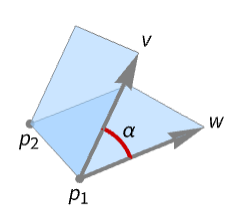
gives the angle between two half-planes bounded by the line through p1 and p2 and extended in the direction v and w.
Details
- DihedralAngle is also known as face angle or torsion angle.
- DihedralAngle[{p1,p2},{v,w}] is the length of the arc of the unit circle Circle[p1] on the plane with normal p2-p1 and delimited by the half‐planes HalfPlane[{p1,p2},v] and HalfPlane[{p1,p2},w].
Examples
open all close allBasic Examples (1)
Scope (2)
Use DihedralAngle to find the angle between two half‐planes:
DihedralAngle[{{0, 0, 0}, {0, 1, 0}}, {{1, 0, 1}, {1, 0, 0}}]Graphics3D[{HalfPlane[{{0, 0, 0}, {0, 1, 0}}, {1, 0, 1}], HalfPlane[{{0, 0, 0}, {0, 1, 0}}, {1, 0, 0}]}]DihedralAngle works with numeric arguments:
DihedralAngle[{{0, 1, 0}, {0, 0, 0}}, {{1, 0, 1}, {1, 0, 0}}]DihedralAngle[{{0, 1, 0}, {0, 0, 0}}, {{a, b, c}, {1, 0, 0}}]Applications (1)
coords = QuantityMagnitude[ChemicalData["Chloral", "AtomPositions"]];Show[{ChemicalData["Chloral", "MoleculePlot"], Graphics3D[Table[Style[Text[i, coords[[i]]], Bold], {i, Length[coords]}]]}]Torsion angle in a chain of atoms Cl-C-C-O:
DihedralAngle[coords[[{5, 6}]], {Subtract@@coords[[{3, 5}]], Subtract@@coords[[{4, 6}]]}]Properties & Relations (2)
Dihedral angle is the planar angle in the plane defined by the normal p2-p1 and a point p1.
p1 = {0, 0, 0};p2 = {0, 0, 1};
v = {1, 0, 0};w = {0, 1, 0};DihedralAngle[{p1, p2}, {v, w}]PlanarAngle[p1[[1 ;; 2]] -> {v, w}[[All, 1 ;; 2]]]DihedralAngle[{p1,p2},{v,w}] is equivalent to PolyhedronAngle[ℛ,{p1,p2}], where v and w are vectors in adjacent faces of {p1,p2} in a polyhedron ℛ:
ℛ = Polyhedron[{{0, 0, 0}, {0, 1, 0}, {1, 1, 0}, {1, 0, 0}, {0, 0, 1}, {0, 1, 1}, {1, 1, 1},
{1, 0, 1}}, {{2, 3, 4, 1}, {1, 4, 8, 5}, {4, 3, 7, 8}, {3, 2, 6, 7}, {2, 1, 5, 6}, {5, 8, 7, 6}}];p1 = {0, 0, 0};p2 = {0, 1, 0};{v, w} = {{0, 0, 1}, {1, 0, 0}} - {p1, p1};{PolyhedronAngle[ℛ, {p1, p2}], DihedralAngle[{p1, p2}, {v, w}]}Graphics3D[{{Opacity[.5], Green, ℛ}, Thickness[.05], Red, Line[{{p1, p1 + v}, {p1, p1 + w}}], Blue, Line[{p1, p2}]}]Possible Issues (1)
DihedralAngle gives generic values for symbolic parameters:
DihedralAngle[{{0, 1, 0}, {0, 0, a}}, {{1, 0, 1}, {1, 0, 0}}]Text
Wolfram Research (2019), DihedralAngle, Wolfram Language function, https://reference.wolfram.com/language/ref/DihedralAngle.html.
CMS
Wolfram Language. 2019. "DihedralAngle." Wolfram Language & System Documentation Center. Wolfram Research. https://reference.wolfram.com/language/ref/DihedralAngle.html.
APA
Wolfram Language. (2019). DihedralAngle. Wolfram Language & System Documentation Center. Retrieved from https://reference.wolfram.com/language/ref/DihedralAngle.html