

PolygonAngle
PolygonAngle[poly]
gives a list of angles at the vertex points of poly.
PolygonAngle[poly,p]
gives the angle at the vertex point p of a polygon poly.
PolygonAngle[poly,i]
gives the angle at the point pi of poly in canonical form Polygon[{p1,…,pn},data].
PolygonAngle[…,"spec"]
gives the angle specified by "spec".
Details
- PolygonAngle is also known as interior angle.
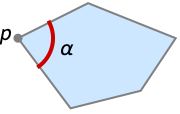
- PolygonAngle[poly, p] gives the angle delimited by the two adjacent sides intersecting at p.
- The following specifications "spec" can be given:
-
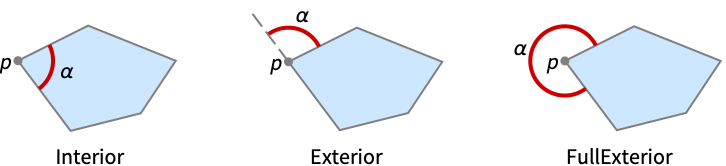
"Interior" interior (inside) angle at p "Exterior" exterior angle at p "FullExterior" full exterior angle at p - PolygonAngle[poly,p,"Interior"] is equivalent to PolygonAngle[poly,p].
- PolygonAngle[poly,p,"Exterior"] is equivalent to π-PolygonAngle[poly,p].
- PolygonAngle[poly,p,"FullExterior"] is equivalent to 2π-PolygonAngle[poly,p].
- PolygonAngle can be used with symbolic polygons in GeometricScene.
Examples
open all close allBasic Examples (2)
The list of angles at the vertex points:
ℛ = Polygon[{{-1., 0.}, {0., 1.7320508075688772}, {1., 0.}}, {1, 3, 2}];PolygonAngle[ℛ]The angle at the vertex point {-2,0}:
ℛ = DynamicModule[«3»];PolygonAngle[ℛ, {-2, 0}]The angle at the point 1 of ℛ in canonical form:
PolygonAngle[ℛ, 1]Scope (6)
Basic Uses (3)
Use PolygonAngle to find the list of angles at the vertex points:
ℛ = DynamicModule[«3»];PolygonAngle[ℛ]The angle at the vertex point:
PolygonAngle[ℛ, {1., 1.5}]PolygonAngle works on polygons:
DynamicModule[«3»];PolygonAngle[%, 1]PolygonAngle[Parallelogram[], 1]PolygonAngle[RegularPolygon[5], 1]PolygonAngle works on polygons with GeoGridPosition:
Polygon[GeoGridPosition[{{{-0.9950503945490105, 1.2366760550756015},
   {-0.9952074890903578, 1.2369207053693891}, {-0.9952196732768064, 1.2369073327446167},
   {-0.9953160063787643, 1.236848436956935}, {-0.9954141759436825, 1.2369993898475449},
   {-0. ... 197645333103}, {-0.9949098578570917, 1.2368130881428654},
   {-0.9948663952535768, 1.2367477711687371}, {-0.9948714472169538, 1.2367426500757825},
{-0.9949211061652593, 1.2367089232486177}, {-0.9949439717990124, 1.236746107097628}}}, "Bonne"]];PolygonAngle[%, 1]Specifications (3)
"Interior" (1)
"Exterior" (1)
Properties & Relations (2)
The sum of interior angles of a regular polygon is  :
:
Total[PolygonAngle[RegularPolygon[5]]] == 3PiPolygonAngle[ℛ, p] is equivalent to PlanarAngle[p->{q1,q2}] where q1 and q2 are adjacent points of p in a polygon ℛ:
ℛ = Polygon[{{1., 0.}, {0.5, 0.8}, {-0.5, 0.8}, {-1., 0.}}]PolygonAngle[ℛ, {0.5, 0.8}]PlanarAngle[{0.5, 0.8} -> {{-0.5, 0.8}, {1., 0.}}]Text
Wolfram Research (2019), PolygonAngle, Wolfram Language function, https://reference.wolfram.com/language/ref/PolygonAngle.html.
CMS
Wolfram Language. 2019. "PolygonAngle." Wolfram Language & System Documentation Center. Wolfram Research. https://reference.wolfram.com/language/ref/PolygonAngle.html.
APA
Wolfram Language. (2019). PolygonAngle. Wolfram Language & System Documentation Center. Retrieved from https://reference.wolfram.com/language/ref/PolygonAngle.html