

PlanarAngle
PlanarAngle[p{q1,q2}]
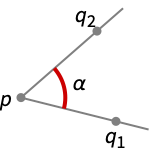
gives the angle between the half‐lines from p through q1 and q2.
PlanarAngle[{q1,p,q2}]
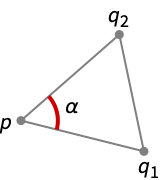
gives the angle at p formed by the triangle with vertex points p, q1 and q2.
PlanarAngle[…,"spec"]
gives the angle specified by "spec".
Details
- PlanarAngle is also known as angle.
- PlanarAngle[p{q1,q2}] gives the length of the arc of the unit circle Circle[p] delimited by the half-line from p through q1 on the left and the half-line from p to q2 on the right.
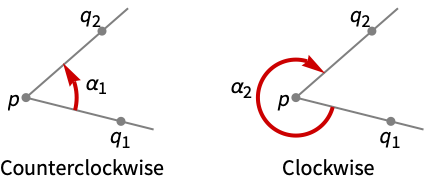
- Two half‐lines from p through q1 and q2 delimit two angles α1 and α2 at p.
- The following specifications "spec" can be given:
-
"Counterclockwise" angle formed by the counterclockwise rotation from q1 to q2 "Clockwise" angle formed by the clockwise rotation from q1 to q2 - PlanarAngle[p{q1,q2},"Counterclockwise"] is equivalent to PlanarAngle[p{q1,q2}].
- PlanarAngle[p{q1,q2},"Clockwise"] is equivalent to PlanarAngle[p{q2,q1}].
- PlanarAngle[{q1,p,q2}] is the angle subtended by the line segment q1 q2 from p.
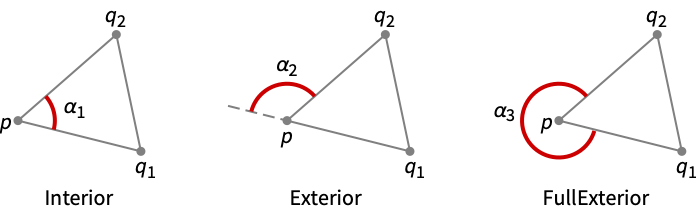
- The triangle with vertex points q1, p and q2 defines three angles α1, α2 and α3 at p.
- The following specifications "spec" can be given:
-
"Interior" interior (inside) angle of the triangle at p "Exterior" exterior angle of the triangle at p "FullExterior" full exterior angle of the triangle at p - PlanarAngle[{q1,p,q2},"Interior"] is equivalent to PlanarAngle[{q1,p,q2}].
- PlanarAngle[{q1,p,q2},"Exterior"] is equivalent to π-PlanarAngle[{q1,p,q2}].
- PlanarAngle[{q1,p,q2},"FullExterior"] is equivalent to 2π-PlanarAngle[{q1,p,q2}].
- With the specification "Interior", "Exterior" or "FullExterior", PlanarAngle[p{q1,q2},"spec"] is taken to be PlanarAngle[{q1,p,q2},"spec"].
- With the specification "Counterclockwise" or "Clockwise", PlanarAngle[{q1,p,q2},"spec"] is taken to be PlanarAngle[p{q1,q2}, "spec"].
- PlanarAngle can be used with symbolic points in GeometricScene.
Examples
open all close allBasic Examples (2)
The angle between the half‐lines from {0,0} through {1,1} and {1,0}:
PlanarAngle[{0, 0} -> {{1, 0}, {1, 1}}]Graphics[{Arrow[{{0, 0}, {1, 0}}], Arrow[{{0, 0}, {1, 1}}]}]The angle formed by a triangle at origin:
PlanarAngle[{{0, 1}, {0, 0}, {1, 0}}]Graphics[Triangle[{{0, 1}, {0, 0}, {1, 0}}]]Scope (7)
Basic Uses (2)
Use PlanarAngle to find the angle between two half‐lines:
PlanarAngle[{0, 0} -> {{1, 0}, {1, 1}}]Graphics[{HalfLine[{0, 0}, {1, 0}], HalfLine[{0, 0}, {1, 1}]}]PlanarAngle works with numeric arguments:
PlanarAngle[{0, 0} -> {{1, 0}, {1, 1}}]PlanarAngle[{0, 0} -> {{0, 1}, {1, a}}]Specifications (5)
"Counterclockwise" (1)
"Clockwise" (1)
"Interior" (1)
"Exterior" (1)
Applications (6)
p = {0, 0};q1 = {1, 0};q2 = {-1, 0};Graphics[{Arrow[{{p, q1}, {p, q2}}], Point[p]}]PlanarAngle[p -> {q1, q2}]p = {0, 0};q1 = {1, 0};q2 = {-1, 1};Graphics[{Arrow[{{p, q1}, {p, q2}}], Point[p]}]
PlanarAngle[p -> {q1, q2}]p = {0, 0};q1 = {1, 0};q2 = {0, 1};Graphics[{Arrow[{{p, q1}, {p, q2}}], Point[p]}]
PlanarAngle[p -> {q1, q2}]p = {0, 0};q1 = {1, 0};q2 = {1, 1};Graphics[{Arrow[{{p, q1}, {p, q2}}], Point[p]}]
PlanarAngle[p -> {q1, q2}]Find the interior angle of a triangle at a point p:
p = {0, 0};q1 = {2, 0};q2 = {1, 1};ℛ = Triangle[{p, q1, q2}];Graphics[ℛ]PlanarAngle[p -> {q1, q2}]An AASTriangle:
AASTriangle[Pi / 6, Pi / 3, 1]Graphics[%]PlanarAngle[{0, 0} -> {{2, 0}, {(3/2), (Sqrt[3]/2)}}]PlanarAngle[{2, 0} -> {{(3/2), (Sqrt[3]/2)}, {0, 0}}]PlanarAngle[{(3/2), (Sqrt[3]/2)} -> {{0, 0}, {2, 0}}]Properties & Relations (7)
PlanarAngle[p,{q2,q1}] is equal to 2π-PlanarAngle[p,{q1,q2}]:
PlanarAngle[{2, 1} -> {{1, 1}, {1, 0}}]2Pi - PlanarAngle[{2, 1} -> {{1, 0}, {1, 1}}]PlanarAngle[{q1,p,q2},"Interior"] is the smallest angle formed by the rotations around p:
PlanarAngle[{{1, 1}, {2, 1}, {1, 0}}, "Interior"]Min[PlanarAngle[{2, 1} -> {{1, 1}, {1, 0}}, #]& /@ {"Counterclockwise", "Clockwise"}]PlanarAngle[p{q1,q2}] takes values from 0 to 2π:
Table[PlanarAngle[{0, 0} -> {{1, 0}, p}], {p, CirclePoints[{1, 0}, 12]}]PlanarAngle[{q1,p,q2}] takes values from 0 to π:
Table[PlanarAngle[{{1, 0}, {0, 0}, p}], {p, CirclePoints[{1, 0}, 12]}]Dihedral angle is the planar angle in the plane defined by the normal p2-p1 and a point p1:
p1 = {0, 0, 0};p2 = {0, 0, 1};
v = {1, 0, 0};w = {0, 1, 0};DihedralAngle[{p1, p2}, {v, w}]PlanarAngle[p1[[1 ;; 2]] -> {v[[1 ;; 2]], w[[1 ;; 2]]}]PlanarAngle[p->{q1,q2}] is equivalent to PolygonAngle[ℛ, p] where q1 and q2 are adjacent points of p in a polygon ℛ:
ℛ = Polygon[{{1., 0.}, {0.5, 0.8}, {-0.5, 0.8}, {-1., 0.}}]PolygonAngle[ℛ, {0.5, 0.8}]PlanarAngle[{0.5, 0.8} -> {{-0.5, 0.8}, {1., 0.}}]PlanarAngle[{q1,p,q2}] is equivalent to SolidAngle[p,{q1,q2}]:
PlanarAngle[{{1, 0}, {0, 0}, {1, 1}}]SolidAngle[{0, 0}, {{1, 0}, {1, 1}}]Graphics[Arrow[{{0, 0}, #}]& /@ {{1, 0}, {1, 1}}]Possible Issues (1)
PlanarAngle gives generic values for symbolic parameters:
PlanarAngle[{0, 0} -> {{1, 0}, {0, a}}]Text
Wolfram Research (2019), PlanarAngle, Wolfram Language function, https://reference.wolfram.com/language/ref/PlanarAngle.html.
CMS
Wolfram Language. 2019. "PlanarAngle." Wolfram Language & System Documentation Center. Wolfram Research. https://reference.wolfram.com/language/ref/PlanarAngle.html.
APA
Wolfram Language. (2019). PlanarAngle. Wolfram Language & System Documentation Center. Retrieved from https://reference.wolfram.com/language/ref/PlanarAngle.html