

PerpendicularBisector
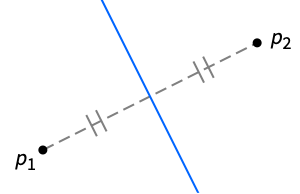
PerpendicularBisector[{p1,p2}]
gives the perpendicular bisector of the line segment connecting p1 and p2.
PerpendicularBisector[Line[{p1,p2}]]
gives the perpendicular bisector of a line segment.
Details
- PerpendicularBisector gives an InfiniteLine object.
- The pi in PerpendicularBisector[{p1,p2}] can be lists of coordinates or explicit Point objects.
- PerpendicularBisector[Line[{p1,p2}]] is equivalent to PerpendicularBisector[{p1,p2}].
- PerpendicularBisector gives the line that divides the line segment into two equal segments and that intersects the segment at right angles.
- PerpendicularBisector only works in 2D.
- PerpendicularBisector can be used with symbolic points in GeometricScene.
Examples
open all close allBasic Examples (2)
Calculate the perpendicular bisector of a line segment:
bisector = PerpendicularBisector[Line[{{-1, -1}, {1, 1}}]]Graphics[{Line[{{-1, -1}, {1, 1}}], bisector}]Calculate the perpendicular bisector of two points:
bisector = PerpendicularBisector[{{0, 0}, {0, 1}}]Graphics[{Point[{{0, 0}, {0, 1}}], bisector}]Scope (3)
Calculate the perpendicular bisector of a line segment containing (0, 0) and (1, 0):
points = {{0, 0}, {1, 0}};bisector = PerpendicularBisector[points]Graphics[{Line[points], StandardRed, bisector}]Calculate the perpendicular bisector of the line segment from (0, 0) to (1, 1):
linesegment = {{0, 0}, {1, 1}};bisector = PerpendicularBisector[linesegment]Graphics[{Line[linesegment], StandardRed, bisector}]Calculate the perpendicular bisector of an abstract line:
bisector = PerpendicularBisector[{{a, b}, {c, d}}]Properties & Relations (2)
The PerpendicularBisector is perpendicular to the line segment and passes through the Midpoint:
PerpendicularBisector[{{0, 0}, {2, 2}}]Midpoint[{{0, 0}, {2, 2}}]PlanarAngle[{{2, 2}, {1, 1}, {1, 1} + {2, -2}}]PlanarAngle[{{0, 0}, {1, 1}, {1, 1} + {2, -2}}]Graphics[{InfiniteLine[{1, 1}, {2, -2}], Point[{1, 1}], Line[{{0, 0}, {2, 2}}]}]TriangleConstruct[{a,b,c},"PerpendicularBisector"] is equivalent to PerpendicularBisector[{a,c}]:
TriangleConstruct[{{0, 0}, {3, 0}, {3, 4}}, "PerpendicularBisector"]PerpendicularBisector[{{0, 0}, {3, 4}}]Graphics[{Style[Triangle[{{0, 0}, {3, 0}, {3, 4}}], Opacity[0.2]], InfiniteLine[{3 / 2, 2}, {4, -3}]}]Possible Issues (1)
PerpendicularBisector only works in 2D:
PerpendicularBisector[{{1, 2, 3}, {-1, 0, 1}}]Neat Examples (1)
The three perpendicular bisectors of a triangle meet at the triangle's circumcenter:
tri = RandomPolygon[3];vert = PolygonCoordinates[tri]perps = PerpendicularBisector /@ Subsets[vert, {2}]circumcircle = Circumsphere[tri];Graphics[{FaceForm[None], EdgeForm[StandardBlue], tri,
circumcircle,
StandardRed, perps, PointSize[Large], Point[circumcircle[[1]]]}]Text
Wolfram Research (2019), PerpendicularBisector, Wolfram Language function, https://reference.wolfram.com/language/ref/PerpendicularBisector.html.
CMS
Wolfram Language. 2019. "PerpendicularBisector." Wolfram Language & System Documentation Center. Wolfram Research. https://reference.wolfram.com/language/ref/PerpendicularBisector.html.
APA
Wolfram Language. (2019). PerpendicularBisector. Wolfram Language & System Documentation Center. Retrieved from https://reference.wolfram.com/language/ref/PerpendicularBisector.html