

PolyhedronGenus
PolyhedronGenus[poly]
gives the genus of the polyhedron poly.
Details
- PolyhedronGenus is also known as genus.
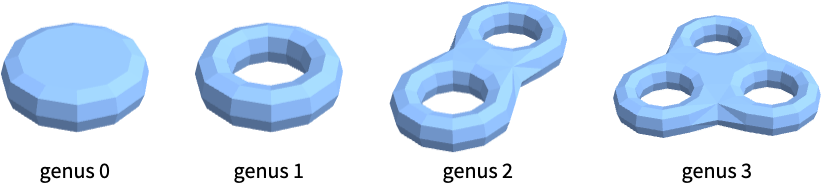
- PolyhedronGenus gives the maximum number of cuttings along non-intersecting closed simple curves on the surface of the polyhedron without disconnecting the polyhedron.
Examples
open all close allBasic Examples (1)
𝒫 = Polyhedron[{{0.1875, 0.108253, 0.}, {0.205078, 0., 0.046875}, {0.21875, 0., 0.},
  {0.205078, 0., -0.046875}, {0.175781, 0.101487, -0.046875}, {0.102539, 0.177603, -0.046875},
  {0.109375, 0.189443, 0.}, {0.102539, 0.177603, 0.046875}, {0.175781, ...  {38, 88, 45},
  {8, 90, 89}, {14, 90, 15}, {50, 90, 91}, {44, 90, 51}, {14, 92, 91}, {20, 92, 21}, {56, 92, 93},
  {50, 92, 57}, {20, 94, 93}, {26, 94, 27}, {62, 94, 95}, {56, 94, 63}, {26, 96, 95}, {32, 96, 33},
{68, 96, 87}, {62, 96, 69}}];PolyhedronGenus[𝒫]Region[𝒫]Scope (3)
PolyhedronGenus works on polyhedrons:
𝒫 = Polyhedron[{{0, 0, 0}, {1, 0, 0}, {0, 1, 0}, {0, 0, 1}}, {{1, 2, 3}, {1, 2, 4}, {2, 3, 4},
{1, 3, 4}}];PolyhedronGenus[𝒫]Region[𝒫]PolyhedronGenus[Tetrahedron[]]PolyhedronGenus[Hexahedron[]]Polyhedron[{{0, 0, 0}, {0, 3, 0}, {3, 3, 0}, {3, 0, 0}, {0, 0, 3}, {0, 3, 3}, {3, 3, 3}, {3, 0, 3}, {1, 1, 1}, {1, 2, 1}, {2, 2, 1}, {2, 1, 1}, {1, 1, 2}, {1, 2, 2}, {2, 2, 2}, {2, 1, 2}}, {{{2, 3, 4, 1}, {1, 4, 8, 5}, {4, 3, 7, 8}, {3, 2, 6, 7}, {2, 1, 5, 6}, {5, 8, 7, 6}} -> {{{10, 11, 12, 9}, {9, 12, 16, 13}, {12, 11, 15, 16}, {11, 10, 14, 15}, {10, 9, 13, 14}, {13, 16, 15, 14}}}}];PolyhedronGenus[%]Polyhedrons with disconnected components:
Polyhedron[{{0, 0, 0}, {1, 0, 0}, {0, 1, 0}, {0, 0, 1}, {1, 1, 1}, {2, 1, 1}, {1, 2, 1}, {1, 1, 2}}, {{{1, 2, 3}, {1, 2, 4}, {2, 3, 4}, {1, 3, 4}}, {{5, 6, 7}, {5, 6, 8}, {6, 7, 8}, {5, 7, 8}}}]PolyhedronGenus[%]Properties & Relations (3)
Use EulerCharacteristic to compute PolyhedronGenus for a simple polyhedron:
𝒫 = Polyhedron[{{0, 0, 0}, {1, 0, 0}, {0, 1, 0}, {0, 0, 1}}, {{1, 2, 3}, {1, 2, 4}, {2, 3, 4},
{1, 3, 4}}];SimplePolyhedronQ[𝒫]1 - EulerCharacteristic[𝒫] / 2 == PolyhedronGenus[𝒫]Convex polyhedron has zero genus:
𝒫 = Polyhedron[{{0, 0, 0}, {1, 0, 0}, {0, 1, 0}, {0, 0, 1}}, {{1, 2, 3}, {1, 2, 4}, {2, 3, 4},
{1, 3, 4}}];ConvexPolyhedronQ[𝒫]PolyhedronGenus[𝒫]The genus of UniformPolyhedron is 0:
UniformPolyhedron[{3, 5}]PolyhedronGenus[%]Text
Wolfram Research (2019), PolyhedronGenus, Wolfram Language function, https://reference.wolfram.com/language/ref/PolyhedronGenus.html.
CMS
Wolfram Language. 2019. "PolyhedronGenus." Wolfram Language & System Documentation Center. Wolfram Research. https://reference.wolfram.com/language/ref/PolyhedronGenus.html.
APA
Wolfram Language. (2019). PolyhedronGenus. Wolfram Language & System Documentation Center. Retrieved from https://reference.wolfram.com/language/ref/PolyhedronGenus.html