

SimplifyMesh
SimplifyMesh[mesh]
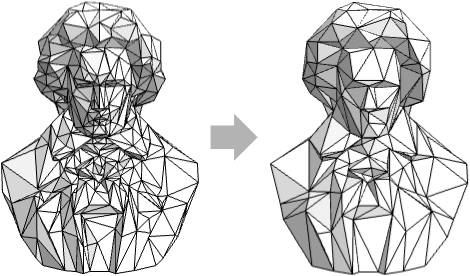
simplifies the mesh region mesh by reducing the number of polygons and keeping the overall shape.
SimplifyMesh[mesh,crit]
reduces the number of polygons using the specified criteria crit.
Details and Options
- SimplifyMesh is also known as mesh decimation or level-of-detail generation (LOD).
- SimplifyMesh is typically used to reduce the complexity of a geometric model by decreasing the number of polygons or vertices while preserving its overall shape, improving rendering, processing and analysis.
- SimplifyMesh[mesh] returns a mesh region obtained by reducing the number of polygons of mesh.
- SimplifyMesh[mesh,crit] returns a mesh region satisfying the specified criteria crit.
- Possible criteria crit include:
-

{"MaxVertexCount",n} at most n vertices 
{"MaxEdgeCount",n} at most n edges 
{"MaxTriangleCount",n} at most n triangles 
{"MaxIncidentEdgeCount",n} at most n incident edges to a vertex - For n between 0 and 1, SimplifyMesh[mesh,{type,n}] simplifies a mesh with approximate size proportion n of type.
- Possible criteria crit for minimal cells measures include:
-

{"MinEdgeLength",l} minimal edge length 
{"MinTriangleArea",a} minimal triangle area - Possible mesh structural criteria crit include:
-

{"TriangleQuality",q} square of the maximal edge length over area 
{"MaxNormalDeviation",d} maximum deviation of normals 
{"MaxHausdorffDistance",d} maximal Hausdorff distance from the given mesh
Examples
open all close allBasic Examples (2)
Scope (8)
Basic Uses (1)
SimplifyMesh works on surfaces:
SimplifyMesh[[image]]SimplifyMesh[[image]]Specification (7)
Specify the maximum number of vertices:
SimplifyMesh[\!\(\*Graphics3DBox[«6»]\), {"MaxVertexCount", 1000}]Specify the maximum number of triangles:
SimplifyMesh[\!\(\*Graphics3DBox[«6»]\), {"MaxTriangleCount", 1000}]Control the maximum number of incident edges per vertex:
SimplifyMesh[\!\(\*Graphics3DBox[«6»]\), {"MaxIncidentEdgeCount", 10}]Specify threshold for the quality of the triangles in the mesh:
SimplifyMesh[\!\(\*Graphics3DBox[«6»]\), {"TriangleQuality", 20}]Specify a minimum target edge length:
SimplifyMesh[\!\(\*Graphics3DBox[«6»]\), {"MinEdgeLength", .8}]Control the maximum deviation of normals:
SimplifyMesh[\!\(\*Graphics3DBox[«6»]\), {"MaxNormalDeviation", 30}]Specify the maximum deviation from the original surface:
SimplifyMesh[\!\(\*Graphics3DBox[«6»]\), {"MaxHausdorffDistance", .01}]Applications (1)
Create lower level-of-detail models from a high-fidelity base mesh to optimize rendering performance and resource utilization:
lodbears = Table[SimplifyMesh[\!\(\*Graphics3DBox[«5»]\), {"MaxVertexCount", i}], {i, 1, 0.01, -.05}];Panel[Framed[Mouseover[...], ...]]Text
Wolfram Research (2025), SimplifyMesh, Wolfram Language function, https://reference.wolfram.com/language/ref/SimplifyMesh.html.
CMS
Wolfram Language. 2025. "SimplifyMesh." Wolfram Language & System Documentation Center. Wolfram Research. https://reference.wolfram.com/language/ref/SimplifyMesh.html.
APA
Wolfram Language. (2025). SimplifyMesh. Wolfram Language & System Documentation Center. Retrieved from https://reference.wolfram.com/language/ref/SimplifyMesh.html