

ElectricCurrentPDEComponent
ElectricCurrentPDEComponent[vars,pars]
yields an electric current PDE term with variables vars and parameters pars.
Details
- ElectricCurrentPDEComponent is typically used to generate an electric current continuity equation with model variables vars and model parameters pars.
- ElectricCurrentPDEComponent returns a sum of differential operators to be used as a part of partial differential equations:
- ElectricCurrentPDEComponent creates PDE components for stationary, frequency and parametric analysis.
- ElectricCurrentPDEComponent models electric fields produced by direct or alternating currents in conductive materials when magnetic and inductive effects are negligible.
- The results of ElectricCurrentPDEComponent can be use to compute current density magnitude values. »
- ElectricCurrentPDEComponent models stationary or harmonic electric fields with the electric scalar potential
 [
[![TemplateBox[{InterpretationBox[, 1], "V", volts, "Volts"}, QuantityTF]](Files/ElectricCurrentPDEComponent.en/4.png "TemplateBox[{InterpretationBox[, 1], \"V\", volts, \"Volts\"}, QuantityTF]") ] as dependent variable and independent variables
] as dependent variable and independent variables  [
[![TemplateBox[{InterpretationBox[, 1], "m", meters, "Meters"}, QuantityTF]](Files/ElectricCurrentPDEComponent.en/6.png "TemplateBox[{InterpretationBox[, 1], \"m\", meters, \"Meters\"}, QuantityTF]") ].
]. - Stationary variables vars are vars={V[x1,…,xn],{x1,…,xn}}.
- Time-dependent variables vars are vars={V[t,x1,…,xn],t,{x1,…,xn}}.
- Frequency-dependent variables vars are vars={V[x1,…,xn],ω,{x1,…,xn}}.
- The current continuity equation is
 with volume charge density
  [
[![TemplateBox[{InterpretationBox[, 1], {"C", , "/", , {"m", ^, 3}}, coulombs per meter cubed, {{(, "Coulombs", )}, /, {(, {"Meters", ^, 3}, )}}}, QuantityTF]](Files/ElectricCurrentPDEComponent.en/9.png "TemplateBox[{InterpretationBox[, 1], {\"C\", , \"/\", , {\"m\", ^, 3}}, coulombs per meter cubed, {{(, \"Coulombs\", )}, /, {(, {\"Meters\", ^, 3}, )}}}, QuantityTF]") ], time variable
], time variable  [
[![TemplateBox[{InterpretationBox[, 1], "s", seconds, "Seconds"}, QuantityTF]](Files/ElectricCurrentPDEComponent.en/11.png "TemplateBox[{InterpretationBox[, 1], \"s\", seconds, \"Seconds\"}, QuantityTF]") ] and current density vector
] and current density vector  [
[![TemplateBox[{InterpretationBox[, 1], {"A", , "/", , {"m", ^, 2}}, amperes per meter squared, {{(, "Amperes", )}, /, {(, {"Meters", ^, 2}, )}}}, QuantityTF]](Files/ElectricCurrentPDEComponent.en/13.png "TemplateBox[{InterpretationBox[, 1], {\"A\", , \"/\", , {\"m\", ^, 2}}, amperes per meter squared, {{(, \"Amperes\", )}, /, {(, {\"Meters\", ^, 2}, )}}}, QuantityTF]") ].
]. - The constitutional material model equation, known as Ohm's law, is
 where
where  [
[![TemplateBox[{InterpretationBox[, 1], {"S", , "/", , "m"}, siemens per meter, {{(, "Siemens", )}, /, {(, "Meters", )}}}, QuantityTF]](Files/ElectricCurrentPDEComponent.en/16.png "TemplateBox[{InterpretationBox[, 1], {\"S\", , \"/\", , \"m\"}, siemens per meter, {{(, \"Siemens\", )}, /, {(, \"Meters\", )}}}, QuantityTF]") ] is the electrical conductivity and
] is the electrical conductivity and  [
[![TemplateBox[{InterpretationBox[, 1], {"V", , "/", , "m"}, volts per meter, {{(, "Volts", )}, /, {(, "Meters", )}}}, QuantityTF]](Files/ElectricCurrentPDEComponent.en/18.png "TemplateBox[{InterpretationBox[, 1], {\"V\", , \"/\", , \"m\"}, volts per meter, {{(, \"Volts\", )}, /, {(, \"Meters\", )}}}, QuantityTF]") ] the electric field with
] the electric field with  .
. - ElectricCurrentPDEComponent provides a stationary electric current model where
 [
[![TemplateBox[{InterpretationBox[, 1], {"A", , "/", , {"m", ^, 2}}, amperes per meter squared, {{(, "Amperes", )}, /, {(, {"Meters", ^, 2}, )}}}, QuantityTF]](Files/ElectricCurrentPDEComponent.en/21.png "TemplateBox[{InterpretationBox[, 1], {\"A\", , \"/\", , {\"m\", ^, 2}}, amperes per meter squared, {{(, \"Amperes\", )}, /, {(, {\"Meters\", ^, 2}, )}}}, QuantityTF]") ] is an externally generated current density vector and
] is an externally generated current density vector and  [
[![TemplateBox[{InterpretationBox[, 1], {"A", , "/", , {"m", ^, 3}}, amperes per meter cubed, {{(, "Amperes", )}, /, {(, {"Meters", ^, 3}, )}}}, QuantityTF]](Files/ElectricCurrentPDEComponent.en/23.png "TemplateBox[{InterpretationBox[, 1], {\"A\", , \"/\", , {\"m\", ^, 3}}, amperes per meter cubed, {{(, \"Amperes\", )}, /, {(, {\"Meters\", ^, 3}, )}}}, QuantityTF]") ] a current source:
] a current source: - ElectricCurrentPDEComponent provides a time domain model with time variable
 [
[![TemplateBox[{InterpretationBox[, 1], "s", seconds, "Seconds"}, QuantityTF]](Files/ElectricCurrentPDEComponent.en/26.png "TemplateBox[{InterpretationBox[, 1], \"s\", seconds, \"Seconds\"}, QuantityTF]") ], vacuum permittivity
], vacuum permittivity  [
[![TemplateBox[{InterpretationBox[, 1], {"F", , "/", , "m"}, farads per meter, {{(, "Farads", )}, /, {(, "Meters", )}}}, QuantityTF]](Files/ElectricCurrentPDEComponent.en/28.png "TemplateBox[{InterpretationBox[, 1], {\"F\", , \"/\", , \"m\"}, farads per meter, {{(, \"Farads\", )}, /, {(, \"Meters\", )}}}, QuantityTF]") ] and relative permittivity
] and relative permittivity  [
[ ]:
]: - ElectricCurrentPDEComponent provides a frequency domain model with vacuum permittivity
 [
[![TemplateBox[{InterpretationBox[, 1], {"F", , "/", , "m"}, farads per meter, {{(, "Farads", )}, /, {(, "Meters", )}}}, QuantityTF]](Files/ElectricCurrentPDEComponent.en/33.png "TemplateBox[{InterpretationBox[, 1], {\"F\", , \"/\", , \"m\"}, farads per meter, {{(, \"Farads\", )}, /, {(, \"Meters\", )}}}, QuantityTF]") ], polarization vector
], polarization vector  [
[![TemplateBox[{InterpretationBox[, 1], {"C", , "/", , {"m", ^, 2}}, coulombs per meter squared, {{(, "Coulombs", )}, /, {(, {"Meters", ^, 2}, )}}}, QuantityTF]](Files/ElectricCurrentPDEComponent.en/35.png "TemplateBox[{InterpretationBox[, 1], {\"C\", , \"/\", , {\"m\", ^, 2}}, coulombs per meter squared, {{(, \"Coulombs\", )}, /, {(, {\"Meters\", ^, 2}, )}}}, QuantityTF]") ], angular frequency
], angular frequency  [
[![TemplateBox[{InterpretationBox[, 1], {"rad", , "/", , "s"}, radians per second, {{(, "Radians", )}, /, {(, "Seconds", )}}}, QuantityTF]](Files/ElectricCurrentPDEComponent.en/37.png "TemplateBox[{InterpretationBox[, 1], {\"rad\", , \"/\", , \"s\"}, radians per second, {{(, \"Radians\", )}, /, {(, \"Seconds\", )}}}, QuantityTF]") ] and the imaginary unit
] and the imaginary unit  :
: - For linear materials, the frequency domain model simplifies to:
 is the unitless relative permittivity.
 can be isotropic, orthotropic or anisotropic.
- The implicit default boundary condition for the electric current model is a 0 ElectricCurrentDensityValue.
- The units of the electric current model terms are in [
![TemplateBox[{InterpretationBox[, 1], {"A", , "/", , {"m", ^, 3}}, amperes per meter cubed, {{(, "Amperes", )}, /, {(, {"Meters", ^, 3}, )}}}, QuantityTF]](Files/ElectricCurrentPDEComponent.en/43.png "TemplateBox[{InterpretationBox[, 1], {\"A\", , \"/\", , {\"m\", ^, 3}}, amperes per meter cubed, {{(, \"Amperes\", )}, /, {(, {\"Meters\", ^, 3}, )}}}, QuantityTF]") ].
]. - The following parameters pars can be given:
-
parameter default symbol "CrossSectionalArea" 1  , cross-sectional area in [
![TemplateBox[{InterpretationBox[, 1], {{"m", ^, 2}}, meters squared, {"Meters", ^, 2}}, QuantityTF]](Files/ElectricCurrentPDEComponent.en/45.png "TemplateBox[{InterpretationBox[, 1], {{\"m\", ^, 2}}, meters squared, {\"Meters\", ^, 2}}, QuantityTF]") ]
] "CurrentSource" 0  , current source in [
![TemplateBox[{InterpretationBox[, 1], {"A", , "/", , {"m", ^, 3}}, amperes per meter cubed, {{(, "Amperes", )}, /, {(, {"Meters", ^, 3}, )}}}, QuantityTF]](Files/ElectricCurrentPDEComponent.en/47.png "TemplateBox[{InterpretationBox[, 1], {\"A\", , \"/\", , {\"m\", ^, 3}}, amperes per meter cubed, {{(, \"Amperes\", )}, /, {(, {\"Meters\", ^, 3}, )}}}, QuantityTF]") ]
]"ElectricalConductivity" 1  , electrical conductivity in [
![TemplateBox[{InterpretationBox[, 1], {"S", , "/", , "m"}, siemens per meter, {{(, "Siemens", )}, /, {(, "Meters", )}}}, QuantityTF]](Files/ElectricCurrentPDEComponent.en/49.png "TemplateBox[{InterpretationBox[, 1], {\"S\", , \"/\", , \"m\"}, siemens per meter, {{(, \"Siemens\", )}, /, {(, \"Meters\", )}}}, QuantityTF]") ]
]"ExternalCurrentSource" {0,…}  , external current density vector in [
![TemplateBox[{InterpretationBox[, 1], {"A", , "/", , {"m", ^, 2}}, amperes per meter squared, {{(, "Amperes", )}, /, {(, {"Meters", ^, 2}, )}}}, QuantityTF]](Files/ElectricCurrentPDEComponent.en/51.png "TemplateBox[{InterpretationBox[, 1], {\"A\", , \"/\", , {\"m\", ^, 2}}, amperes per meter squared, {{(, \"Amperes\", )}, /, {(, {\"Meters\", ^, 2}, )}}}, QuantityTF]") ]
]"Material" - none "RegionSymmetry" None 
"Thickness" 1  , thickness in [
![TemplateBox[{InterpretationBox[, 1], "m", meters, "Meters"}, QuantityTF]](Files/ElectricCurrentPDEComponent.en/54.png "TemplateBox[{InterpretationBox[, 1], \"m\", meters, \"Meters\"}, QuantityTF]") ]
] - If a "Material" is specified, material constants are extracted from the material data; otherwise, relevant material parameters need to be specified.
- Additional parameters can be specified for the frequency domain models:
-
parameter default symbol "Polarization" {0,…}  , polarization vector in [
![TemplateBox[{InterpretationBox[, 1], {"C", , "/", , {"m", ^, 2}}, coulombs per meter squared, {{(, "Coulombs", )}, /, {(, {"Meters", ^, 2}, )}}}, QuantityTF]](Files/ElectricCurrentPDEComponent.en/56.png "TemplateBox[{InterpretationBox[, 1], {\"C\", , \"/\", , {\"m\", ^, 2}}, coulombs per meter squared, {{(, \"Coulombs\", )}, /, {(, {\"Meters\", ^, 2}, )}}}, QuantityTF]") ]
]"RelativePermittivity" 1  , unitless relative permittivity
"RemanentPolarization" {0,…}  , remanent polarization vector in [
![TemplateBox[{InterpretationBox[, 1], {"C", , "/", , {"m", ^, 2}}, coulombs per meter squared, {{(, "Coulombs", )}, /, {(, {"Meters", ^, 2}, )}}}, QuantityTF]](Files/ElectricCurrentPDEComponent.en/59.png "TemplateBox[{InterpretationBox[, 1], {\"C\", , \"/\", , {\"m\", ^, 2}}, coulombs per meter squared, {{(, \"Coulombs\", )}, /, {(, {\"Meters\", ^, 2}, )}}}, QuantityTF]") ]
]"VacuumPermittivity" 
 , vacuum permittivity in [
![TemplateBox[{InterpretationBox[, 1], {"F", , "/", , "m"}, farads per meter, {{(, "Farads", )}, /, {(, "Meters", )}}}, QuantityTF]](Files/ElectricCurrentPDEComponent.en/62.png "TemplateBox[{InterpretationBox[, 1], {\"F\", , \"/\", , \"m\"}, farads per meter, {{(, \"Farads\", )}, /, {(, \"Meters\", )}}}, QuantityTF]") ]
] - All parameters may depend on the spacial variable
 and dependent variable
  .
. - The number of independent variables
 determines the dimensions of
  ,
,  and
and  , and the length of vectors
  ,
,  and
and  .
. - A possible choice for the parameter "RegionSymmetry" is "Axisymmetric".
- "Axisymmetric" region symmetry represents a truncated cylindrical coordinate system where the cylindrical coordinates are reduced by removing the angle variable as follows:
-
dimension reduction e.g. stationary equation 1D 

2D 

- In 1D, when a "CrossSectionalArea"
 is specified, the ElectricCurrentPDEComponent equation is given as:
 - In 2D, when a "Thickness"
 is specified, the ElectricCurrentPDEComponent equation is given as:
 - In a 1D axisymmetric case, when a "Thickness"
 is specified, the ElectricCurrentPDEComponent equation is given as:
 - The input specification for the parameters is exactly the same as for their corresponding operator terms.
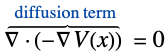
- If no parameters are specified, the default electric current PDE is:
- If the ElectricCurrentPDEComponent depends on parameters
 that are specified in the association pars as …,keypi…,pivi,…, the parameters
  are replaced with
  .
.








Examples
open all close allBasic Examples (4)
Define an stationary current PDE model:
ElectricCurrentPDEComponent[{V[x, y], {x, y}}, Entity["Element", "Copper"]]Define a symbolic time-dependent current PDE model:
ElectricCurrentPDEComponent[{V[t, x, y], t, {x, y}}, <|"ElectricalConductivity" -> σ, "RelativePermittivity" -> Subscript[ϵ, 𝓇], "VacuumPermittivity" -> Subscript[ϵ, 0], "Thickness" -> d|>]Define a symbolic frequency current PDE model:
ElectricCurrentPDEComponent[{V[x, y], ω, {x, y}}, <|"ElectricalConductivity" -> σ, "RelativePermittivity" -> Subscript[ϵ, 𝓇], "VacuumPermittivity" -> Subscript[ϵ, 0], "Thickness" -> d|>]Solve for the electric scalar potential in a constricted rectangular plate with an electrical conductivity of  :
:
Vfun = NDSolveValue[{ElectricCurrentPDEComponent[{V[x, y], {x, y}}, <|"ElectricalConductivity" -> 6*^7|>] == 0, ElectricPotentialCondition[y == -2, {V[x, y], {x, y}}, <|"ElectricPotential" -> 0|>], ElectricPotentialCondition[y == 2, {V[x, y], {x, y}}, <|"ElectricPotential" -> 1|>]}, V, {x, y}∈RegionUnion[Rectangle[{-1, -2}, {1, -0.3}], Rectangle[{-1, 0.3}, {1, 2}], Rectangle[{-0.3, -0.3}, {0.3, 0.3}]]];Compute the current density vector:
Jfield = -6*^7 * Grad[Vfun[x, y], {x, y}];Visualize the current density vector:
VectorPlot[Jfield, {x, y}∈RegionUnion[Rectangle[{-1, -2}, {1, -0.3}], Rectangle[{-1, 0.3}, {1, 2}], Rectangle[{-0.3, -0.3}, {0.3, 0.3}]], AspectRatio -> Automatic]Scope (8)
Define a symbolic stationary current PDE:
ElectricCurrentPDEComponent[{V[x, y], {x, y}}, <|"ElectricalConductivity" -> σ, "ExternalCurrentSource" -> {Jex[x, y], Jey[x, y]}, "CurrentSource" -> Subscript[Q, v], "Thickness" -> d|>]Define a stationary current PDE model for a specific material:
ElectricCurrentPDEComponent[{V[X, y], {x, y}}, <|"Material" -> Entity["Element", "Gold"]|>]Specify an stationary current PDE with an electrical conductivity of  in units of [
![TemplateBox[{InterpretationBox[, 1], {"S", , "/", , "m"}, siemens per meter, {{(, "Siemens", )}, /, {(, "Meters", )}}}, QuantityTF]](Files/ElectricCurrentPDEComponent.en/88.png "TemplateBox[{InterpretationBox[, 1], {\"S\", , \"/\", , \"m\"}, siemens per meter, {{(, \"Siemens\", )}, /, {(, \"Meters\", )}}}, QuantityTF]") ] and an external current density of
] and an external current density of  in units of [
![TemplateBox[{InterpretationBox[, 1], {"A", , "/", , {"m", ^, 2}}, amperes per meter squared, {{(, "Amperes", )}, /, {(, {"Meters", ^, 2}, )}}}, QuantityTF]](Files/ElectricCurrentPDEComponent.en/90.png "TemplateBox[{InterpretationBox[, 1], {\"A\", , \"/\", , {\"m\", ^, 2}}, amperes per meter squared, {{(, \"Amperes\", )}, /, {(, {\"Meters\", ^, 2}, )}}}, QuantityTF]") ]:
]:
ElectricCurrentPDEComponent[{V[x, y], {x, y}}, <|"ElectricalConductivity" -> Quantity[4.5*^7, "Siemens"/"Meters"], "ExternalCurrentSource" -> {Quantity[10, "Amperes"/"Meters"^2], 0}|>]Activate a stationary current PDE model for a specific material:
Activate[ElectricCurrentPDEComponent[{V[X, y], {x, y}}, <|"Material" -> Entity["Element", "Gold"]|>]]Define a symbolic stationary current PDE with electrical conductivity  an external current, a current source and a thickness:
ElectricCurrentPDEComponent[{V[x, y], {x, y}}, <|"ElectricalConductivity" -> σ, "ExternalCurrentSource" -> {Jex[x, y], Jey[x, y]}, "CurrentSource" -> Subscript[Q, v], "Thickness" -> d|>]Define a symbolic 2D axisymmetric stationary current PDE:
ElectricCurrentPDEComponent[{V[r, z], {r, z}}, <|"ElectricalConductivity" -> σ, "ExternalCurrentSource" -> {Jer[r, z], Jez[r, z]}, "CurrentSource" -> Subscript[Q, v], "RegionSymmetry" -> "Axisymmetric"|>]Define a 3D frequency current PDE model:
ElectricCurrentPDEComponent[{V[x, y, z], ω, {x, y, z}}, <|"ElectricalConductivity" -> 4.5*^7, "RelativePermittivity" -> IdentityMatrix[3]|>]Define a 3D time-dependent current PDE model:
ElectricCurrentPDEComponent[{V[t, x, y, z], t, {x, y, z}}, <|"ElectricalConductivity" -> 4.5*^7|>]Applications (5)
2D Stationary Analysis (1)
Solve for the electric scalar potential in a 3-bar electric switch with an electrical conductivity of  :
:
Vfun = NDSolveValue[{ElectricCurrentPDEComponent[{V[x, y], {x, y}}, <|"ElectricalConductivity" -> 6*^7|>] == 0, ElectricPotentialCondition[y == -7.5, {V[x, y], {x, y}}, <|"ElectricPotential" -> 0|>], ElectricPotentialCondition[y == 7.5, {V[x, y], {x, y}}, <|"ElectricPotential" -> 5|>]}, V, {x, y}∈RegionUnion[Rectangle[{0, 2.5}, {10, 7.5}], Rectangle[{9, -2.5}, {10 + 9, 2.5}], Rectangle[{0, -7.5}, {10, -2.5}]]];Compute the current density vector:
Jfield = -6*^7 * Grad[Vfun[x, y], {x, y}];Visualize the current density vector:
VectorPlot[Jfield, {x, y}∈RegionUnion[Rectangle[{0, 2.5}, {10, 7.5}], Rectangle[{9, -2.5}, {10 + 9, 2.5}], Rectangle[{0, -7.5}, {10, -2.5}]], AspectRatio -> Automatic]3D Stationary Analysis (3)
Model a copper wire that is excited with a direct current (DC) of  [
[![TemplateBox[{InterpretationBox[, 1], "A", amperes, "Amperes"}, QuantityTF]](Files/ElectricCurrentPDEComponent.en/94.png "TemplateBox[{InterpretationBox[, 1], \"A\", amperes, \"Amperes\"}, QuantityTF]") ] with a current density boundary condition at the upper boundary and with a zero electric potential condition at the lower boundary.
] with a current density boundary condition at the upper boundary and with a zero electric potential condition at the lower boundary.
Set up the stationary current PDE model variables  and
and  :
:
vars = {V[x, y, z], {x, y, z}};
pars = <|"Material" -> Entity["Element", "Copper"]|>;op = ElectricCurrentPDEComponent[vars, pars];Specify ground potential at the lower boundary:
Subscript[Γ, ground] = ElectricPotentialCondition[z == 0, vars, pars, <|"ElectricPotential" -> 0|>];Specify an inward current flow at the upper boundary:
Subscript[Γ, source] = ElectricCurrentDensityValue[z == 0.01, vars, pars, <|"Current" -> 1|>];Ω = Cylinder[{{0, 0, 0}, {0, 0, 0.01}}, 0.0005];Vfun = NDSolveValue[{op == Subscript[Γ, source], Subscript[Γ, ground]}, V, {x, y, z}∈Ω]Visualize the electric potential:
Show[Graphics3D[{Opacity[0.2], Ω}, Boxed -> False],
	SliceDensityPlot3D[Vfun[x, y, z], {x, y, z}∈Ω, ...]]
Model a tungsten wire with a potential difference of  [
[![TemplateBox[{InterpretationBox[, 1], "V", volts, "Volts"}, QuantityTF]](Files/ElectricCurrentPDEComponent.en/98.png "TemplateBox[{InterpretationBox[, 1], \"V\", volts, \"Volts\"}, QuantityTF]") ]. Set up the stationary current PDE model variables
]. Set up the stationary current PDE model variables  and
and  :
:
vars = {V[x, y, z], {x, y, z}};
pars = <|"Material" -> Entity["Element", "Tungsten"]|>;
Set up the stationary current PDE:
op = ElectricCurrentPDEComponent[vars, pars];The radius of the tungsten wire is  [
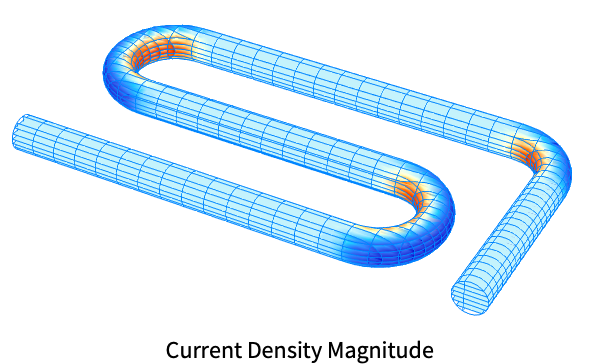
[![TemplateBox[{InterpretationBox[, 1], "m", meters, "Meters"}, QuantityTF]](Files/ElectricCurrentPDEComponent.en/102.png "TemplateBox[{InterpretationBox[, 1], \"m\", meters, \"Meters\"}, QuantityTF]") ] and the geometric shape of the wire is s-shaped. Specify the parameters of the geometry:
] and the geometric shape of the wire is s-shaped. Specify the parameters of the geometry:
L = 0.05;
r = 0.0025;
R = 0.0075;Ω = \!\(\*Graphics3DBox[«5»]\);An electric potential boundary condition of  [
[![TemplateBox[{InterpretationBox[, 1], "V", volts, "Volts"}, QuantityTF]](Files/ElectricCurrentPDEComponent.en/104.png "TemplateBox[{InterpretationBox[, 1], \"V\", volts, \"Volts\"}, QuantityTF]") ] is applied at the left end boundary and a zero electric potential condition is applied at the right end boundary. A tolerance 0f
] is applied at the left end boundary and a zero electric potential condition is applied at the right end boundary. A tolerance 0f  is applied at both ends to account for numerical errors in the discretized domain.
Set the electric potential boundary conditions at both ends of the wire:
Subscript[Γ, potential] = {ElectricPotentialCondition[Abs[x] ≤ 0.01r && y^2 + z^2 ≤ r^2, vars, pars, <|"ElectricPotential" -> 0.2|>], ElectricPotentialCondition[Abs[y + r] ≤ 0.01r && (x - (L + 2R + r))^2 + z^2 ≤ r^2, vars, pars]};Vfun = NDSolveValue[{op == 0, Subscript[Γ, potential]}, V, {x, y, z}∈Ω]Compute the current density vector:
Jfield = -QuantityMagnitude[pars["Material"]["ElectricalConductivity"]] * Grad[Vfun[x, y, z], {x, y, z}];Visualize the current density magnitude:
SliceDensityPlot3D[Sqrt[Total[Jfield ^ 2]], {{"XStackedPlanes", 10}, {"YStackedPlanes", 12}, {"ZStackedPlanes", 3}}, {x, y, z}∈Ω, ...]Model a copper spiral inductor that is excited with a current density normal to the left boundary and has a zero electric potential boundary condition at the right boundary.
Define the spiral inductor geometry:
Ω = RegionUnion[Cuboid[{0, 0, 0}, {2, 1, 1}], Cuboid[{1, 1, 0}, {2, 8, 1}], Cuboid[{2, 7, 0}, {8, 8, 1}], Cuboid[{7, 7, 0}, {8, 0, 1}], Cuboid[{7, 0, 0}, {3, 1, 1}], Cuboid[{3, 1, 0}, {4, 6, 1}], Cuboid[{4, 6, 0}, {6, 5, 1}], Cuboid[{6, 5, 0}, {5, 2, 1}], Cuboid[{5, 2, 1}, {6, 3, 1.2}], Cuboid[{5, 2, 1.2}, {10, 3, 2.2}]]Set up the stationary current PDE model variables  and
and  :
:
vars = {V[x, y, z], {x, y, z}};
pars = <|"Material" -> Entity["Element", "Copper"]|>;
Specify an inward current flow on the left boundary:
Subscript[Γ, source] = ElectricCurrentDensityValue[x == 0, vars, pars, <|"NormalCurrentDensity" -> 10|>];Subscript[Γ, ground] = ElectricPotentialCondition[x == 10, vars, pars];Vfun = NDSolveValue[{ElectricCurrentPDEComponent[vars, pars] == Subscript[Γ, source], Subscript[Γ, ground]}, V, {x, y, z}∈Ω]Compute the current density vector:
Jfield = -QuantityMagnitude[pars["Material"]["ElectricalConductivity"]] * Grad[Vfun[x, y, z], {x, y, z}];Visualize the current density magnitude:
SliceDensityPlot3D[Sqrt[Total[Jfield ^ 2]], {{"XStackedPlanes", 10}, {"YStackedPlanes", 10}, {"ZStackedPlanes", 5}}, {x, y, z}∈Ω, ...]Frequency Analysis (1)
Model a dielectric material of a cylindrical capacitor that is excited with an alternating current (AC) of  [
[![TemplateBox[{InterpretationBox[, 1], "Hz", hertz, "Hertz"}, QuantityTF]](Files/ElectricCurrentPDEComponent.en/109.png "TemplateBox[{InterpretationBox[, 1], \"Hz\", hertz, \"Hertz\"}, QuantityTF]") ], with a current density boundary condition at the upper electrode, and with a zero electric potential boundary condition at the lower boundary.
], with a current density boundary condition at the upper electrode, and with a zero electric potential boundary condition at the lower boundary.
Set up the frequency current PDE model variables  :
:
vars = {V[x, y, z], ω, {x, y, z}};Define the frequency and the period:
f0 = 60;
T0 = 1 / f0;
r0 = 0.01;
h = 0.001;
Ω = Cylinder[{{0, 0, 0}, {0, 0, h}}, r0];
Specify an electrical conductivity  and a relative permittivity
  :
:
pars = <|"ElectricalConductivity" -> 1*^-8, "RelativePermittivity" -> 2|>;Specify the ground potential at the lower boundary:
Subscript[Γ, ground] = ElectricPotentialCondition[z == 0, vars, pars];Specify an inward current flow at the upper boundary:
Subscript[Γ, current] = ElectricCurrentDensityValue[z == h, vars, pars, <|"Current" -> 1*^-7|>];op = ElectricCurrentPDEComponent[vars, pars];Solve the harmonic PDE for  [
[![TemplateBox[{InterpretationBox[, 1], "Hz", hertz, "Hertz"}, QuantityTF]](Files/ElectricCurrentPDEComponent.en/115.png "TemplateBox[{InterpretationBox[, 1], \"Hz\", hertz, \"Hertz\"}, QuantityTF]") ]:
]:
Vfun = NDSolveValue[{(op /. {ω -> 2 Pi f0}) == Subscript[Γ, current], Subscript[Γ, ground]}, V, {x, y, z}∈Ω]Transform the voltage at the upper boundary to the time domain:
Vlist = Table[{t, Re[Vfun[0, 0, h] * Exp[I ω t] /. {ω -> 2 Pi f0}]}, {t, 0, 3 * T0, T0 / 100}];Visualize the voltage at the upper plate of the capacitor:
ListLinePlot[Vlist]Possible Issues (2)
For a symbolic computation, the "ElectricalConductivity", "VacuumPermittivity" or "RelativePermittivity" parameters should be given as a matrix:
ElectricCurrentPDEComponent[{V[x, y], ω, {x, y}}, <|"ElectricalConductivity" -> σ * IdentityMatrix[2], "VacuumPermittivity" -> Subscript[ϵ, 0], "RelativePermittivity" -> {{Subscript[ϵ, r11], 0}, {0, Subscript[ϵ, r12]}}|>]//ActivateFor numeric values, the "ElectricalConductivity", "VacuumPermittivity" or "RelativePermittivity" parameter is automatically converted to a matrix of proper dimensions:
ElectricCurrentPDEComponent[{V[x, y], {x, y}}, <|"ElectricalConductivity" -> 10|>]This automatic conversion is not possible for symbolic input:
ElectricCurrentPDEComponent[{V[x], {x}}, <|"ElectricalConductivity" -> σ|>]Not providing the properly dimensioned matrix will result in an error:
%//Activate
For frequency domain models, material parameters are not available when "Material" is specified:
ElectricCurrentPDEComponent[{V[x, y], ω, {x, y}}, <|"Material" -> Entity["Element", "Copper"]|>]
Text
Wolfram Research (2024), ElectricCurrentPDEComponent, Wolfram Language function, https://reference.wolfram.com/language/ref/ElectricCurrentPDEComponent.html (updated 2025).
CMS
Wolfram Language. 2024. "ElectricCurrentPDEComponent." Wolfram Language & System Documentation Center. Wolfram Research. Last Modified 2025. https://reference.wolfram.com/language/ref/ElectricCurrentPDEComponent.html.
APA
Wolfram Language. (2024). ElectricCurrentPDEComponent. Wolfram Language & System Documentation Center. Retrieved from https://reference.wolfram.com/language/ref/ElectricCurrentPDEComponent.html