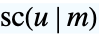




JacobiSC
JacobiSC[u,m]
gives the Jacobi elliptic function 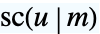 .
.
Details
- Mathematical function, suitable for both symbolic and numerical manipulation.
 , where
  .
.  is a doubly periodic function in
  with periods
  and
and  , where
  is the elliptic integral EllipticK.
- JacobiSC is a meromorphic function in both arguments.
- For certain special arguments, JacobiSC automatically evaluates to exact values.
- JacobiSC can be evaluated to arbitrary numerical precision.
- JacobiSC automatically threads over lists.
Examples
open all close allBasic Examples (4)
JacobiSC[0.2, 0.5]Plot the function over a subset of the reals:
Plot[JacobiSC[u, 1 / 3], {u, -6, 6}]Plot over a subset of the complexes:
ComplexPlot3D[JacobiSC[z, 2], {z, -2 - 2I, 2 + 2I}, PlotLegends -> Automatic]Series expansions at the origin:
Series[JacobiSC[u, m], {u, 0, 6}]Series[JacobiSC[u, m], {m, 0, 1}]Scope (34)
Numerical Evaluation (5)
Evaluate numerically to high precision:
N[JacobiSC[Pi / 3, 1 / 3], 50]The precision of the output tracks the precision of the input:
JacobiSC[Pi / 3, 0.3333333333333333333333333333333333]Evaluate for complex arguments:
JacobiSC[5.2 - 2.5I, 0.3 + I]Evaluate JacobiSC efficiently at high precision:
JacobiSC[3, 0.3`500]//TimingJacobiSC[3, 0.3`10000];//TimingCompute average-case statistical intervals using Around:
JacobiSC[2, Around[1 / 2, 0.01]]Compute the elementwise values of an array:
JacobiSC[-(I π/3), {{1, 0}, {0, 1}}]Or compute the matrix JacobiSC function using MatrixFunction:
MatrixFunction[JacobiSC[-(I π/3), #]&, {{1, 0}, {0, 1}}]Specific Values (3)
Simple exact values are generated automatically:
{JacobiSC[z, 0], JacobiSC[z, 1]}{JacobiSC[0, m], JacobiSC[EllipticK[m] / 2, m], JacobiSC[I EllipticK[1 - m], m]}Some poles of JacobiSC:
{JacobiSC[EllipticK[m], m], JacobiSC[3EllipticK[m], m], JacobiSC[EllipticK[m] + 2I EllipticK[1 - m], m]}Find a local inflection point of JacobiSC as a root of ![(d)/(dx)TemplateBox[{x, {1, /, 3}}, JacobiSC]=0](Files/JacobiSC.en/9.png "(d)/(dx)TemplateBox[{x, {1, /, 3}}, JacobiSC]=0") :
:
xzero = Solve[JacobiSC[x, 1 / 3] == 0 && 3.0 < x < 4.0, x][[1, 1, 2]]//QuietPlot[JacobiSC[x, 1 / 3], {x, 0, 6}, Epilog -> Style[Point[{xzero, JacobiSC[xzero, 1 / 3]}], PointSize[Large], Red]]Visualization (3)
Plot the JacobiSC functions for various parameter values:
Plot[{JacobiSC[x, 0], JacobiSC[x, 4 / 5], JacobiSC[x, 1], JacobiSC[x, 3]}, {x, -5, 5}]Plot JacobiSC as a function of its parameter  :
:
Plot[{JacobiSC[1, m], JacobiSC[2, m], JacobiSC[3, m]}, {m, -4, 4}]![TemplateBox[{z, {1, /, 2}}, JacobiSC]](Files/JacobiSC.en/11.png "TemplateBox[{z, {1, /, 2}}, JacobiSC]")
ComplexContourPlot[Re[JacobiSC[z, 1 / 2]], {z, -4 - 4 I, 4 + 4 I}, IconizedObject[«PlotOptions»]]![TemplateBox[{z, {1, /, 2}}, JacobiSC]](Files/JacobiSC.en/12.png "TemplateBox[{z, {1, /, 2}}, JacobiSC]")
ComplexContourPlot[Im[JacobiSC[z, 1 / 2]], {z, -4 - 4 I, 4 + 4 I}, IconizedObject[«PlotOptions»]]Function Properties (8)
JacobiSC is ![2TemplateBox[{m}, EllipticK]](Files/JacobiSC.en/13.png "2TemplateBox[{m}, EllipticK]") -periodic along the real axis:
-periodic along the real axis:
JacobiSC[x, m] == JacobiSC[x + 2EllipticK[m], m]JacobiSC is ![4ⅈTemplateBox[{{1, -, m}}, EllipticK]](Files/JacobiSC.en/14.png "4ⅈTemplateBox[{{1, -, m}}, EllipticK]") -periodic along the imaginary axis:
-periodic along the imaginary axis:
JacobiSC[x, m] == JacobiSC[x + 4I EllipticK[1 - m], m]JacobiSC is an odd function in its first argument:
JacobiSC[-x, m] == -JacobiSC[x, m]![TemplateBox[{x, m}, JacobiSC]](Files/JacobiSC.en/15.png "TemplateBox[{x, m}, JacobiSC]") is an analytic function of
is an analytic function of  for
for  :
:
FunctionAnalytic[JacobiSC[x, m], x, Assumptions -> m >= 1]It is not, in general, analytic:
FunctionAnalytic[JacobiSC[x, m], {x, m}]//QuietIt has both singularities and discontinuities for  :
:
FunctionSingularities[JacobiSC[x, m], {x, m}]FunctionDiscontinuities[JacobiSC[x, 3], {x, m}]![TemplateBox[{x, 3}, JacobiSC]](Files/JacobiSC.en/19.png "TemplateBox[{x, 3}, JacobiSC]") is neither nondecreasing nor nonincreasing:
is neither nondecreasing nor nonincreasing:
FunctionMonotonicity[JacobiSC[x, 3], x]JacobiSC is not injective for any fixed 
FunctionInjective[JacobiSC[x, m], x, Assumptions -> m < 1]FunctionInjective[JacobiSC[x, m], x, Assumptions -> m > 1]Plot[{JacobiSC[x, 1 / 3], .5}, {x, -10, 10}]
FunctionInjective[JacobiSC[x, 1], x]Plot[{JacobiSC[x, 1], 5}, {x, -5, 5}]![TemplateBox[{x, m}, JacobiSC]](Files/JacobiSC.en/22.png "TemplateBox[{x, m}, JacobiSC]")

FunctionSurjective[JacobiSC[x, m], x, Assumptions -> m > 1]Plot[{JacobiSC[x, 3], 1}, {x, -5, 5}]
FunctionSurjective[JacobiSC[x, m], x, Assumptions -> m <= 1]JacobiSC is neither non-negative nor non-positive:
FunctionSign[JacobiSC[x, m], {x, m}]JacobiSC is neither convex nor concave:
FunctionConvexity[JacobiSC[x, m], {x, m}]Differentiation (3)
D[JacobiSC[x, m], x]derivs = Table[D[JacobiSC[x, m], {x, n}], {n, 1, 4}]
Plot[Evaluate[derivs /. m -> 1 / 3], {x, -5, 5}, PlotLegends -> {"First Derivative", "Second Derivative", "Third Derivative", "Fourth Derivative"}]
D[JacobiSC[x, m], m]Integration (3)
Indefinite integral of JacobiSC:
Integrate[JacobiSC[z, m], z]Definite integral of JacobiSC:
Integrate[JacobiSC[z, 1 / 3], {z, 0, 1}]Integrate[JacobiSC[z, m]JacobiDC[z, m], z]Integrate[1 / JacobiSC[z, m], z]Series Expansions (3)
![TemplateBox[{x, {1, /, 3}}, JacobiSC]](Files/JacobiSC.en/27.png "TemplateBox[{x, {1, /, 3}}, JacobiSC]")
Series[JacobiSC[x, 1 / 3], {x, 0, 7}]Plot the first three approximations for ![TemplateBox[{x, {1, /, 3}}, JacobiSC]](Files/JacobiSC.en/28.png "TemplateBox[{x, {1, /, 3}}, JacobiSC]") around
around  :
:
terms = Normal@Table[Series[JacobiSC[x, 1 / 3], {x, 0, n}], {n, 1, 5, 2}];
Plot[{JacobiSC[x, 1 / 3], terms}, {x, -1.5, 1.5}]![TemplateBox[{1, m}, JacobiSC]](Files/JacobiSC.en/30.png "TemplateBox[{1, m}, JacobiSC]")
Series[JacobiSC[1, m], {m, 0, 3}]//FullSimplifyPlot the first three approximations for ![TemplateBox[{1, m}, JacobiSC]](Files/JacobiSC.en/31.png "TemplateBox[{1, m}, JacobiSC]") around
around  :
:
terms = Normal@Table[Series[JacobiSC[1, m], {m, 0, n}], {n, 1, 3}];
Plot[{JacobiSC[1, m], terms}, {m, -4, 4}]
JacobiSC can be applied to a power series:
JacobiSC[ArcSin[x] + O[x] ^ 8, m]Function Identities and Simplifications (3)
Parity transformation and periodicity relations are automatically applied:
JacobiSC[-u, m]JacobiSC[u + 2 EllipticK[m] + 4I EllipticK[1 - m], m]Identity involving JacobiNC:
JacobiNC[z, m]^2 - JacobiSC[z, m]^2//FullSimplifyJacobiSC[z + EllipticK[m], m]JacobiSC[z + I EllipticK[1 - m], m]Function Representations (3)
Representation in terms of Tan of JacobiAmplitude:
Tan[JacobiAmplitude[z, m]]//FullSimplifyRelation to other Jacobi elliptic functions:
JacobiSC[z, m] == (1/JacobiCS[z, m])//FullSimplifyJacobiSC[z, m] == JacobiSD[z, m] JacobiDC[z, m]//FullSimplifyTraditionalForm formatting:
JacobiSC[z, m]//TraditionalFormApplications (3)
Flow lines in a rectangular region with a current flowing from the lower‐right to the upper‐left corner:
With[{m = 0.4, ε = 1 / 10 ^ 6}, ContourPlot[JacobiDN[x, m]JacobiDN[y, 1 - m]JacobiSC[x, m]JacobiSC[y, 1 - m], {x, ε, EllipticK[m]}, {y, ε, EllipticK[1 - m]}, ContourShading -> False]]Conformal map from a unit triangle to the unit disk:
w[z_] := With[{ζ = (z Gamma[1 / 3] ^ 3/2^1 / 33^1 / 4π), m = Sin[π / 12] ^ 2}, 2^11 / 6Cos[π / 12](1 - JacobiSN[ζ, m] / JacobiSC[ζ, m])(1 + Tan[π / 12]JacobiSN[ζ, m] / JacobiSC[ζ, m]) /
	(2 3^1 / 4JacobiSN[ζ, m]JacobiDN[ζ, m] + (1 - JacobiCN[ζ, m]) ^ 2)]
Show points before and after the map:
trianglePoints = With[{t = E ^ (2Pi I / 3)}, Flatten[Table[s / 8. Table[#1 + j / 16(#2 - #1), {j, 0, 16}]&@@@({{1, t}, {t, 1 / t}, {1 / t, 1}} / Sqrt[3]), {s, 8}]]];Row[{Graphics[Point[{Re[#], Im[#]}]& /@ trianglePoints, Frame -> True, ImageSize -> Small],
Graphics[Point[{Re[#], Im[#]}]& /@ w[trianglePoints], Frame -> True, ImageSize -> Small]}, Spacer[20]]Solution of the sinh‐Gordon equation  :
:
u[x_, t_] := 2ArcCsch[JacobiSC[x - t, m]]FullSimplify[D[u[x, t], x, t] + Sinh[u[x, t]]]Plot3D[Evaluate[u[x, t] /. m -> 4 / 3], {x, -3, 2}, {t, 0, 5 / 2}, MaxRecursion -> 1]Properties & Relations (3)
Compose with inverse functions:
{JacobiSC[InverseJacobiSC[z, m], m], InverseJacobiSC[JacobiSC[z, m], m]}Use PowerExpand to disregard multivaluedness of the inverse function:
PowerExpand[%]Solve a transcendental equation:
Solve[JacobiSC[x, m]^2 + 3JacobiSC[x, m] == a, x]//QuietJacobiSC can be represented with related elliptic functions:
JacobiSC[z, m] == -((JacobiCN[z, m] JacobiCS[z, m] JacobiDN[z, m] - JacobiDS[z, m]) / (JacobiCN[z, m] JacobiDN[z, m]))//FullSimplifyPossible Issues (2)
Machine-precision input is insufficient to give the correct answer:
JacobiSC[10. ^ 16, 1 / 4]N[JacobiSC[10 ^ 16, 1 / 4], 20]Currently only simple simplification rules are built in for Jacobi functions:
JacobiSC[z, m] - (JacobiSN[z, m]/JacobiCN[z, m])FullSimplify[%]JacobiDC[u, m]^2 + JacobiSC[u, m]^2 (-1 + m)//FullSimplifyRelated Links

 MathWorld
Text
Wolfram Research (1988), JacobiSC, Wolfram Language function, https://reference.wolfram.com/language/ref/JacobiSC.html.
CMS
Wolfram Language. 1988. "JacobiSC." Wolfram Language & System Documentation Center. Wolfram Research. https://reference.wolfram.com/language/ref/JacobiSC.html.
APA
Wolfram Language. (1988). JacobiSC. Wolfram Language & System Documentation Center. Retrieved from https://reference.wolfram.com/language/ref/JacobiSC.html