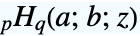




BilateralHypergeometricPFQ
BilateralHypergeometricPFQ[{a1,…,ap},{b1,…,bq},z]
is the bilateral hypergeometric function 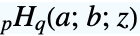 .
.
Details
- The bilateral hypergeometric series has a similar definition for its terms as the generalized hypergeometric series but sums over all integers, thus forming a doubly infinite series.
- Mathematical function, suitable for both symbolic and numerical manipulation.
 has the series expansion
 ![sum_(k=-infty)^(infty)TemplateBox[{{a, _, 1}, k}, Pochhammer]...TemplateBox[{{a, _, p}, k}, Pochhammer]/TemplateBox[{{b, _, 1}, k}, Pochhammer]...TemplateBox[{{b, _, q}, k}, Pochhammer]z^k](Files/BilateralHypergeometricPFQ.en/3.png "sum_(k=-infty)^(infty)TemplateBox[{{a, _, 1}, k}, Pochhammer]...TemplateBox[{{a, _, p}, k}, Pochhammer]/TemplateBox[{{b, _, 1}, k}, Pochhammer]...TemplateBox[{{b, _, q}, k}, Pochhammer]z^k") , where
, where ![TemplateBox[{a, k}, Pochhammer]](Files/BilateralHypergeometricPFQ.en/4.png "TemplateBox[{a, k}, Pochhammer]") is the Pochhammer symbol.
is the Pochhammer symbol.- The bilateral hypergeometric series
 is convergent if
  and
and  .
. - The bilateral hypergeometric function
 for the case when
  is calculated using Borel regularization.
 - None of the parameters
 can be positive integers and none of the
  can be negative integers.
 - BilateralHypergeometricPFQ can be evaluated to arbitrary numerical precision.
- For certain special arguments, BilateralHypergeometricPFQ automatically evaluates to exact values.
- BilateralHypergeometricPFQ automatically threads over lists.
Examples
open all close allBasic Examples (3)
BilateralHypergeometricPFQ[{1 / 2, 3 / 4}, {1 / 4, 1 / 3}, 5.4]BilateralHypergeometricPFQ[{1 / 2, 3 / 4}, {1 / 4, -1 / 3}, 5.4]Plot the real and complex parts of  :
:
ReImPlot[BilateralHypergeometricPFQ[{1 / 2, 3 / 4}, {1 / 4, 1 / 3}, x], {x, 0, 0.9}]Series expansion at the origin:
Series[ BilateralHypergeometricPFQ[{a1, a2, a3}, {b1, b2}, z], {z, 0, 2}]Scope (18)
Numerical Evaluation (4)
N[BilateralHypergeometricPFQ[{1 / 2, 3 / 4}, {1 / 4, 1 / 3}, 5], 30]The precision of the output tracks the precision of the input:
BilateralHypergeometricPFQ[{1 / 2, 3 / 4}, {1 / 4, 1 / 3}, 5`20]Evaluate for complex arguments and parameters:
BilateralHypergeometricPFQ[{1 / 2I, 3 / 4I}, {1 / 4I, 1 / 3I}, 5`20I]Evaluate BilateralHypergeometricPFQ efficiently at high precision:
BilateralHypergeometricPFQ[{1 / 2I, 3 / 4I}, {1 / 4I, 1 / 3I}, 5`100]//TimingBilateralHypergeometricPFQ[{1 / 2I, 3 / 4I}, {1 / 4I, 1 / 3I}, 5`2000];//TimingBilateralHypergeometricPFQ threads elementwise over lists in its third argument:
BilateralHypergeometricPFQ[{1 / 2, 3 / 4}, {1 / 4, 1 / 3}, {0.1, 0.3, 0.5}]Specific Values (3)
BilateralHypergeometricPFQ automatically evaluates to simpler functions for certain parameters:
BilateralHypergeometricPFQ[{1 / 2}, {1}, z]BilateralHypergeometricPFQ[{1 / 2, 3 / 2}, {1, 5 / 2}, z]BilateralHypergeometricPFQ at  :
:
BilateralHypergeometricPFQ[{1 / 2, 1 / 3}, {1 / 4, 1 / 5, 1 / 6}, 1.]BilateralHypergeometricPFQ at  for the case
  :
:
BilateralHypergeometricPFQ[{a1, a2}, {b1, b2}, 0]Integration (2)
Integrate BilateralHypergeometricPFQ:
Integrate[BilateralHypergeometricPFQ[{1 / 2, 3 / 4}, {1 / 4, 1 / 3}, z], z]Definite integral of BilateralHypergeometricPFQ:
Integrate[BilateralHypergeometricPFQ[{0.5, 0.75}, {0.25, 0.3}, z], {z, 1 / 3, 1 / 2}]Differentiation (1)
The first derivative of a specific BilateralHypergeometricPFQ:
D[BilateralHypergeometricPFQ[{1 / 2, 3 / 4}, {1 / 4, 1 / 3}, z], z]The  th derivative of this BilateralHypergeometricPFQ:
D[BilateralHypergeometricPFQ[{1 / 2, 3 / 4}, {1 / 4, 1 / 3}, z], {z, n}]Series Expansions (3)
Calculate the series expansion of BilateralHypergeometricPFQ at the origin:
Series[BilateralHypergeometricPFQ[{1 / 2, 3 / 4}, {1 / 4, 1 / 3}, z], {z, 0, 1}]Calculate the series expansion of BilateralHypergeometricPFQ at Infinity:
Series[BilateralHypergeometricPFQ[{1 / 2}, {1 / 3}, z], {z, ∞, 1}]Calculate the series expansion of BilateralHypergeometricPFQ at a generic point:
Series[BilateralHypergeometricPFQ[{1 / 2, 3 / 4}, {1 / 4, 1 / 3}, z], {z, z0, 1}]Visualization (2)
Plot the real and complex parts of  :
:
ReImPlot[BilateralHypergeometricPFQ[{1 / 2, 3 / 4}, {1 / 4, 1 / 3}, z], {z, -1, 0.9}]
ComplexContourPlot[Re[BilateralHypergeometricPFQ[{1 / 2, 3 / 4}, {1 / 4, 1 / 3}, z]], {z, -1 / 2 - 1 / 2I, 1 / 2 + 1 / 2I}]
ComplexContourPlot[Im[BilateralHypergeometricPFQ[{1 / 2, 3 / 4}, {1 / 4, 1 / 3}, z]], {z, -1 / 2 - 1 / 2I, 1 / 2 + 1 / 2I}]Function Properties (3)



BilateralHypergeometricPFQ[{1 / 2, 3 / 2}, {9 / 4, 13 / 4}, 1.]
BilateralHypergeometricPFQ[{a1, a2, a3}, {b1, b2}, z] == BilateralHypergeometricPFQ[{a3, a2, a1}, {b2, b1}, z]TraditionalForm[BilateralHypergeometricPFQ[{a1, a2, a3}, {b1, b2}, z]]Applications (1)
Compute doubly infinite sums via BilateralHypergeometricPFQ:
Sum[(Pochhammer[a, k]/Pochhammer[b, k])z^k, {k, -∞, ∞}]Sum[(Pochhammer[1 / 2, n]/Pochhammer[1, n])z^n, {n, -∞, ∞}]//AbsoluteTimingSum[(Pochhammer[1 / 3, n]/Pochhammer[1, n])z^n, {n, -∞, ∞}]//AbsoluteTimingSum[(Pochhammer[a1, n]Pochhammer[a2, n]/Pochhammer[b1, n]Pochhammer[b2, n])z^n, {n, -∞, ∞}]//AbsoluteTimingProperties & Relations (2)
BilateralHypergeometricPFQ may be written as a sum of two HypergeometricPFQ:
BilateralHypergeometricPFQ[{1 / 2, 3 / 4}, {1 / 4, 1 / 3}, 3 / 10`20]HypergeometricPFQ[{1 / 2, 3 / 4, 1}, {1 / 4, 1 / 3}, 3 / 10`10] + HypergeometricPFQ[{1, 3 / 4, 2 / 3}, {1 / 2, 1 / 4}, 10 / 3] - 1BilateralHypergeometricPFQ may simplify to elementary functions:
BilateralHypergeometricPFQ[{1 / 2}, {1}, z]Possible Issues (1)
When  , BilateralHypergeometricPFQ uses Borel regularization, which may be time-consuming:
BilateralHypergeometricPFQ[{1 / 2, 3 / 4}, {1 / 4, 1 / 3, 1 / 5}, 0.3]//AbsoluteTimingThe evaluation is fast for the case  :
:
BilateralHypergeometricPFQ[{1 / 2, 3 / 4}, {1 / 4, 1 / 3}, 0.3]//AbsoluteTimingNeat Examples (1)
BilateralHypergeometricPFQ may autosimplify to simpler special functions:
BilateralHypergeometricPFQlist = Inactivate[...];Grid[...]//TraditionalForm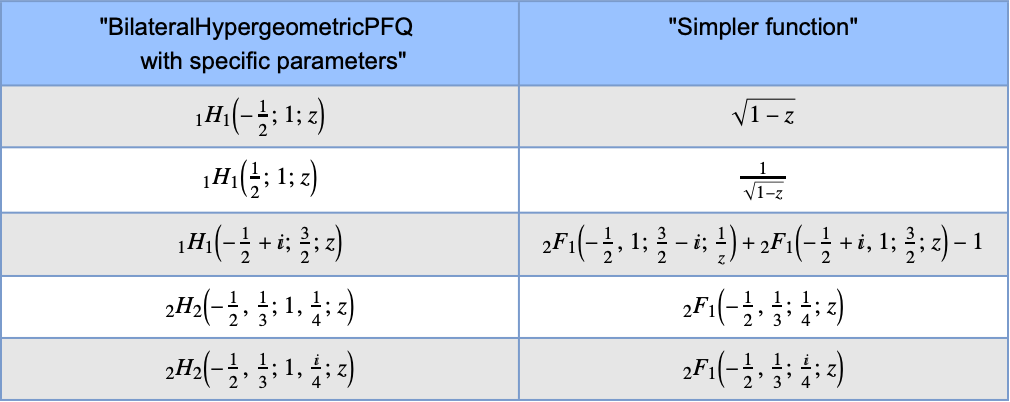
Text
Wolfram Research (2024), BilateralHypergeometricPFQ, Wolfram Language function, https://reference.wolfram.com/language/ref/BilateralHypergeometricPFQ.html.
CMS
Wolfram Language. 2024. "BilateralHypergeometricPFQ." Wolfram Language & System Documentation Center. Wolfram Research. https://reference.wolfram.com/language/ref/BilateralHypergeometricPFQ.html.
APA
Wolfram Language. (2024). BilateralHypergeometricPFQ. Wolfram Language & System Documentation Center. Retrieved from https://reference.wolfram.com/language/ref/BilateralHypergeometricPFQ.html