

CharacteristicFunction
CharacteristicFunction[dist,t]
gives the characteristic function for the distribution dist as a function of the variable t.
CharacteristicFunction[dist,{t1,t2,…}]
gives the characteristic function for the multivariate distribution dist as a function of the variables t1, t2, ….
Details
- CharacteristicFunction[dist,t] is equivalent to Expectation[Exp[ t x],xdist].
- CharacteristicFunction[dist,{t1,t2,…}] is equivalent to Expectation[Exp[ t.x],xdist] for vectors t and x.
- The k
 moment can be extracted from a characteristic function cf through SeriesCoefficient[cf,{t,0,k}]k! (-)k.
Examples
open all close allBasic Examples (4)
Characteristic function (cf) for the normal distribution:
CharacteristicFunction[NormalDistribution[μ, σ], t]Characteristic function for the binomial distribution:
CharacteristicFunction[BinomialDistribution[n, p], t]Characteristic function for the bivariate normal distribution:
CharacteristicFunction[BinormalDistribution[ρ], {Subscript[t, 1], Subscript[t, 2]}]Characteristic function for the multinomial distribution:
CharacteristicFunction[MultinomialDistribution[n, {Subscript[p, 1], Subscript[p, 2], Subscript[p, 3]}], {Subscript[t, 1], Subscript[t, 2], Subscript[t, 3]}]Scope (8)
Characteristic function for a specific continuous distribution:
CharacteristicFunction[StudentTDistribution[5], t]Characteristic function for a specific discrete distribution:
CharacteristicFunction[DiscreteUniformDistribution[{4, 10}], t]Characteristic function at a particular value:
CharacteristicFunction[HalfNormalDistribution[1], 2]Characteristic function evaluated numerically:
CharacteristicFunction[LogisticDistribution[0, 1], 2.0]Obtain a result at any precision:
CharacteristicFunction[LogisticDistribution[0, 1], N[2, 25]]Compute the characteristic function for a formula distribution:
dist = ProbabilityDistribution[(BesselK[0, x]/Pi / 2), {x, 0, ∞}];CharacteristicFunction[dist, t]Find the characteristic function for a parameter mixture distribution:
dist = ParameterMixtureDistribution[LaplaceDistribution[0, σ], σUniformDistribution[]];CharacteristicFunction[dist, t]//FullSimplifyCharacteristic function for the slice distribution of a random process:
CharacteristicFunction[PoissonProcess[μ][s], t]Applications (7)
Compute the raw moments for a Poisson distribution:
cfun = CharacteristicFunction[PoissonDistribution[μ], t]First 5 raw moments using derivatives of the characteristic function at the origin:
Table[Limit[D[cfun, {t, n}], t -> 0] / I ^ n, {n, 5}]Use Moment directly:
Table[Moment[PoissonDistribution[μ], n], {n, 5}]Simplify[%% - %]Compute mixed raw moments for a multivariate  distribution:
CharacteristicFunction[MultivariateTDistribution[{{1, r}, {r, 1}}, 3], {t1, t2}]Limit[Limit[D[%, t1, t2], t1 -> 0], t2 -> 0] / I ^ 2Use Moment to obtain raw moments directly:
Moment[MultivariateTDistribution[{{1, r}, {r, 1}}, 3], {1, 1}]Find raw moments of a Student  distribution from its characteristic function:
cfun = PiecewiseExpand[CharacteristicFunction[StudentTDistribution[5], t], t∈Reals]Compute  to extract moments by taking limits from the right:
Table[Limit[(-I) ^ n D[cfun, {t, n}], t -> 0, Direction -> -1], {n, 5}]Evaluate the limits from the left:
Table[Limit[(-I) ^ n D[cfun, {t, n}], t -> 0, Direction -> 1], {n, 5}]Only the first four moments are defined, as confirmed by using Moment directly:
Table[Moment[StudentTDistribution[5], r], {r, 5}]Use inverse Fourier transform to compute the PDF corresponding to a characteristic function:
pdf = InverseFourierTransform[Exp[-t ^ 2], t, x, FourierParameters -> {1, 1}]Plot[pdf, {x, -5, 5}]NIntegrate[pdf, {x, -∞, ∞}]Illustrate the central limit theorem on the example of symmetric LaplaceDistribution:
dist = LaplaceDistribution[0, σ];Find the characteristic function of the rescaled random variate:
CharacteristicFunction[dist, t / Sqrt[n Variance[dist]]]Compute the large  limit of the cf of the sum of
  such i.i.d. random variates:
Limit[% ^ n, n -> Infinity]Compare with the characteristic function of a standard normal variate:
CharacteristicFunction[NormalDistribution[], t]Use smooth characteristic function to construct the upper bound for the distribution density of ErlangDistribution:
𝒟 = ErlangDistribution[4, 1];chf = CharacteristicFunction[𝒟, t]UpperBound1 = (1/2Pi)Integrate[Abs[chf], {t, -Infinity, Infinity}]UpperBound2 = (1/2Pi)(1/x^2)Integrate[Abs[D[chf, {t, 2}]], {t, -Infinity, Infinity}]Plot the upper bounds and the original density:
Plot[{PDF[𝒟, x], UpperBound1, UpperBound2}, {x, 0, 10}]Verify that the sum 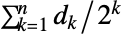 where
where  are independent identically distributed BernoulliDistribution[1/2] variates tends in distribution to UniformDistribution[] for large
  :
:
Subscript[cf, k] = CharacteristicFunction[TransformedDistribution[(Subscript[d, k]/2^k), Subscript[d, k]BernoulliDistribution[(1/2)]], t]Use a combinatorial equality for product  :
:
Table[Underoverscript[∏, k = 1, n]((1/2) + (1/2) E^(I t/2^k)) == (1/2^n)Underoverscript[∑, k = 0, 2^n - 1]Exp[(I t k/2^n)], {n, 6}]//Simplifychf = (1/2^n)Underoverscript[∑, k = 0, 2^n - 1]Exp[(I t k/2^n)]Take the limit and compare it to the characteristic function of the UniformDistribution:
{Limit[ComplexExpand[chf], n -> ∞], CharacteristicFunction[UniformDistribution[], t]}//TrigToExpProperties & Relations (5)
CharacteristicFunction is the Expectation of  for real
  :
:
Expectation[Exp[I t x], xUniformDistribution[{min, max}], Assumptions -> Element[t, Reals]]CharacteristicFunction[UniformDistribution[{min, max}], t]%% - %The characteristic function is related to all other generating functions when they exist:
𝒟 = PolyaAeppliDistribution[μ, p];{MomentGeneratingFunction[𝒟, I t], CharacteristicFunction[𝒟, t]}{Exp[CumulantGeneratingFunction[𝒟, I t]], CharacteristicFunction[𝒟, t]}{FactorialMomentGeneratingFunction[𝒟, t], CharacteristicFunction[𝒟, -I Log[t]]}The cf of a continuous distribution is equivalent to FourierTransform of its PDF:
FourierTransform[PDF[CauchyDistribution[0, 1], x], x, t, FourierParameters -> {1, 1}]CharacteristicFunction[CauchyDistribution[0, 1], t]The cf of a discrete distribution is equivalent to FourierSequenceTransform of its PDF:
FourierSequenceTransform[PDF[PoissonDistribution[μ], x], x, t, FourierParameters -> {1, 1}, Assumptions -> μ > 0]CharacteristicFunction[PoissonDistribution[μ], t]The PDF is the inverse Fourier transform of the cf for continuous distributions:
cf = CharacteristicFunction[NormalDistribution[μ, σ], t]InverseFourierTransform[cf, t, x, Assumptions -> μ∈Reals && σ > 0, FourierParameters -> {1, 1}]PDF[NormalDistribution[μ, σ], x]Simplify[%% - %, σ > 0]The PDF is the inverse Fourier sequence transform of the cf for discrete distributions:
cf = CharacteristicFunction[GeometricDistribution[p], t]InverseFourierSequenceTransform[cf, t, -n, FourierParameters -> {1, 1}]//FullSimplify[#, 0 < p < 1]&//PiecewiseExpandPDF[GeometricDistribution[p], n]% - %%Possible Issues (1)
Neat Examples (1)
Visualize real and imaginary parts of CharacteristicFunction for random instances of BinomialDistribution:
Plot[MapThread[ReIm[CharacteristicFunction[BinomialDistribution[#1, #2], t]]&, {RandomInteger[{4, 16}, 5], RandomReal[1, 5]}]//Flatten//Evaluate, {t, -4, 4}, PlotRange -> All]Text
Wolfram Research (2007), CharacteristicFunction, Wolfram Language function, https://reference.wolfram.com/language/ref/CharacteristicFunction.html (updated 2010).
CMS
Wolfram Language. 2007. "CharacteristicFunction." Wolfram Language & System Documentation Center. Wolfram Research. Last Modified 2010. https://reference.wolfram.com/language/ref/CharacteristicFunction.html.
APA
Wolfram Language. (2007). CharacteristicFunction. Wolfram Language & System Documentation Center. Retrieved from https://reference.wolfram.com/language/ref/CharacteristicFunction.html