




CscDegrees
CscDegrees[θ]
gives the cosecant of  degrees.
Details
- CscDegrees and other trigonometric functions are studied in high-school geometry courses and are also used in many scientific disciplines.
- The argument of CscDegrees is assumed to be in degrees.
- CscDegrees of angle
 is the ratio of the adjacent side to the hypotenuse of a right triangle:
 - CscDegrees is related to SinDegrees by the identity
![TemplateBox[{x}, CscDegrees]=1/(TemplateBox[{x}, SinDegrees])](Files/CscDegrees.en/3.png "TemplateBox[{x}, CscDegrees]=1/(TemplateBox[{x}, SinDegrees])") .
. - For certain special arguments, CscDegrees automatically evaluates to exact values.
- CscDegrees can be evaluated to arbitrary numerical precision.
- CscDegrees automatically threads over lists.
- CscDegrees can be used with Interval, CenteredInterval and Around objects.
- Mathematical function, suitable for both symbolic and numerical manipulation.
Examples
open all close allBasic Examples (6)
The argument is given in radians:
CscDegrees[60]Calculate CscDegrees of 45 Degree for a right triangle with unit sides:
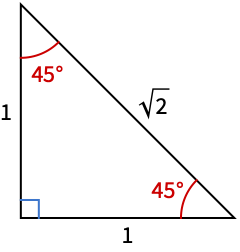
Calculate the cosecant by hand:
Csc45deg = (Sqrt[1 + 1]/1)Csc45deg == CscDegrees[45]Solve a trigonometric equation:
Solve[CscDegrees[x] == 2 && 0 < x < 90, x]Solve a trigonometric inequality:
Reduce[CscDegrees[x] > 2 && 0 <= x <= 180, x]Plot[CscDegrees[x], {x, -180, 540}]Series[CscDegrees[x], {x, 0, 6}]Scope (46)
Numerical Evaluation (6)
CscDegrees[12.2]N[CscDegrees[122 / 10], 50]The precision of the output tracks the precision of the input:
CscDegrees[12.2000000000000000000000000000000000000000000]Evaluate for complex arguments:
CscDegrees[2.5 + I]Evaluate CscDegrees efficiently at high precision:
CscDegrees[12.2`500]//TimingCscDegrees[12.2`100000];//TimingCompute worst-case guaranteed intervals using Interval and CenteredInterval objects:
CscDegrees[Interval[{30, 60}]]CscDegrees[CenteredInterval[60, 1 / 100]]CscDegrees[CenteredInterval[20 + 3I, (1 + I) / 100]]Or compute average-case statistical intervals using Around:
CscDegrees[Around[20, 0.01]]Compute the elementwise values of an array:
CscDegrees[{{60, 180}, {30, -90}}]Or compute the matrix CscDegrees function using MatrixFunction:
MatrixFunction[CscDegrees[#]&, {{60, 180}, {30, -90}}]Specific Values (6)
Values of CscDegrees at fixed points:
CscDegrees[{15, 30, 45, 60, 90, 180}]CscDegrees has exact values at rational multiples of 30 degrees:
Table[CscDegrees[30n ], {n, 1, 12, 2}]CscDegrees[Infinity]CscDegrees[ComplexInfinity]Simple exact values are generated automatically:
CscDegrees[180 / 5]More complicated cases require explicit use of FunctionExpand:
CscDegrees[180 / 30]FunctionExpand[%]Singular points of CscDegrees:
Assuming[m∈Integers, Refine[CscDegrees[180 m]]]Local extrema of CscDegrees:
Assuming[m∈Integers, FullSimplify[Refine[CscDegrees[180 ((1/2) + m)]]]]Find a local minimum of CscDegrees as the root of ![(dTemplateBox[{x}, CscDegrees])/(d x)=0](Files/CscDegrees.en/5.png "(dTemplateBox[{x}, CscDegrees])/(d x)=0") in the minimum's neighborhood:
in the minimum's neighborhood:
sol = Solve[D[CscDegrees[x], x] == 0 && 0 < x < 180, x]xmin = x /. First[sol]Plot[CscDegrees[x], {x, 0, 180}, Rule[...]]Visualization (4)
Plot the CscDegrees function:
Plot[CscDegrees[x], {x, 0, 720}]Plot over a subset of the complexes:
ComplexPlot3D[CscDegrees[z], {z, -90 - I, 90 + I}, Rule[...]]Plot the real part of CscDegrees:
ComplexContourPlot[Re[CscDegrees[z]], {z, -180 - 180 I, 180 + 180 I}, ...]Plot the imaginary part of CscDegrees:
ComplexContourPlot[Im[CscDegrees[z]], {z, -180 - 180 I, 180 + 180 I}, ...]Polar plot with CscDegrees:
Table[PolarPlot[CscDegrees[k ϕ * 180 / Pi], {ϕ, -π, π}, ...], {k, 1, 6}]Function Properties (13)
CscDegrees is a periodic function with a period of  :
:
CscDegrees[30] == CscDegrees[30 + 360]Check this with FunctionPeriod:
FunctionPeriod[CscDegrees[x], x]The real domain of CscDegrees:
FunctionDomain[CscDegrees[x], x]FunctionDomain[CscDegrees[z], z, Complexes]CscDegrees achieves all real values except from the open interval  :
:
FunctionRange[CscDegrees[x], x, y]FunctionRange[CscDegrees[x], x, y, Complexes]CscDegrees is an odd function:
CscDegrees[-x]CscDegrees has the mirror property ![csc(TemplateBox[{z}, Conjugate])=TemplateBox[{{csc, (, z, )}}, Conjugate]](Files/CscDegrees.en/8.png "csc(TemplateBox[{z}, Conjugate])=TemplateBox[{{csc, (, z, )}}, Conjugate]") :
:
FullSimplify[CscDegrees[Conjugate[z]] == Conjugate[CscDegrees[z]]]CscDegrees is not an analytic function:
FunctionAnalytic[CscDegrees[x], x]FunctionMeromorphic[CscDegrees[x], x]CscDegrees is monotonic in a specific range:
FunctionMonotonicity[CscDegrees[x], x]FunctionMonotonicity[{CscDegrees[x], 0 < x < 90}, x]CscDegrees is not injective:
FunctionInjective[CscDegrees[x], x]Plot[{CscDegrees[x], 2}, {x, -360, 360}]CscDegrees is not surjective:
FunctionSurjective[CscDegrees[x], x]Plot[{CscDegrees[x], .5}, {x, -360, 360}]CscDegrees is neither non-negative nor non-positive:
FunctionSign[CscDegrees[x], x]It has both singularity and discontinuity when x is a multiple of 180:
FunctionSingularities[CscDegrees[x], x]FunctionDiscontinuities[CscDegrees[x], x]FunctionConvexity[CscDegrees[x], x]It is convex for x in [0,180]:
FunctionConvexity[{CscDegrees[x], 0 < x < 180}, x]Plot[CscDegrees[x], {x, 0, 180}]TraditionalForm formatting:
CscDegrees[α]//TraditionalFormDifferentiation (3)

 derivative:
Integration (3)
Compute the indefinite integral of CscDegrees via Integrate:
Integrate[CscDegrees[x], x]//SimplifyDefinite integral of CscDegrees over a period is 0:
Integrate[CscDegrees[x], {x, 30, 30 + 360}, PrincipalValue -> True]Integrate[CscDegrees[x]CosDegrees[x], x]//SimplifyIntegrate[CscDegrees[z]^a, z]Integrate[SinDegrees[b z] CscDegrees[c z], z]Series Expansions (3)
Find the Taylor expansion using Series:
Series[CscDegrees[x], {x, 90, 7}]Plot the first three approximations for CscDegrees around  :
:
terms = Normal@Table[Series[CscDegrees[x], {x, 90, m}], {m, 2, 6, 2}];
Plot[{CscDegrees[x], terms}, {x, 0, 180}, PlotRange -> {0, 4}]
Asymptotic expansion at a singular point:
Series[CscDegrees[x], {x, 180, 5}]CscDegrees can be applied to power series:
CscDegrees[90 + x + (x^2/2) + (x^3/3) + O[x]^4]Function Identities and Simplifications (5)
Double-angle formula using TrigExpand:
TrigExpand[CscDegrees[2x]]TrigExpand[CscDegrees[x + y]]TrigExpand[CscDegrees[4x]]TrigReduce[%]Convert sums to products using TrigFactor:
TrigFactor[CscDegrees[x] + CscDegrees[y]]Convert to complex exponentials:
TrigToExp[CscDegrees[z]]Function Representations (3)
Representation through SinDegrees:
Simplify[1 / SinDegrees[x]]Representation through CosDegrees:
Simplify[1 / CosDegrees[90 - x]]Representations through CosDegrees and CotDegrees:
Simplify[CotDegrees[x] / CosDegrees[x]]Applications (11)
Basic Trigonometric Applications (2)
Given  , find the CscDegrees of the angle
  using the formula
  :
:
Solve[x^2 == 1 + (5/9), x]Find the missing opposite side length of a right triangle with hypotenuse 5 given the angle is 30 degrees:
Solve[CscDegrees[30] == 5 / x, x]Trigonometric Identities (3)
Calculate the CscDegrees value of 105 degrees using the sum and difference formulas:
CscDegrees[α + β]//TrigExpand% /. {α -> 60, β -> 45}//Simplify% == CscDegrees[105]Simplify trigonometric expressions:
FullSimplify[(CosDegrees[x]/1 + 1 / CscDegrees[x])]Verify trigonometric identities:
Simplify[(CosDegrees[x]/CscDegrees[x]CotDegrees[x]) == 1 - CosDegrees[x]^2]Trigonometric Equations (2)
Solve a basic trigonometric equation:
Solve[CscDegrees[5x] == 1 / 2, x]Solve trigonometric equations including other trigonometric functions:
Solve[CscDegrees[5x] == SinDegrees[x], x, Reals]Solve trigonometric equations with conditions:
Reduce[3CscDegrees[x] + 2Sqrt[CosDegrees[x]] == 9 / 2 && x < 60, x]Trigonometric Inequalities (2)
Advanced Applications (2)
Generate a plot over the complex argument plane:
Plot3D[Re[CscDegrees[x + I y]], {x, -90, 360}, {y, 0, 180}]Automatically label different trigonometric functions:
Table[Plot[Evaluate[f[x]], {x, -180, 180}, PlotLabel -> f[x]], {f, {SinDegrees, CosDegrees, SecDegrees, CscDegrees}}]Properties & Relations (13)
Check that 1 degree is  radians:
CscDegrees[60] == Csc[π / 3]Basic parity and periodicity properties of the cosecant function get automatically applied:
CscDegrees[x + 180]CscDegrees[-x]CscDegrees[I x]1 / CscDegrees[x]//SimplifySimplify under assumptions on parameters:
CscDegrees[-x + 180k]Simplify[%, k∈Integers]Complicated expressions containing trigonometric functions do not automatically simplify:
1 / CscDegrees[Subscript[z, 1] + Subscript[z, 2]] - 2SinDegrees[Subscript[z, 2]]CosDegrees[Subscript[z, 1]]FullSimplify[%]CscDegrees[Conjugate[z]] - Conjugate[CscDegrees[z]]FullSimplify[%]Use FunctionExpand to express CscDegrees in terms of radicals:
{CscDegrees[180 / 8], CscDegrees[180 / 12], CscDegrees[180 / 15]}FunctionExpand[%]Compositions with the inverse trigonometric functions:
{CscDegrees[ArcCscDegrees[z]], CscDegrees[2ArcCscDegrees[z]], CscDegrees[3ArcCscDegrees[z]]}FunctionExpand[%]//TogetherSolve a trigonometric equation:
Reduce[3CscDegrees[z]^2 - 6CscDegrees[z - 30] == -8, z]Numerically find a root of a transcendental equation:
FindRoot[CscDegrees[z]^2 + 3 CscDegrees[z + 60] + z == 32, {z, 15, 20}]Plot the function to check if the solution is correct:
Plot[CscDegrees[z]^2 + 3 CscDegrees[z + 60] + z - 32, {z, 15, 20}]The zeros of CscDegrees:
Reduce[CscDegrees[α x + β] == 0, x]The poles of CscDegrees:
Reduce[1 / CscDegrees[α x + β] == 0, x]Calculate residue symbolically and numerically:
Table[Residue[CscDegrees[z]^k, {z, 0}], {k, 10}](1/2π I)NIntegrate[CscDegrees[z], {z, -(1/4), -(I/4), +(1/4), +(I/4), -(1/4)}]FunctionExpand applied to CscDegrees generates expressions in trigonometric functions in radians:
FunctionExpand[CscDegrees[x]]FunctionExpand[CscDegrees[x ^ 2]CscDegrees[120 - x / 2]]ExpToTrig applied to the outputs of TrigToExp will generate trigonometric functions in radians:
TrigToExp[CscDegrees[z]]ExpToTrig[%]TrigToExp[CscDegrees[2z]CscDegrees[z]];
ExpToTrig[%]CscDegrees is a numeric function:
NumericQ[CscDegrees[2 + E]]Possible Issues (1)
Neat Examples (5)
Trigonometric functions are ratios that relate the angle measures of a right triangle to the length of its sides:
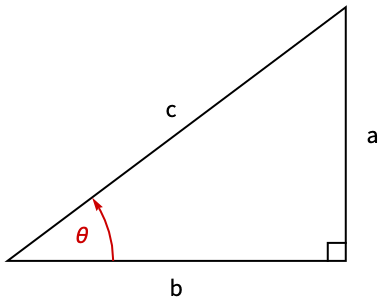
Trigfunclist = {SinDegrees[θ], CosDegrees[θ], TanDegrees[θ], CotDegrees[θ], SecDegrees[θ], CscDegrees[θ]};
ratioslist = {a / c, b / c, a / b, b / a, c / b, c / a};Grid[...]//TraditionalFormSolve trigonometric equations:
Solve[CscDegrees[x] == 1 / CosDegrees[2x], x]//SimplifyAdd some condition on the solution:
Reduce[CscDegrees[x] == 1 / CosDegrees[2x] && 0 < x < 60, x]Some arguments can be expressed as a finite sequence of nested radicals:
CscDegrees[(180/2^12)]//FunctionExpand
∫CscDegrees[x]^nⅆxPlot CscDegrees at integer points:
ArrayPlot[Table[ArcTanDegrees[Abs[CscDegrees[x y]]], {x, -120, 120}, {y, -120, 120}]]Text
Wolfram Research (2024), CscDegrees, Wolfram Language function, https://reference.wolfram.com/language/ref/CscDegrees.html.
CMS
Wolfram Language. 2024. "CscDegrees." Wolfram Language & System Documentation Center. Wolfram Research. https://reference.wolfram.com/language/ref/CscDegrees.html.
APA
Wolfram Language. (2024). CscDegrees. Wolfram Language & System Documentation Center. Retrieved from https://reference.wolfram.com/language/ref/CscDegrees.html