

FactorialMomentGeneratingFunction
FactorialMomentGeneratingFunction[dist,t]
gives the factorial moment-generating function for the distribution dist as a function of the variable t.
FactorialMomentGeneratingFunction[dist,{t1,t2,…}]
gives the factorial moment-generating function for the multivariate distribution dist as a function of the variables t1, t2, ….
Details
- FactorialMomentGeneratingFunction is also known as probability generating function (pgf).
- FactorialMomentGeneratingFunction[dist,t] is equivalent to Expectation[tx,xdist].
- FactorialMomentGeneratingFunction[dist, {t1,t2,…}] is equivalent to Expectation[t1x1t2x2…,{x1,x2,…}dist].
- The i
 factorial moment can be extracted from a factorial moment-generating function fmgf through SeriesCoefficient[fmgf,{t,1,i}]i!.
 - The probability for a discrete random variable to assume the value i can be extracted from a factorial moment-generating function expr through SeriesCoefficient[expr,{t,0,i}].
Examples
open all close allBasic Examples (3)
The factorial moment-generating function (fmgf) for a univariate discrete distribution:
FactorialMomentGeneratingFunction[PoissonDistribution[μ], t]Compute an fmgf for a continuous univariate distribution:
FactorialMomentGeneratingFunction[NormalDistribution[μ, σ], t]The fmgf for a multivariate distribution:
FactorialMomentGeneratingFunction[MultinomialDistribution[n, {p1, p2, p3}], {t1, t2, t3}]Scope (5)
Find the factorial moment-generating function (fmgf) for a discrete formula distribution:
FactorialMomentGeneratingFunction[ProbabilityDistribution[(18^-k/Sqrt[6]) Binomial[4k, 2k], {k, 0, Infinity, 1}], t]Compute the fmgf for data distribution:
FactorialMomentGeneratingFunction[EmpiricalDistribution[{1, 2, 3, 3, 4, 5, 5}], t]Find the fmgf for a censored distribution:
FactorialMomentGeneratingFunction[CensoredDistribution[{0, 10}, PoissonDistribution[2]], t]Compute the fmgf for parameter mixture distribution:
FactorialMomentGeneratingFunction[ParameterMixtureDistribution[PoissonDistribution[λ], λExponentialDistribution[μ]], t]Find the fmgf for the slice distribution of a random process:
FactorialMomentGeneratingFunction[PoissonProcess[μ][s], t]Applications (6)
Find the fmgf for the sum of  i.i.d. geometric variates:
FactorialMomentGeneratingFunction[GeometricDistribution[p], t] ^ nCompare with the fmgf of NegativeBinomialDistribution:
FactorialMomentGeneratingFunction[NegativeBinomialDistribution[n, p], t]% - %%Find the fmgf of the sum of a random number  of i.i.d. geometric random variates, assuming
  follows PoissonDistribution:
Expectation[FactorialMomentGeneratingFunction[GeometricDistribution[p], t] ^ n, nPoissonDistribution[μ]]Compare with the fmgf of PolyaAeppliDistribution:
FactorialMomentGeneratingFunction[PolyaAeppliDistribution[μ(1 - p), 1 - p], t]Simplify[% / %%]Find the PDF of a non-negative integer random variate from its fmgf:
fmgf[t_] = ((2 - t)^3/(4 - 3 t)^5);Use the probability generating function interpretation:
pdf = SeriesCoefficient[fmgf[z], {z, 0, k}, Assumptions -> k ≥ 0]Show the probability mass function:
DiscretePlot[pdf, {k, 0, 25}, FillingStyle -> Gray]Sum[pdf, {k, 0, Infinity}]Construct a probability generating function for BernoulliDistribution:
bpgf[z_] = FactorialMomentGeneratingFunction[BernoulliDistribution[p], z]Construct its Lagrange transformation, and use it as a new probability generating function:
{pgf[z_]} = u /. Solve[u == z bpgf[u], u] //SimplifyCompare it with the probability generating function of a shifted GeometricDistribution:
FactorialMomentGeneratingFunction[TransformedDistribution[x + 1, xGeometricDistribution[1 - p]], z]Apply a Lagrange transformation to the probability generating function (pgf) of GeometricDistribution:
gpgf[z_] = FactorialMomentGeneratingFunction[GeometricDistribution[p], z]u /. Solve[u == z gpgf[u] && 0 < p < 1 && 0 < u < 1 && 0 < z < 1, u, Reals]{hpgf[z_]} = Refine[%, 0 < p < 1 && 0 < z < 1]Reconstruct PDF:
pdf = SeriesCoefficient[hpgf[z], {z, 0, k}, Assumptions -> 0 < p < 1]//FullSimplifyThe resulting distribution is known as Haight's distribution. It is only normalized to 1 for 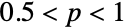 :
:
Sum[pdf, {k, 1, Infinity}, Assumptions -> 0 < p < 1]Show the probability mass function:
DiscretePlot[pdf /. p -> 5 / 9, {k, 0, 10}]Find the distribution of the number of times a biased coin should be flipped until heads appear twice in a row. Let  be the probability of heads. Event space is comprised of three types of events: tail (T), head then tail (HT), and two heads in a row (HH) with probabilities:
pr["T"] = (1 - p);
pr["HT"] = p(1 - p);
pr["HH"] = p ^ 2;
Find the fmgf of the random variate of interest, interpreting it as the total of the number of T events added to double the number of HT events plus 2:
fmgf = t ^ 2FactorialMomentGeneratingFunction[NegativeMultinomialDistribution[1, {pr["T"], pr["HT"]}], {t, t^2}]Reconstruct PDF:
pdf = SeriesCoefficient[fmgf, {t, 0, k}, Assumptions -> k ≥ 0]mean = Limit[D[fmgf, t], t -> 1]//SimplifyMomentConvert[CentralMoment[2], FactorialMoment]variance = Factor[Limit[D[fmgf, {t, 2}], t -> 1] + mean(1 - mean)]Properties & Relations (3)
FactorialMomentGeneratingFunction is equivalent to Expectation of  :
:
Expectation[t ^ n, nGeometricDistribution[p]]FactorialMomentGeneratingFunction[GeometricDistribution[p], t]Simplify[% - %%]For non-negative discrete variates, the fmgf is the probability generating function (pgf):
FactorialMomentGeneratingFunction[GeometricDistribution[p], z]Sum[PDF[GeometricDistribution[p], k]z^k, {k, 0, Infinity}]Simplify[% == %%]The factorial moments can be extracted from the factorial moment-generating function:
𝒟 = HypergeometricDistribution[n, m, nt];D[FactorialMomentGeneratingFunction[𝒟, t], {t, 3}] /. t -> 1FactorialMoment[𝒟, 3]//Refine[#, nt ≥ 3]&%% - %//SimplifyAlternatively, use SeriesCoefficient:
SeriesCoefficient[3!FactorialMomentGeneratingFunction[𝒟, t], {t, 1, 3}]FactorialMoment[𝒟, 3]//Refine[#, nt ≥ 3]&%% - %//SimplifyPossible Issues (2)
For some distributions with long tails, factorial moments of only several low orders are defined:
FactorialMoment[BetaNegativeBinomialDistribution[7, 11, 13], r]Correspondingly, the factorial moment-generating function is not defined:
FactorialMomentGeneratingFunction[BetaNegativeBinomialDistribution[7, 11, 13], t]FactorialMomentGeneratingFunction is not always known in closed form:
FactorialMomentGeneratingFunction[WalleniusHypergeometricDistribution[n, m, nt, w], t]Neat Examples (1)
Visualize fmgf over complex plane for some univariate distributions:
dists = {NegativeBinomialDistribution[10, 2 / 3], PoissonDistribution[3], BorelTannerDistribution[5 / 6, 10], ExponentialDistribution[1], BirnbaumSaundersDistribution[1, 3], HyperbolicDistribution[2, 1, 1, 2]};Table[Plot3D[Re[FactorialMomentGeneratingFunction[𝒟, x + I y]]//Evaluate, {x, -2, 2}, {y, -4, 4}, Mesh -> None, ImageSize -> 200, PlotLabel -> 𝒟], {𝒟, dists}]Text
Wolfram Research (2010), FactorialMomentGeneratingFunction, Wolfram Language function, https://reference.wolfram.com/language/ref/FactorialMomentGeneratingFunction.html.
CMS
Wolfram Language. 2010. "FactorialMomentGeneratingFunction." Wolfram Language & System Documentation Center. Wolfram Research. https://reference.wolfram.com/language/ref/FactorialMomentGeneratingFunction.html.
APA
Wolfram Language. (2010). FactorialMomentGeneratingFunction. Wolfram Language & System Documentation Center. Retrieved from https://reference.wolfram.com/language/ref/FactorialMomentGeneratingFunction.html