

LCHColor
Details
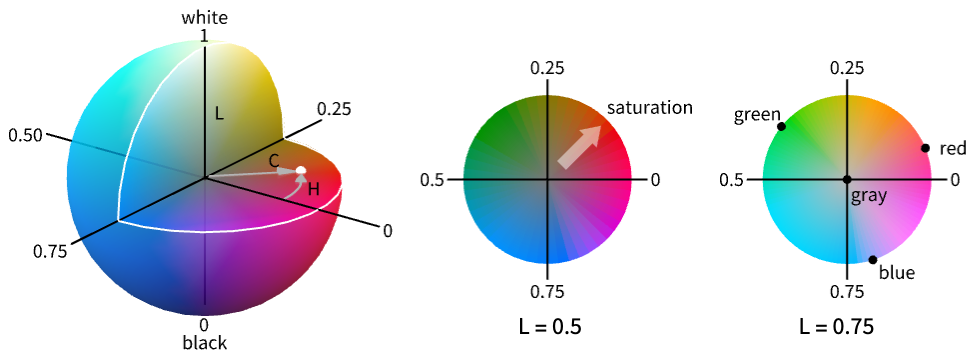
- LCHColor is a perceptual color space corresponding to a cylindrical transformation of LABColor with the a and b components represented in polar form in terms of c and h, allowing for easier interpretation of color parameters.
- LCHColor is device independent and corresponds to the CIE


 color space with
  .
. - Components
 ,
,  and
and  can be derived from
  ,
,  and
and  parameters of LABColor:
 -

lightness, approximate luminance 
chroma, color saturation 
hue, cyclic color from red to green to blue - ColorConvert can be used to convert to and from other color spaces such as RGB and XYZ.
- LCHColor allows any real number for l, c, and h.
- If no opacity has been specified, LCHColor[l,c,h] is equivalent to LCHColor[l,c,h,1].
- LCHColor[l,c,h,a] is equivalent to {LCHColor[l,c,h],Opacity[a]}.
- The alternative forms LCHColor[{l,c,h}] and LCHColor[{l,c,h,a}] can also be used. »
- RGBColor approximately corresponds to l between 0 and 1, c between 0 and 1.3, and h between 0 and 1.
- The following wrappers can be used around colors:
-
ColorsNear[color,…] specifies a region around color Directive[…,color,…] specifies a color in combination with other directives Glow[color] specifies color independent of lighting » Opacity[a,color] specifies a color with an opacity a » Specularity[color,…] specifies the specularity color Style[expr,color] displays expr with the specified color » - For 3D surfaces, explicit LCHColor directives define surface colors; the final shading depends on lighting and contributions from specularity and glow. »
Examples
open all close allBasic Examples (4)
Specify the color of graphics primitives:
Graphics[{LCHColor[0.5, 1, 0], Disk[]}]Specify the color with opacity:
Graphics3D[{LCHColor[0.5, 1, 0, 0.5], Sphere[]}]Specify the output color of expressions:
Style[x ^ 2 + y ^ 2, LCHColor[0.5, 1, 0]]Plot[Sin[x ^ 2], {x, 0, 2Pi}, PlotStyle -> LCHColor[.6, .5, 1]]Scope (2)
Colors in 3D (1)
Graphics3D[{LCHColor[.4, 1, 0], Sphere[]}]Use diffuse and specular surface color:
Graphics3D[{LCHColor[.4, 1, 0], Specularity[White, 20], Sphere[]}]Use glow color, setting the diffuse surface color to black:
Graphics3D[{Black, Glow[LCHColor[.4, 1, 0]], Sphere[]}]Generalizations & Extensions (2)
LCHColor[{l,c,h}] is equivalent to LCHColor[l,c,h]:
{Graphics[{LCHColor[{1, 1, 0}], Disk[]}], Graphics[{LCHColor[1, 1, 0], Disk[]}]}Table[Graphics[{Orange, Disk[{1, 0}], Opacity[a], LCHColor[1 / 2, 1 / 2, 1 / 3], Disk[]}], {a, 0, 1, .33}]Use the opacity argument in LCHColor directly:
Table[Graphics[{Orange, Disk[{1, 0}], LCHColor[1 / 2, 1 / 2, 1 / 3, a], Disk[]}], {a, 0, 1, .33}]Applications (1)
Properties & Relations (2)
LCHColor is a cylindrical transformation of LABColor:
ChromaticityPlot3D["LCH", "LAB", PlotPoints -> 35]Blend of LCHColor directives happens in LCh parameter space:
{c1, c2} = {LCHColor[.5, 0, 1], LCHColor[0.5, 1, 0]};
Blend[{c1, c2}]//InputFormTable[Graphics[{color, Disk[]}], {color, {c1, Blend[{c1, c2}], c2}}]Interactive Examples (1)


Text
Wolfram Research (2014), LCHColor, Wolfram Language function, https://reference.wolfram.com/language/ref/LCHColor.html (updated 2021).
CMS
Wolfram Language. 2014. "LCHColor." Wolfram Language & System Documentation Center. Wolfram Research. Last Modified 2021. https://reference.wolfram.com/language/ref/LCHColor.html.
APA
Wolfram Language. (2014). LCHColor. Wolfram Language & System Documentation Center. Retrieved from https://reference.wolfram.com/language/ref/LCHColor.html