

GeodesicPolyhedron
gives the order‐n geodesic polyhedron.
GeodesicPolyhedron["poly",n]
gives the order‐n geodesic polyhedron based on the polyhedron "poly".
Details and Options
- GeodesicPolyhedron is also known as icosphere.
- GeodesicPolyhedron is typically used to approximate a sphere.
- GeodesicPolyhedron["poly",n] gives a Polyhedron generated by subdividing faces of "poly" and projecting the new points onto the surface of the unit sphere.
- Possible values of "poly" include "Tetrahedron", "Octahedron" and "Icosahedron".
- GeodesicPolyhedron[n] is effectively equivalent to GeodesicPolyhedron["Icosahedron",n].
- GeodesicPolyhedron takes the following options:
-
BaseStyle {} base style specifications TextureMapping Automatic texture mapping to use VertexColors Automatic vertex colors to be interpolated VertexNormals Automatic effective vertex normals for shading VertexTextureCoordinates None coordinates for textures
Examples
open all close allBasic Examples (1)
Scope (6)
Basic Uses (5)
Generate an equilateral tetrahedron, octahedron, icosahedron, etc.:
Table[Graphics3D[GeodesicPolyhedron[name, 1]], {name, {"Tetrahedron", "Octahedron", "Icosahedron"}}]Color directives specify the face colors of geodesic polyhedrons:
Table[Graphics3D[{c, GeodesicPolyhedron[2]}], {c, {Red, Green, Blue, Yellow}}]FaceForm and EdgeForm can be used to specify the styles of the interior and boundary:
Graphics3D[{FaceForm[Pink], EdgeForm[Directive[Dashed, Thick, Blue]], GeodesicPolyhedron[2]}]Geodesic polyhedra are three-dimensional geometric regions:
RegionQ[GeodesicPolyhedron[2]]RegionDimension[GeodesicPolyhedron[2]]Find the geometric properties of a geodesic polyhedron:
Volume[GeodesicPolyhedron[2]]SurfaceArea[GeodesicPolyhedron[2]]Applications (2)
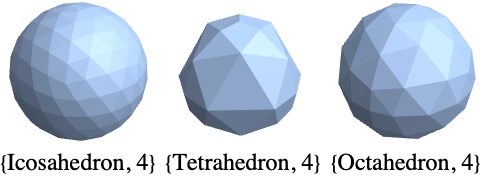
Generate a gallery of geodesic polyhedron:
Grid[Table[Graphics3D[GeodesicPolyhedron[name, i], Boxed -> False], {name, {"Tetrahedron", "Octahedron", "Icosahedron"}}, {i, 4}]]Generate the duals of a gallery of geodesic polyhedron:
Grid[Table[Graphics3D[DualPolyhedron[GeodesicPolyhedron[name, i]], Boxed -> False], {name, {"Tetrahedron", "Octahedron", "Icosahedron"}}, {i, 4}]]Properties & Relations (5)
A geodesic polyhedron is convex:
GeodesicPolyhedron[2]ConvexPolyhedronQ[%]A geodesic polyhedron is simple:
GeodesicPolyhedron[2]SimplePolyhedronQ[%]The OuterPolyhedron of a geodesic polyhedron is itself:
𝒫 = GeodesicPolyhedron[2]OuterPolyhedron[𝒫]Geodesic polyhedrons do not have holes:
InnerPolyhedron[𝒫]The number of faces of a geodesic polyhedron from Icosahedron:
Table[Length[GeodesicPolyhedron["Icosahedron", n][[2]]], {n, 5}]FindSequenceFunction[%, n]The number of vertices of a geodesic polyhedron from Icosahedron:
Table[Length[PolyhedronCoordinates@GeodesicPolyhedron["Icosahedron", n]], {n, 5}]FindSequenceFunction[%, n]Text
Wolfram Research (2022), GeodesicPolyhedron, Wolfram Language function, https://reference.wolfram.com/language/ref/GeodesicPolyhedron.html.
CMS
Wolfram Language. 2022. "GeodesicPolyhedron." Wolfram Language & System Documentation Center. Wolfram Research. https://reference.wolfram.com/language/ref/GeodesicPolyhedron.html.
APA
Wolfram Language. (2022). GeodesicPolyhedron. Wolfram Language & System Documentation Center. Retrieved from https://reference.wolfram.com/language/ref/GeodesicPolyhedron.html